


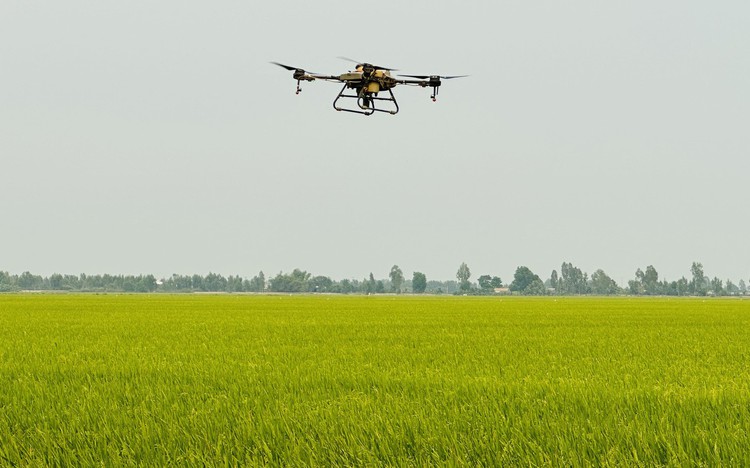
A drone flies over a rice field in Vietnam’s Mekong Delta region. Photo: Tieu Bac / Tuoi Tre News
Speaking at the forum, Nguyen Thai Viet Huy, chairman of Saty Holding Joint Stock Company, said drones had rapidly gained traction in agricultural production across the delta since the technology was introduced to the region.
Initially, agricultural drones were mainly equipped with 10-20-liter tanks for spraying crop protection chemicals.
Today, larger models can carry hundreds of kilograms and perform multiple tasks, including rice seeding, fertilizer application, and pesticide spraying.
However, Huy noted that the widespread adoption of drone spraying did not necessarily guarantee more efficient pesticide use.
Under conventional rice-farming practices, farmers often hire drone operators to spray entire fields, ensuring that no areas are missed.
Yet pest and disease infestations are rarely distributed evenly across a field, meaning that some areas receive unnecessary chemical applications.
This can waste pesticides and drive up production costs.
To address the problem, his company is developing technology that can identify different crop health conditions across fields, distinguishing healthy areas from those showing normal growth or signs of weakness and pest or disease damage.
As the rice sector undergoes a significant transition toward high-quality production, reduced emissions, and climate change adaptation, the safe and responsible use of plant protection products is not merely a technical requirement, but is also directly linked to the goals of environmental protection, public health protection, and enhancing the value of agricultural products.
Le Thanh Tung, chairman of the Vietnam Rice Sector Association, stressed that decisions about which crop protection products to use should be viewed as having implications for the entire rice value chain, rather than simply as measures to control pests and diseases.
“Farmers need to think differently about this issue because it affects whether their products can enter domestic and export markets,” Tung said.
He urged cooperatives and farmers to treat pest and disease control as a form of production risk management, emphasizing the need to use crop protection products appropriately and safely while moving toward greener agricultural production.
Data from the Plant Production and Protection Department under the Ministry of Agriculture and Environment show that Vietnam uses an average of 3.42 kilograms of crop protection chemicals per hectare of cultivated land nationwide.
In the Mekong Delta, the figure rises to 5.05 kilograms per hectare, 48 percent above the national average.
Chemical pesticides account for 80.5 percent of the total usage.
In the delta, the average application of chemical pesticides reaches 4.25 kilograms per hectare, 54 percent higher than the national average.
The elevated usage is largely attributed to the region’s intensive rice-farming practices, with many farmers growing two to three crops a year.
High pest and disease pressure, the widespread practice of spraying pesticides on a fixed schedule, and limited access to biological crop protection products have exacerbated the problem.








Max: 1500 characters
There are no comments yet. Be the first to comment.