


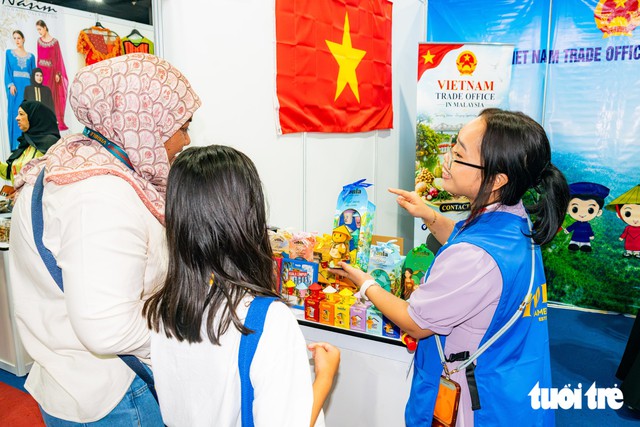
Halal-certified coffee products from Nonla business are showcased at the Vietnam Trade Office’s booth at the Malaysia International Halal Showcase (MIHAS) 2026. Photo: Ngoc Duc / Tuoi Tre
Over the past decade, bilateral trade between Vietnam and Malaysia has more than doubled to US$16.33 billion in 2025, including growing trade in halal products.
However, while Vietnam's imports from Malaysia surged from $3.95 billion in 2015 to $11 billion in 2025, its exports to the neighboring market grew only from $3.58 billion to $5.33 billion over the same period.
The figures point to significant untapped potential, as Malaysia is considered a relatively accessible market in terms of consumer tastes and geographic proximity.
Speaking to Tuoi Tre (Youth) online newspaper on the sidelines of the 22nd Malaysia International Halal Showcase (MIHAS 2026) in Kuala Lumpur, Phung Van Thanh, Vietnam's trade counselor in Malaysia, attributed the situation to a lack of halal certification.
A gateway to Muslim market
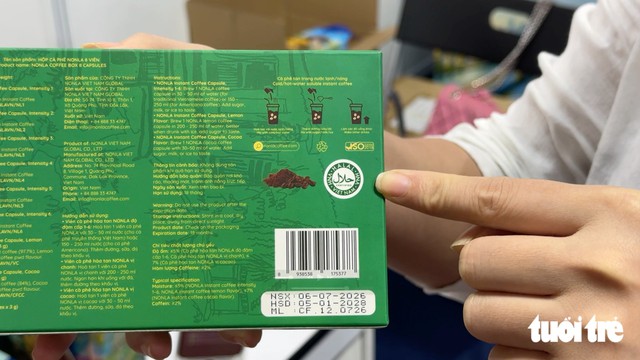
Halal-certified products carry a halal certification mark on the product or packaging to enter Muslim markets. Photo: Ngoc Duc / Tuoi Tre
Tran Thi Xuyen, director of Nonla Malaysia, a Vietnamese coffee brand operating in Malaysia, said that apart from the halal certification hurdle, Malaysia is relatively receptive to Vietnamese products and geographically close, with shipments by sea taking only about three days.
Halal certification in Malaysia can also serve as a stepping stone for businesses seeking halal certification from the Gulf Cooperation Council (GCC), opening access to markets in the Middle East and Indonesia.
Malaysia is also a large consumer market. According to Phung Van Thanh, Vietnam Trade Counselor in Malaysia, the country imports more than $20 billion worth of halal food each year, placing it among the five largest halal food importers in the Organisation of Islamic Cooperation (OIC).
Malaysia has also set a goal of becoming a global leader in the halal economy, with domestic halal consumption targeted at $113 billion by 2030.
"The Malaysian government also aims to turn the country into a global hub for Muslim trade. This means Vietnamese halal products can seize the opportunity by using Malaysia as a gateway to the wider Muslim market," Thanh said.
Xuyen also said: "Halal certification is the gateway for us to enter the Muslim market, with around 2 billion Muslims worldwide, as well as the Malaysian market. Malaysia may not initially appear to be a particularly promising market, but in reality, there are many opportunities and plenty of room for us to tap into."
Trade Counselor Phung Van Thanh said he was confident that if more Vietnamese products obtained halal certification, Vietnam and Malaysia could not only reach their bilateral trade target of $20 billion by 2030 but also aim for $25 billion a year.
Halal may seem tough, but the hurdle is within reach
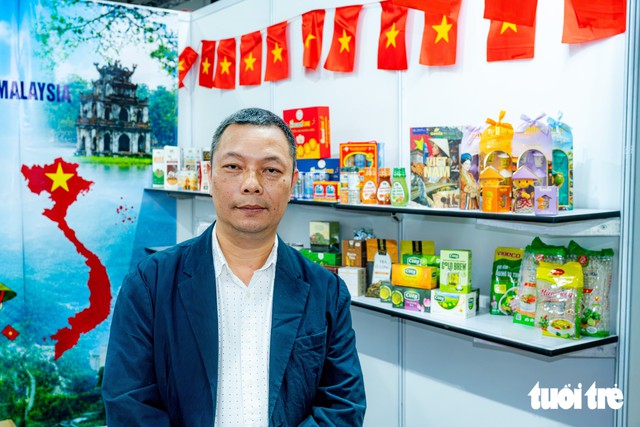
Vietnam Trade Counselor in Malaysia Phung Van Thanh said bilateral trade could reach $25 billion if more Vietnamese products obtain halal certification. Photo: Ngoc Duc / Tuoi Tre
Thanh explained: “One of the reasons Vietnam’s exports to Malaysia have grown slowly is the difficulties and barriers related to halal requirements. Food and beverage products exported to Malaysia are often required to meet strict halal standards, which many Vietnamese exports have yet to meet.”
As a result, Vietnamese exports to Malaysia currently consist mainly of machinery, equipment and raw materials, which do not require halal certification.
According to Thanh, Vietnamese businesses also face challenges related to halal knowledge, consulting services and certification costs.
Halal standards are not uniform across Muslim-majority countries and, in some cases, certification bodies compete with one another, leaving businesses confused.
Vietnam also has relatively few certification organizations that are widely recognized by Muslim-majority countries, forcing businesses to seek certification from foreign organizations, which is more costly and complicated.
However, Thanh stressed that halal requirements are not an insurmountable barrier. Vietnamese products already have several advantages when it comes to meeting strict halal standards.
“Vietnam ranks among the world’s top 10 exporters of several major agricultural products. More than 80 percent of Vietnam’s plant-based agricultural products already meet the basic principles of halal, as they contain natural ingredients and no alcohol or prohibited derivatives,” Thanh said.
A small shipment can offset the certification cost
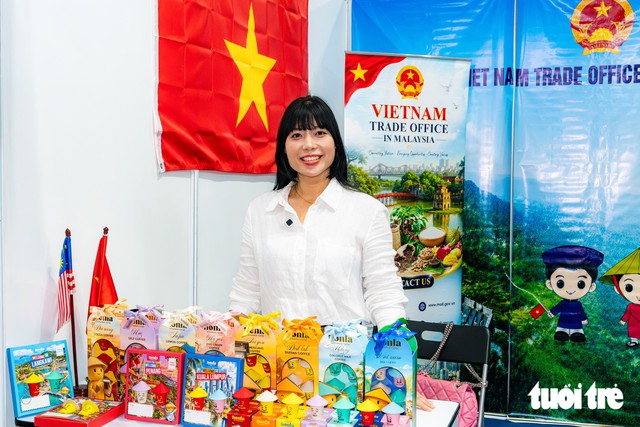
Tran Thi Xuyen, director of Nonla Malaysia, said the Malaysian halal certification process is quick and inexpensive once businesses understand the procedures. Photo: Ngoc Duc / Tuoi Tre
Recognizing the huge potential of the Muslim market, Vietnamese coffee company Nonla has spent years pursuing halal certification and exporting its products to Malaysia.
Nguyen Thi Xuyen, director of Nonla Malaysia, described the certification as a 'golden ticket,' saying supermarkets and distributors would immediately reject products without it.
Having gone through the certification process herself, Xuyen said it is not particularly difficult.
“For businesses applying for halal certification for the first time or those unfamiliar with the process, it can be quite difficult. But once you understand how it works, preparing all the required documents takes just one to two days, much easier than FDA registration for food exports to the United States or ISO certification,” she said.
According to Xuyen, the key requirement is that products contain no pork or pork fat.
With careful preparation, a factory inspection by a team of experts takes only about 40 minutes to an hour, and the certification can be issued about 10 days later.
“The cost is only around VND25-30 million ($1,000-$1,200), which is actually not much at all. The first order does not have to be large, even a shipment worth around $3,000-$4,000 is enough to recoup the certification cost,” the Nonla Malaysia representative said.
MIHAS 2026 sets new visitor record
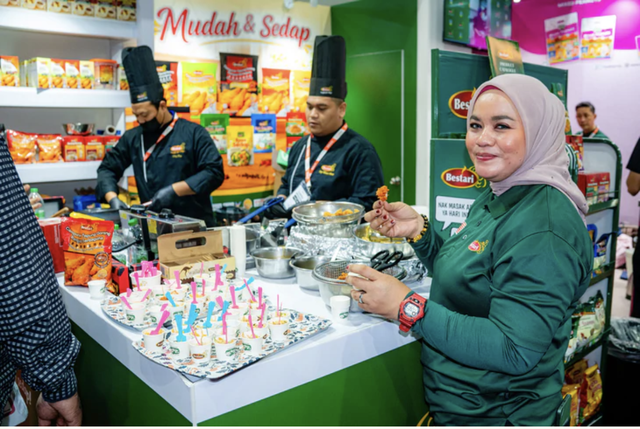
MIHAS 2026 wrapped up with impressive figures, far surpassing its target for the value of deals concluded. Photo: Ngoc Duc / Tuoi Tre
On September 26, the Malaysia International Halal Showcase (MIHAS) 2026 officially concluded with a series of strong results.
According to the Malaysia External Trade Development Corporation (MATRADE), the four-day showcase generated 6.78 billion ringgit ($1.66 billion) in sales, up 12 percent from 2025 and well above its 5 billion ringgit target.
The exhibition attracted nearly 70,000 visitors from 93 countries, the highest attendance since MIHAS was launched in 2004.
The International Sourcing Programme (INSP), which connects Malaysian businesses with international buyers, generated 4 billion ringgit ($979 million) in sales.
The figures further cement MIHAS as the world’s largest halal trade exhibition.









Max: 1500 characters
There are no comments yet. Be the first to comment.