


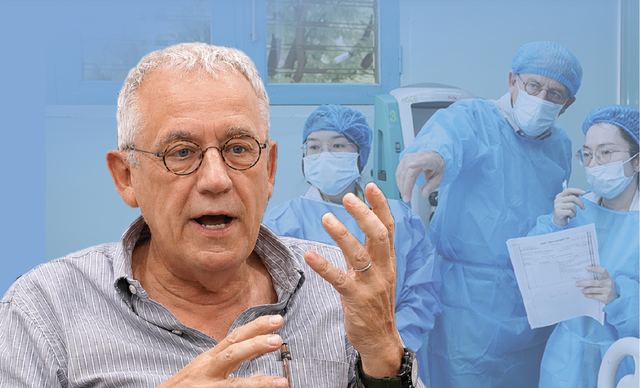
Professor Raymond Reding, a leading Belgium’s liver transplant expert, has worked with doctors at Children’s Hospital 2 in Ho Chi Minh City for more than 20 years to advance pediatric liver transplantation. Photo: Tuoi Tre
Raymond Reding, MD, PhD, is a Belgian specialist in pediatric liver transplantation at Saint-Luc University Clinics in Brussels, where he has been involved in the development of one of Europe's established pediatric liver transplant programs.
His connection with Vietnam dates back to the late 1990s, when a university cooperation program began training doctors from Children's Hospital 2 in pediatric gastrointestinal and liver transplant care.
A connection that changed everything
Reding's connection with Vietnam began in 1995, when he read an article about the successful separation of the Vietnamese-German conjoined twins.
Impressed by the surgery, he contacted Professor Tran Dong A, who had led the operation, and proposed collaborating on pediatric gastrointestinal and liver care, including liver transplantation.
Reding initially came to Vietnam with a more modest goal: to share his knowledge and experience in treating pediatric gastrointestinal diseases.
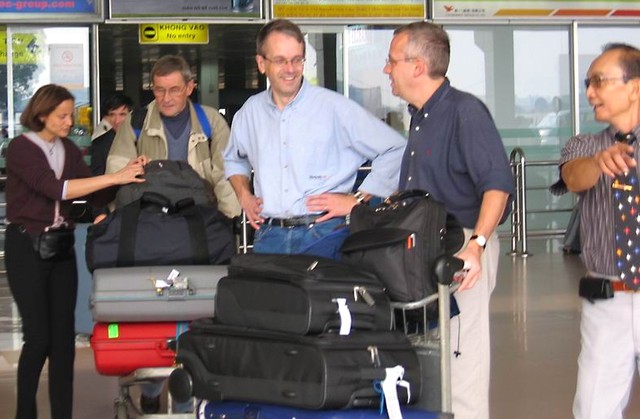
Professor Tran Dong A (R) welcomes Professor Raymond Reding (center) and his colleagues at Ho Chi Minh City’s international airport in 2005. Photo: Supplied
But his visits soon took a different direction.
Hospital leaders wanted to go beyond knowledge-sharing and build a pediatric organ transplant program, a completely new and highly challenging field in Vietnam at the time.
Reding was asked to help turn that ambition into reality, beginning a collaboration that would eventually make pediatric liver transplantation a lasting capability at Children's Hospital 2.
Reding recalled Tran Dong A, then head of surgery at Children's Hospital 2, telling him that the hospital truly wanted to perform organ transplants, but that realizing the goal would require extensive preparation.
The two sides therefore started with the fundamentals, working toward the first pediatric liver transplant in southern Vietnam.
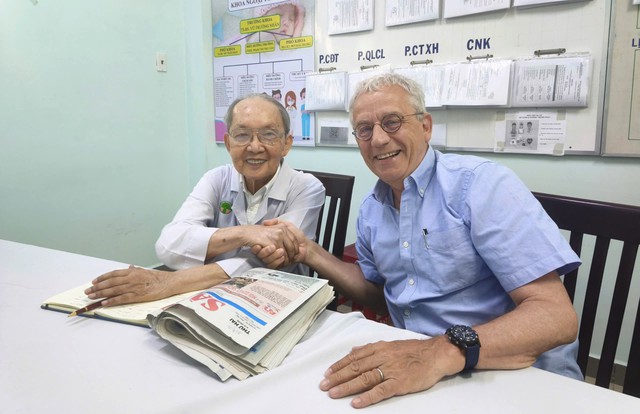
Professor Tran Dong A and Professor Raymond Reding became close friends while working together to build and develop Children’s Hospital 2’s pediatric liver transplant program. Photo: Supplied
On December 5, 2005, that operation was successfully performed at Children's Hospital 2, opening a new chapter for pediatric liver transplantation in the region.
The first transplant would not happen overnight.
Reding and the hospital team spent five years preparing for the operation, working on everything from specialized equipment and infrastructure to comprehensive protocols for running an entire transplant program.
But Reding said the most critical factor was the people.
The team focused on training doctors and medical staff who were not only technically skilled, but also able to understand one another's every move, coordinate seamlessly and remain ready to face unprecedented challenges.
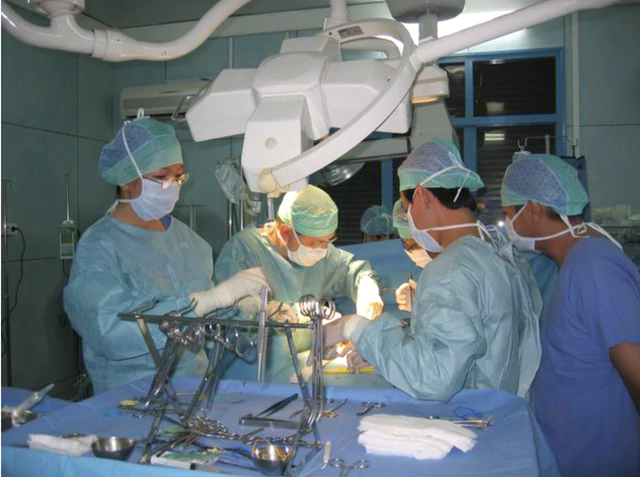
Professor Raymond Reding and the Children’s Hospital 2 medical team perform a liver transplant in 2005. Photo: Supplied
Building a self-sustaining program
Since the first transplant in 2005, Children's Hospital 2's program has continued to grow.
A total of 74 liver transplants have now been performed at the hospital. During Reding's most recent visit, he and the hospital team carried out four living-donor liver transplants in just one week.
The journey has also been marked by difficult and tense moments.
Reding still remembers a surgical complication that occurred on the very first day of the hospital's first liver transplant, when pediatric patient Xuan Quy had to undergo an immediate second operation. Working together, the team managed to save the transplanted liver.
The program's ability to stand on its own was tested even further during the COVID-19 pandemic.
With international flights grounded and travel severely restricted, Reding could no longer be there to work alongside the doctors at Children's Hospital 2.
For about two years, however, the team continued performing liver transplants and maintained and developed the program without his direct support.
When Reding returned after the pandemic, he was impressed by how much the team had advanced, progress that motivated him to keep returning to Vietnam and working alongside them.
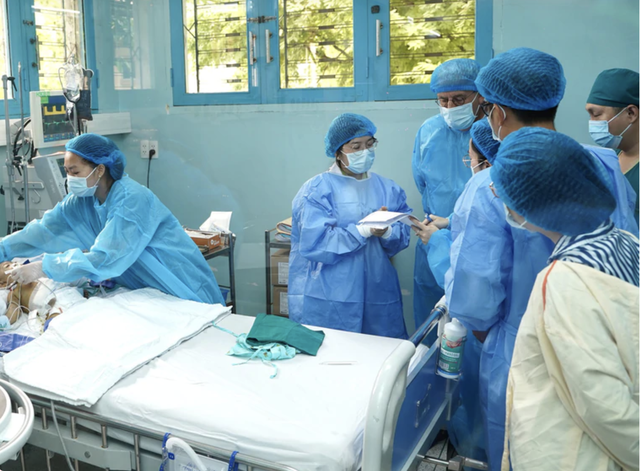
Professor Raymond Reding consults with the Children’s Hospital 2 liver transplant team and checks in with organ donors. His careful, disciplined and tireless approach to work has inspired the entire team. Photo: Huu Duy / Tuoi Tre
Today, Reding sees clear progress in both the number of transplants the hospital can perform and, more importantly, the quality of its care.
"The number of transplants the hospital can perform has increased, but what is much more important, in my view, is the quality," Reding said.
He said the team's medical expertise has improved significantly and now meets international standards, putting Children's Hospital 2 among the leading pediatric transplant centers in Vietnam and Southeast Asia.
More importantly, the team has become strong enough to operate independently and continue developing the program.
For Reding, the progress also points to a larger ambition for pediatric transplantation in Vietnam.
He estimates that the country could have around 100 pediatric transplant cases a year and hopes Children's Hospital 2 can eventually perform most of them, including for children from northern Vietnam.
He believes Vietnam has the potential to develop transplant centers that serve as regional referral centers, not only for Vietnamese patients but also for children from neighboring countries.
In his view, Children's Hospital 2 has the potential to become a trusted regional center for pediatric transplantation as its expertise and capacity continue to grow.
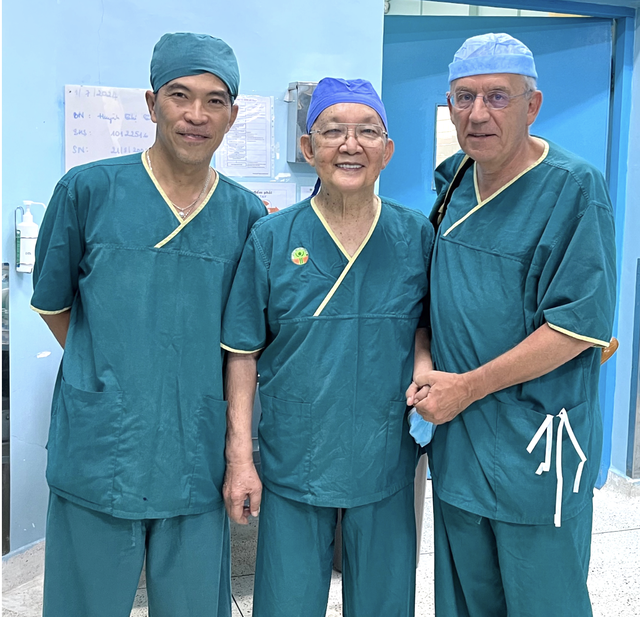
Professor Raymond Reding (R) with Professor Tran Dong A (center) and his successor, Dr. Tran Thanh Tri (L). Photo: Supplied
The doctor who gave children a second chance at life
For the doctors and families who have worked with Reding, he is more than a doctor. He is a lifeline for children with severe liver disease, giving them a second chance at life when they are on the brink of death.
Professor Tran Dong A, who first brought Reding into collaboration with Children's Hospital 2, said their relationship has grown far beyond medicine. "Professor Raymond Reding and I have become very close friends," Tran Dong A said.
For Dr. Pham Ngoc Thach, deputy director of Children's Hospital 2, Reding's greatest contribution has been helping the hospital build a strong transplant program that allows more children with severe liver disease to receive treatment in Vietnam.
"The greatest contribution of Professor Raymond Reding is helping turn a highly complex technique into a strong medical capability for the hospital," Thach said.
Dr. Tran Thanh Tri, head of the hospital's liver, biliary and pancreatic surgery and liver transplant department, was among the Vietnamese doctors sent to Belgium for liver transplant training in 2002.
He said Reding's influence extends beyond technical knowledge. "I have learned so much from Professor Reding. He is not only my mentor, but also the person who shaped the way I practice my profession," Tri said.
But for the families whose children have received a new liver, Reding's contribution is measured in something much more personal: the chance to keep their children alive and watch them grow up.
N.T.B. was diagnosed with F4 cirrhosis and received a liver transplant from his mother at just 22 months old, with Reding and the Children's Hospital 2 team performing the procedure. Now five, he is healthy and in his second year of school.
His mother, Vu Anh Nguyen, still remembers meeting Reding before the operation. "Our family was extremely happy and felt very fortunate when Professor Raymond Reding agreed to perform the transplant with the Children's Hospital 2 team," Nguyen said.
"We met him the day before the surgery and were deeply impressed by how gentle, cheerful and approachable he was."
"He is not only a foreign surgeon, but also the person who gave our child a chance at life and gave us back our family life. Our family will always remember and be grateful to Professor Reding," Nguyen said.
For the families of children once on the brink of death, Reding's legacy is not measured in surgical techniques or the number of procedures performed. It is measured in children who survived, families who stayed together and ordinary childhoods that became possible.








Max: 1500 characters
There are no comments yet. Be the first to comment.