


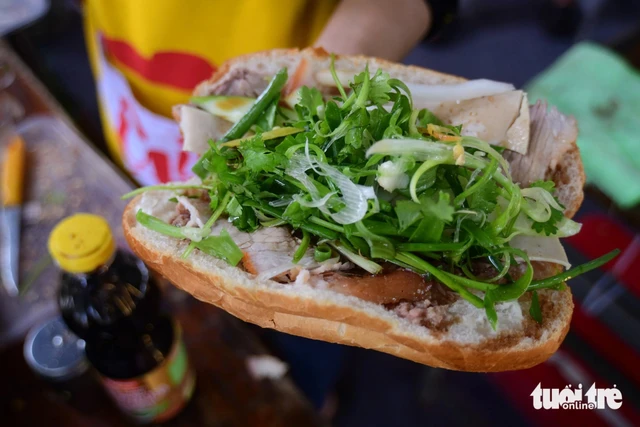
Vietnamese 'banh mi,' known for its pork filling, sauces, and herbs, has won over international diners. Photo: Quang Dinh / Tuoi Tre
Vietnam's Food Safety Authority under the Ministry of Health this week asked the Lam Dong Department of Health to investigate a suspected food poisoning outbreak that led to the hospitalization of 84 people after they ate banh mi with grilled pork and pâté from a food stall in Nam Ban Lam Ha Commune.
After eating the sandwiches, many people developed symptoms including abdominal pain, nausea, fever, and diarrhea, and were thus taken to medical facilities for treatment.
The authority instructed local officials to investigate the incident, trace the origin of the food to identify the source of the ingredients and food suspected of causing the poisoning, collect food and patient samples for laboratory testing to determine the cause, and strictly handle any violations of food safety regulations.
As of July 30, nearly all patients hospitalized had been discharged.
Preliminary investigations found that the patients had purchased and eaten banh mi from the same food stall on the mornings of July 25 and 26.
Food safety authorities collected samples of grilled pork, pâté, mayo, meat sauce, Vietnamese pork sausage, cucumber, and pickled radish for laboratory testing to determine the cause.

A patient receives treatment after being hospitalized with suspected food poisoning linked to 'banh mi' in Lam Dong Province, Vietnam, July 27, 2026. Photo: D.V.C.
The incident has once again raised familiar questions: Why is banh mi so often linked to mass food poisoning outbreaks? Why do some people become seriously ill while others who eat from the same vendor experience only mild symptoms? And what food safety measures should vendors take to prevent such incidents from happening again?
The real culprit: The fillings
Dr. Phan Thach Khue, head of the nephrology and dialysis department and former head of the intensive care unit at Lam Dong General Hospital, said the bread itself is largely blameless because its dry, low-moisture interior does not provide a favorable environment for bacteria to survive and multiply.
Instead, the real problem lies in the fillings.
According to Dr. Khue, a typical banh mi contains pâté, cold cuts, Vietnamese pork rolls, Vietnamese mayo, sauces, fresh vegetables, and pickles.
These ingredients are rich in protein, high in moisture, and low in acidity, making them an ideal environment for bacteria to multiply.
Pâté, which is made from liver and ground meat, can spoil quickly if it is undercooked or left unrefrigerated for a long time.
The Vietnamese mayo spread commonly used in banh mi, typically made from raw egg yolks, is also highly susceptible to bacterial contamination.
In hot weather, bacteria can multiply rapidly if these ingredients are left at room temperature for just a few hours.
In other words, the culprit is bacteria-contaminated fillings that have been improperly prepared or stored.
Explaining why such incidents often turn into mass food poisoning outbreaks, Dr. Khue said banh mi is sold in large quantities, especially in the morning, and its fillings are often prepared the day before for use throughout the day.
If just one batch of pâté or one container of sauce becomes contaminated, it can be spread across hundreds of sandwiches within a few hours.
Meanwhile, the incubation period for this type of poisoning is relatively short, typically ranging from a few hours to one day.
As a result, people who eat the contaminated banh mi on the same morning often develop symptoms by noon or later in the afternoon, and are hospitalized around the same time, making the incident appear to be a sudden outbreak.
Dr. Khue said it is common for people who eat the same banh mi to experience different outcomes, with some developing severe food poisoning, others experiencing milder symptoms, and some remaining unaffected.
The first factor is the infectious dose. People who consume more are likely to ingest more bacteria and therefore face a higher risk of severe illness.
Those who eat less or do not consume the contaminated portion may not become ill at all.
Toxins are also not distributed evenly, meaning not every banh mi contains the same level of contamination.
Another factor is individual susceptibility. Young children, older adults, people with underlying conditions such as diabetes, liver or kidney disease, and those taking medications that reduce stomach acid are more likely to develop severe illness.
By contrast, people who have previously been exposed to the bacteria or have a healthy gut microbiome may experience milder symptoms.

A patient receives treatment after being hospitalized with suspected food poisoning linked to 'banh mi' in Lam Dong Province, Vietnam. Photo: D.V.C.
How to prevent
From a food safety perspective, Dr. Khue said banh mi shops need to strengthen control over several key steps.
First is ingredient sourcing. Pâté, cold cuts, and pork sausage should come from traceable suppliers with food safety certification rather than cheap, unverified sources.
Next is cold storage. Ready-to-eat ingredients should be kept refrigerated at temperatures below five degrees Celsius and should not be left on display throughout the day.
As a general rule, cooked food left at room temperature for more than two hours should be discarded, as bacteria can double in number every 20 minutes under favorable conditions.
Finally, proper food preparation is essential. Pâté should be thoroughly cooked or steamed.
Knives and cutting boards used for raw and cooked foods should be kept separate and cleaned properly to prevent cross-contamination.
Vendors should wear gloves and avoid handling food with the same hands used to collect cash.
Fresh vegetables must be washed thoroughly while pickles must be prepared properly.
Dr. Khue advises that if those steps are followed, banh mi will still be a delicious and safe food.
People don't need to turn their backs on banh mi. What needs to be eliminated is the careless habit of processing and preserving it, he added.









Max: 1500 characters
There are no comments yet. Be the first to comment.