


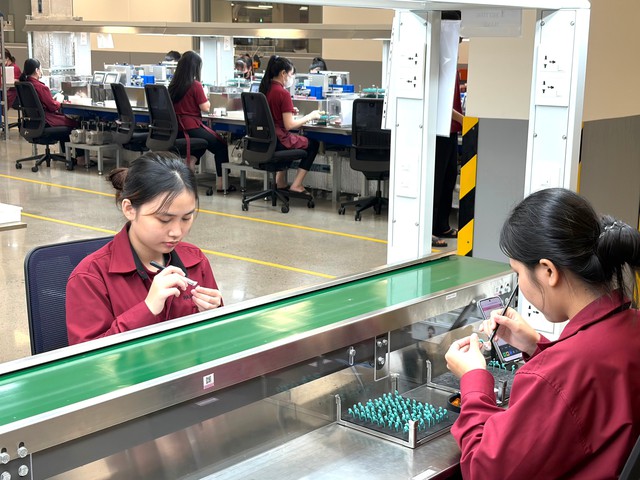
Employees at Pandora’s newly inaugurated factory in Ho Chi Minh City. Photo: Nghi Vu / Tuoi Tre
Speaking to Tuoi Tre (Youth) online newspaper, Rizwan Khan, managing partner at investment consultancy Acclime Vietnam, said the latest tariff reductions cover only a limited share of bilateral trade.
Around US$60 billion worth of goods is covered by the tariff-reduction mechanism, accounting for about 14 percent of U.S.-China trade in 2025.
Of this, some $30 billion worth of Chinese goods could see lower U.S. tariffs, equivalent to 9.7 percent of China’s exports to the U.S..
The average U.S. tariff on Chinese goods would also fall only modestly, from about 22 percent to 20.5 percent, still nearly double the 11 percent level recorded in early 2025.
Short-term pressure on orders
Khan said most of the products covered are non-sensitive goods, but some categories are important to Vietnam, including toys, plastics, and household products.
These are low-margin, highly price-sensitive industries, meaning even a small tariff difference can affect sourcing decisions.
US-China $30 billion tariff deal may reshape competition for Vietnamese exports
30/09/2026 15:11
Vietnamese consumers favor US goods but want lower prices
27/09/2026 20:04
“Some U.S. buyers may shift part of their short-term orders back to existing suppliers in China, particularly for products whose tariffs return to most-favored-nation levels,” he said.
Still, Khan said the impact is more likely to emerge through order volumes and price negotiations over the next few quarters than through factory relocation.
For multinational companies, moving production is a long-term decision involving investment cycles of 10 to 20 years and substantial costs in supplier networks, logistics, and labor.
The tariff changes therefore have some significance, he said, but they are not broad enough to fundamentally alter the investment logic behind China+1, the business strategy of avoiding investing only in China or sourcing only from China.
Investors will also wait for clarity on final tariff rates, product coverage, and the duration of the reductions, as well as U.S. rules on origin and transshipment, Vietnam-U.S. trade negotiations and the tariff gap between China and alternative manufacturing bases.
Khan said China+1 remains a broader strategy aimed at reducing supply-chain concentration and geopolitical risk, rather than merely a response to tariffs.
Vietnam urged to strengthen domestic value
For Vietnam, Khan said a key priority is to conclude a reciprocal trade arrangement with the U.S. and address concerns raised by Washington, including non-tariff barriers.
Vietnam could also help ease concerns over its bilateral trade surplus by increasing purchases of U.S. products where there is genuine demand, such as agricultural goods, liquefied natural gas, and aircraft.
Rules of origin are another key issue.
As the U.S. steps up scrutiny of tariff evasion and transshipment, Vietnam will need stronger systems to verify where goods come from and how much processing takes place domestically.
Khan suggested digitizing certificates of origin, increasing oversight of projects at risk of being used mainly for transshipment, and improving supply-chain traceability, including compliance with U.S. forced-labor requirements.
He also said Vietnam needs to raise the share of value created at home.
Many manufacturing sectors still depend heavily on imported components and raw materials. In electronics, for example, industry estimates put the localization rate at only around 15-20 percent.
Building stronger domestic Tier-1 and Tier-2 supplier networks would help Vietnam retain more value and reduce its reliance on imported inputs.
“The goal should not simply be to attract another factory, but to build the capabilities of suppliers and supporting industries around that factory,” Khan said.
Beyond a manufacturing base
Human resources and energy will also become increasingly important as the next wave of China+1 investment moves into more advanced industries.
Future projects will require technical workers in semiconductor design and testing, automation and supply-chain management, as well as better access to renewable energy.
For Vietnam, Khan said the opportunity is therefore no longer just about absorbing production leaving China.
“The more important question is not whether China+1 will continue, but whether Vietnam can move from being an alternative manufacturing location to becoming an increasingly integrated and higher-value link in global supply chains,” he said.
U.S.-China tariff deal
The U.S. and China agreed in late September to reduce tariffs on about $30 billion worth of non-sensitive goods in each direction following Chinese President Xi Jinping’s visit to Washington.
According to the White House, the agreement covers U.S. exports to China such as agricultural products, wood, and cosmetics, while Chinese exports to the U.S. include small appliances, toys, and decorations.
The two sides described the deal as a consensus on recommendations for more favorable tariff treatment, rather than a blanket tariff cut across all bilateral trade.








Max: 1500 characters
There are no comments yet. Be the first to comment.