


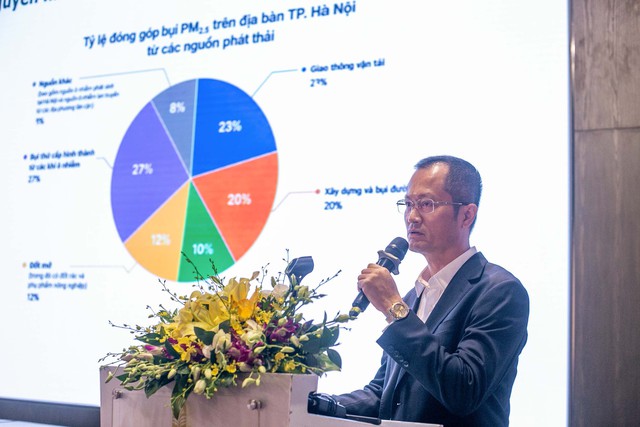
Le Hoai Nam, deputy head of the Environment Administration under Vietnam's Ministry of Agriculture and Environment, speaks at a workshop in Hanoi, September 29, 2026. Photo: C.Tue / Tuoi Tre
The excessive PM2.5 levels were revealed by Le Hoai Nam, deputy head of the Environment Administration under the Ministry of Agriculture and Environment at a workshop in Hanoi on Tuesday.
The findings come as air pollution ranked third among the country's top five death risk factors in 2023, according to Le Thai Ha, deputy head of the Vietnam Administration of Disease Prevention.
PM2.5 exceeds 24-hour limit on one-third of days
Nam said environmental monitoring data in Vietnam, particularly in Hanoi, showed average fine particulate matter concentrations of around 47-48 µg/Nm³, a relatively high PM2.5 level compared with cities in other countries in Southeast Asia.
According to data from the Ministry of Agriculture and Environment, PM2.5 concentrations exceed the 24-hour average limit of 50 µg/Nm³ on about one-third of days each year, typically from September to April in Hanoi and several northern provinces.
Based on emission inventories and chemical composition sampling conducted from 2023 to 2025, the main sources of air pollution include transportation, construction and road dust, industry, open burning, and secondary particulate matter formed from polluted gases, Nam said.
The ministry is continuing to conduct inventories and assessments to update the latest data and identify the causes of air pollution, he said.
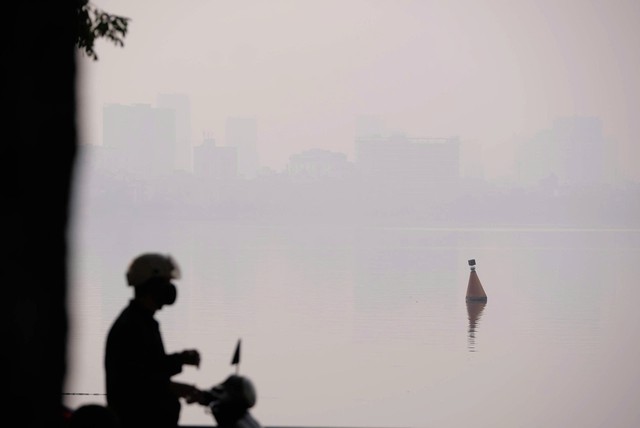
Hanoi on a day of heavy air pollution. Photo: Nam Tran / Tuoi Tre
On measures to tackle air pollution, Nam said the Ministry of Agriculture and Environment is drafting regulations for coordination and interprovincial and interregional air quality management in northern provinces.
The ministry is currently reviewing and responding to feedback and plans to submit the regulations to the prime minister in October 2026.
In particular, Hanoi, Bac Ninh City, Hung Yen Province, Ninh Binh Province, Phu Tho Province, and Thai Nguyen Province have recently signed a coordination agreement for environmental management in the capital region, including cooperation on air quality management, Nam said.
The ministry has also submitted a proposal to the prime minister to establish a national steering committee on tackling air pollution, he said.
Regarding the roadmap for applying vehicle emission standards to cars, motorcycles, and mopeds, Nam said Hanoi and Ho Chi Minh City have recently begun issuing permits and establishing networks of emissions testing facilities in preparation for vehicle emissions testing from July 1, 2027.
The Ministry of Industry and Trade is developing a roadmap for fuel supply and fuel quality control in line with national technical standards and the roadmap for applying emission standards to road motor vehicles, Nam said.
The roadmap takes into account the production capacity and upgrade plans of the Dung Quat and Nghi Son oil refineries, as well as standards for imported fuel.
The ministry has drafted the roadmap and sought feedback from relevant ministries and agencies, with Vietnam's fuel standards expected to be aligned with emission standards around 2030-31, Nam said.
Air pollution linked to nearly 95,000 premature deaths
According to Ha, the Ministry of Health has conducted studies and assessments of the health impacts of air pollution in Vietnam and collected data from reports by scientists.
The 2023 Global Burden of Disease study found that air pollution ranked third among the leading risk factors for death in Vietnam, after systolic high blood pressure and smoking.
"Air pollution was estimated to be linked to nearly 95,000 premature deaths in 2023, based on the average life expectancy of Vietnamese people," Ha said.
"Besides the direct effects of air pollution, we also need to pay attention to premature deaths caused by smoking.
"Tobacco smoke can also contribute to air pollution, particularly indoor air pollution."
Regarding the health impacts of air pollution, Ha said evidence from Vietnam shows that exposure to outdoor air pollution can cause various health effects throughout a person's lifetime.
Exposure during pregnancy has been associated with pregnancy complications and adverse birth outcomes, including low birth weight and premature birth.
In children, air pollution increases the risk of respiratory diseases and hospitalization.
Among adults, its effects extend to both respiratory and cardiovascular diseases, including chronic obstructive pulmonary disease (COPD), ischemic heart disease, and stroke.
Among older people, the risk of hospitalization for cardiovascular and respiratory diseases also increases.
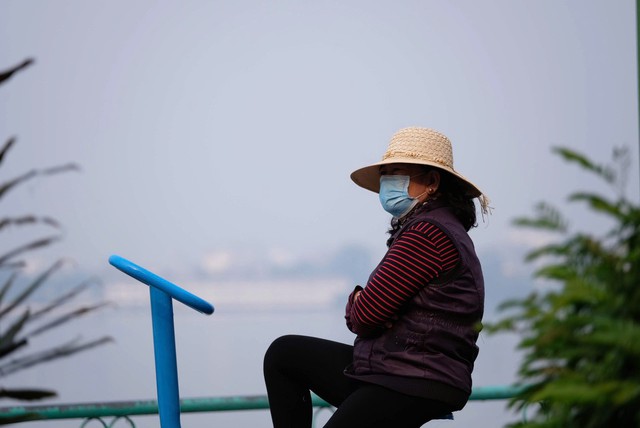
Air pollution may increase the risk of hospitalization for cardiovascular and respiratory diseases among older people. Photo: Nam Tran / Tuoi Tre
According to Ha, the health burden of air pollution in Vietnam can be seen in three main areas: deaths, years of life and life expectancy lost, and the rising number of illnesses and hospitalizations.
In terms of mortality, studies in Vietnam have recorded deaths attributable to PM2.5 exposure, with the burden particularly high in major cities such as Hanoi and Ho Chi Minh City.
Studies have also found that a significant share of lung cancer deaths is linked to air pollution.
"Evidence on the health impacts of air pollution in Vietnam remains limited, as most studies have focused on a few major cities. There is a lack of evidence on long-term impacts and a lack of studies on the effects of multiple air pollutants," Ha stressed.
"If there is sufficient evidence on the health impacts of air pollution, it will provide a basis for the health sector to develop appropriate policies."









Max: 1500 characters
There are no comments yet. Be the first to comment.