


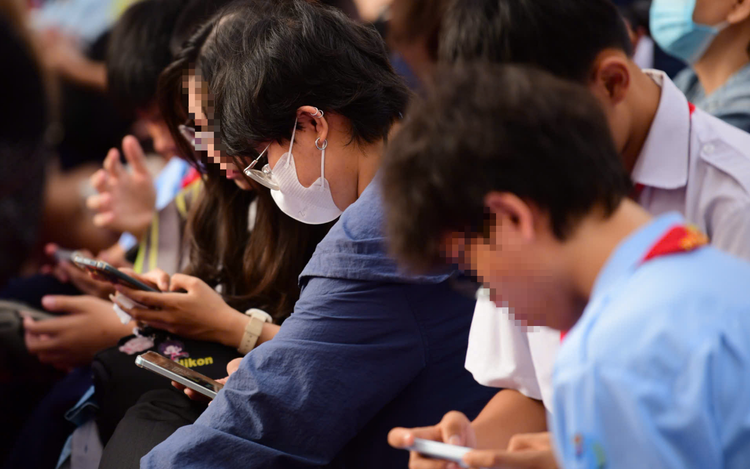
Social media can broaden young people’s world, but it is eroding their emotions, concentration, and self-control abilities. Photo: Quang Dinh / Tuoi Tre
Never before have young people been so connected to the world.
Yet never before have adults been so deeply concerned about the emotional and psychological harm social media may inflict on children.
Social media has dramatically expanded the horizons of today’s youth, but it causes the gradual erosion of attention spans, emotional stability, and self-control when young users lack the digital resilience needed to navigate online life responsibly.
A 2024 report by the regional office for Europe under the World Health Organization found that problematic social media use among adolescents is rising significantly across many countries.
Common signs included difficulty controlling time spent online, emotional dependency, and declining sleep quality – all factors linked to mental health and psychological well-being.
UNICEF has also warned that children today are not simply growing up in the real world.
They are maturing inside a vast digital ecosystem filled with both opportunities and risks.
Cyberbullying, privacy violations, behavioral manipulation, and exposure to harmful content are becoming increasingly serious threats when young users lack self-protection skills and guidance from adults.
In Vietnam, school-life surveys and educational studies have similarly shown that many students are experiencing declining concentration, dependence on virtual interactions, and growing psychological stress on account of excessive social media use.
The issue is no longer merely technological.
It has become a matter of education, child development, and public well-being.
Around the world and in Vietnam alike, alarming incidents involving minors and social media have become more common.
Harmful online challenges spread through platforms such as TikTok and YouTube have encouraged children to put themselves in danger.
Cases of prolonged cyberbullying have pushed students into emotional crises, social withdrawal, and deep loss of confidence.
Several studies on media psychology have also found that constant exposure to rapid-fire content, violent imagery, and unrealistic beauty standards can intensify feelings of insecurity, anxiety, and social pressure among adolescents.
What makes social media especially concerning is that its effects are often subtle rather than immediate.
The danger does not always arrive in the form of dramatic incidents.
More often, it appears as a slow weakening of concentration, emotional regulation, and behavioral control.
No control software can fully protect a child if that child lacks the internal strength and digital competence to manage the online world independently.
Vietnam takes action to protect children from social media
Faced with these concerns, many countries have begun tightening regulations surrounding children’s access to social media.
Australia became the first country to block users under 16 from accessing major platforms including TikTok, YouTube, Instagram, and Facebook starting December 10, 2025.
Though controversial, the decision reflects a growing global movement toward stronger protections for minors in digital spaces.
Vietnam has chosen an approach that combines regulation with education instead of imposing outright bans.
Under the country’s Cybersecurity Law and Decree 147/2024 on Internet services and online information management, children under 16 registering social media accounts must use information belonging to parents or guardians.
Parents are also responsible for supervising the content their children access, post, and share online.
The approach emphasizes not only legal accountability but also the central role of families in guiding children through the digital age.
Still, framing the debate simply as ‘ban or not ban’ risks overlooking the psychology of adolescence.
For many teenagers, social media functions as a place for connection, entertainment, learning, and identity formation.
Blanket prohibitions can provoke resistance, encourage circumvention, and push young users toward less regulated platforms.
Restrictions on social media use among minors should not be viewed as simplistic punishment.
They should be understood as protective boundaries designed to safeguard emotional development, self-control, and psychological maturity.
Education has always recognized the importance of age-appropriate limits.
Just as children are not allowed to drive vehicles or consume harmful substances before reaching sufficient maturity, so regulating social media access can be seen as a preventive measure for healthy development.
Age verification systems, screen-time limits, content moderation, and stronger accountability for technology companies are all necessary steps.
Schools must also expand digital literacy education, psychological support services, and online safety training.
The core value of education is to help children develop inner self-regulation.
Long-term safety cannot rely solely on constant surveillance, but it depends on whether young people can recognize risks and adjust their own behavior responsibly.
It is also necessary to raise urgent questions about the social responsibility of technology companies, regulators, and tech investors.
A society cannot claim to embrace digital innovation while placing profits above the safety of children.
Algorithms cannot remain indifferent to the emotional harm, addictive behaviors, and toxic content increasingly woven into the daily lives of young users.
A healthy digital environment is built not only through advanced technology but also through ethical standards, social responsibility, and a commitment to protecting vulnerable users, especially children and adolescents.
Parents remain first line of defense
Within this broader picture, parents hold a uniquely important role.
Government Decree 147/2024 is not merely an administrative regulation, but also a reminder that family guidance remains essential in the digital era.
Many parents attempt to manage their children’s online activity while overlooking a deeper issue: loneliness in real life often drives children to seek refuge online.
Young people cannot develop healthy social media habits if adults disengage from their emotional lives.
Many parents are handing smartphones to children as entertainment devices without paying close attention to what content they consume, who influences them online or what psychological struggles they may be facing.
In reality, children learn more from adult behavior than from repeated warnings.
Families that encourage dialogue, establish clear digital boundaries, and model responsible online behavior create far stronger protection than any software filter ever could.
That means giving children genuine presence, real conversation, and authentic emotional connection.
Education functions as strongest shield
Children must be taught to use social media as a tool for learning, communication, and personal growth instead of becoming dependent on it.
They need to learn how to verify information, protect personal data, behave responsibly online, and manage screen time wisely.
UNESCO has repeatedly asserted that digital competence and digital citizenship are becoming essential components of 21st-century civic education.
A child who knows how to swim is far safer than one who is only told to stay away from water.
In the same way, a student equipped with digital literacy, emotional resilience, and clear personal values is far more capable of navigating online spaces without losing a sense of self.
Many young people believe they are using social media, when in reality social media is using their emotions and attention.
The greatest danger of social media is not its power alone, but the vulnerability of those who use it without preparation.
Age-based regulations are necessary in today’s environment.
However, the word ‘ban’ should not be interpreted as simply closing a door. It should represent a gradual process of preparation, guidance, and maturity.
Children’s digital futures cannot be built through algorithms designed solely to maximize engagement and advertising revenue.
Some boundaries exist not because society distrusts young people, but because adults carry a responsibility to protect their development before silent damage becomes irreversible.
When families, schools, policies, and society together form a truly meaningful digital education ecosystem, social media will no longer be merely a risk zone to be controlled, but it can become a tool that supports the development of younger generations.
* This article was originally written in Vietnamese by Professor Dr. Huynh Van Son, president of the Ho Chi Minh City University of Education.








Max: 1500 characters
There are no comments yet. Be the first to comment.