


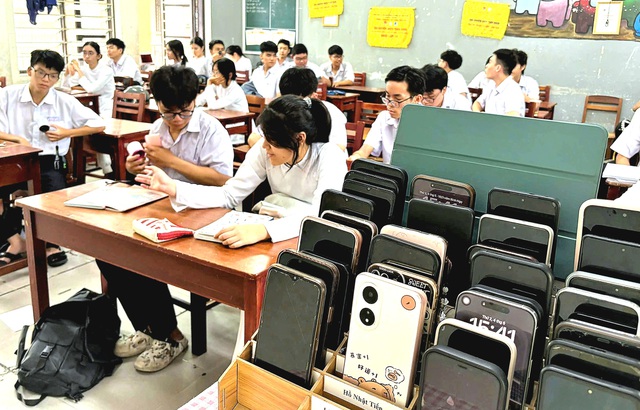
Students at Tran Phu High School in Da Nang City, central Vietnam stop using phones during class under school rules. Photo: B.D.
Schools said some social media platforms considered harmful remain highly attractive to students, while more educational platforms struggle to engage them.
A few years ago, Tran Phu High School became one of the first schools in the coastal city to temporarily collect students’ phones and ban phone use during class.
The rule emerged after the COVID-19 pandemic, when students returned to school but continued to interact almost exclusively online, even while sitting side by side.
Nguyen Pham Hoang Phuc, secretary of the school’s youth union, said pandemic distancing measures kept students from gathering during breaks, leading many to spend nearly all their free time staring at their phones.
Teachers initially tried warnings and reminders, but found them ineffective.
Some homeroom teachers then assigned class monitors to check students’ electronic devices before lessons.
Others purchased wooden lockers or metal cabinets where students had to switch off and store their phones until class ended.
The approach officially became school policy in 2022.
Students are not allowed to use phones during class except when teachers require them for educational purposes.
“Schools can restrict phone use during class, but we still cannot completely stop students from using social media because there is no clear regulation,” Phuc said.
'Green boundary' at school
More than 10 schools across Da Nang are gradually implementing measures to limit students’ use of internet-connected phones on campus, partly because many recent cases of school violence have been linked to social media disputes.
Vo Thanh Phuoc, principal of Nguyen Hue Middle School in Hai Chau Ward, estimated nearly all students with smartphones use social media.
He said even sixth graders often create personal accounts to post photos and updates online.
“Students use social media differently from adults. Parents and teachers are rarely included in their friend lists, so most interactions happen only among peers online. Sometimes just one negative comment on a photo can spark conflicts,” Phuoc said.
For years, the school’s more than 2,000 students have followed a unique rule: the flagpole in the schoolyard serves as a “boundary line.”
Once students pass it, they must switch off phone connections and silence their devices unless teachers instruct them to use phones for learning activities.
The principal added that parents have largely supported the policy, because many struggle to separate their children from screens at home.
Le Thanh Hai, principal of Le Quy Don High School for the Gifted, said he personally supports banning social media use for children under 16.
He argued that while platforms offer some benefits, they expose children to risks they are not mature enough to handle.
“Adults are tempted by social media, let alone children,” he said, calling for a nationwide ban for minors.
Parents urged to set examples
While many people supported limiting children’s phone use or even banning social media access for those under 16, others argued that parents must also change their own behavior.
One reader of Tuoi Tre (Youth) newspaper commenting on the issue said many adults are themselves addicted to phones, making it unrealistic to expect children to avoid screens.
Some suggested banning phones in all schools and stopping teachers from assigning homework through social media platforms.
Others said parents should spend more time talking and interacting with children instead of handing them phones to keep them quiet.
Teachers act as 'undercover monitors'
School representatives in Da Nang said teachers have increasingly created anonymous social media accounts or relied on class monitors to quietly track online conflicts among students before they escalate into violence.
“One recent case started simply because students criticized each other’s photos online. They later arranged to meet after school to settle the argument,” a high school teacher said.
“We used anonymous accounts and class representatives to monitor the situation, then informed authorities in time to prevent fights from happening.”










Max: 1500 characters
There are no comments yet. Be the first to comment.