


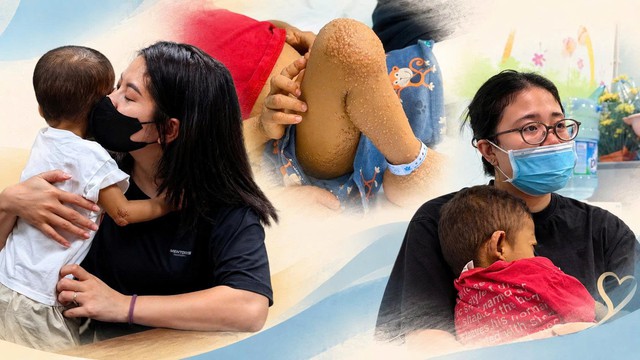
Mothers of children with Alagille syndrome hope their children can be accepted and included in the community. Photo: D.L. / Tuoi Tre
Alagille syndrome caused M. to develop bile duct paucity in the liver, impairing bile flow and leading to jaundice and liver damage.
The condition can also affect the kidneys, eyes, heart, and spine.
Poor absorption and metabolism have made it difficult for her to gain weight, leaving the child smaller than other children her age.
But M.'s health problems are not the only challenge. Her journey to school has also been far from easy.
M.s’ mother, D.T.N., recalled that when her child attended a public school in their commune, several parents had taken photos of M.’s yellowish skin and shared them in a parents' group.
Perhaps because they did not understand the disease, some parents feared that it might be contagious.
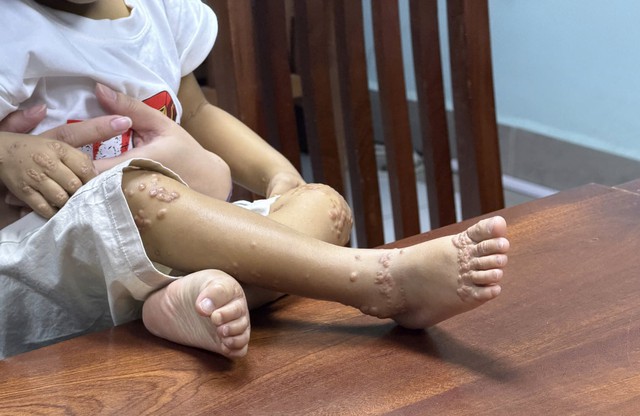
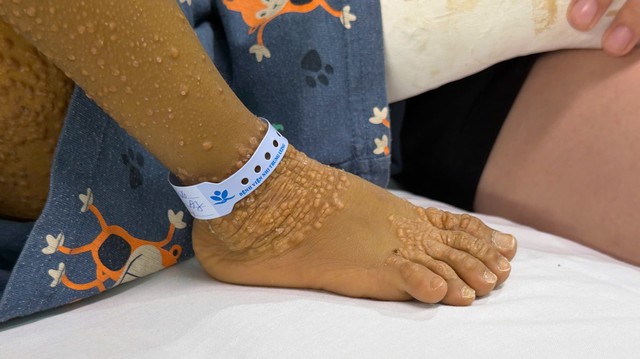
Lumps on M.'s arms and legs have led some parents to worry that she has an infectious disease. Photo: D.L. / Tuoi Tre
N. eventually decided to move her child to a school closer to home.
Having learned from the experience at her previous school, N. proactively explained M.’s condition to the principal and homeroom teacher.
"In the new environment, the teachers pay more attention to her and coordinate more closely with our family,” N. said.
“For now, M. only attends school in the morning to get used to her classmates. Around 10:00 am, we pick her up so she can eat and rest at home.”
For the family, their biggest wish is not only for their child to receive treatment but also to live, study, and play like other children.
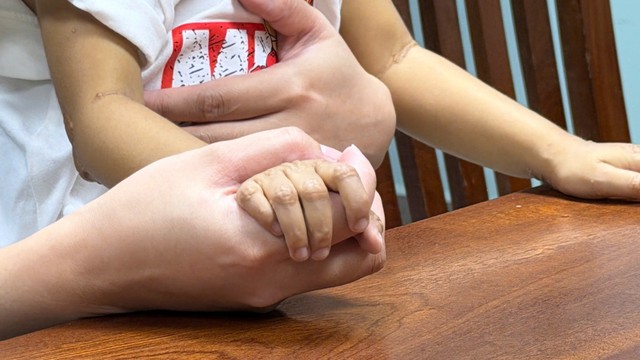
M.'s mother holds her hand tightly to encourage him. Photo: D.L. / Tuoi Tre
A liver transplant is currently an option for treating the condition, but N. does not yet know whether her child's health and physical condition are suitable for the procedure.
The cost of a liver transplant is also a major concern for her family and many other parents of children with Alagille syndrome.
"A liver transplant would be a miracle if it were possible, but the cost is too high,” N. said.
“For now, we only hope that our child will be accepted wherever she goes. That alone would make us very happy."
There’s nothing called a good night's sleep
Sitting on a hospital bed and preparing for a lengthy liver transplant operation, four-year-old L.T. from Hanoi repeatedly scratched the yellow lumps beneath his skin, known as xanthomas, caused by a disorder of fat metabolism associated with Alagille syndrome.
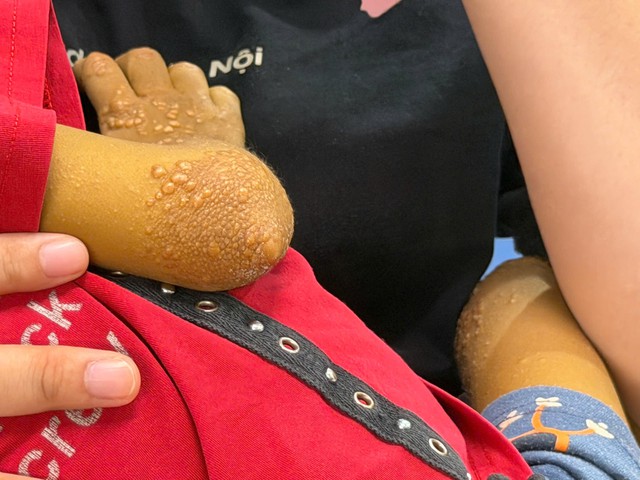
L.T.'s hands show yellow xanthomas caused by a disorder of fat metabolism associated with Alagille syndrome. Photo: D.Lieu / Tuoi Tre
L.T. was diagnosed with Alagille syndrome when he was about two months old. Since then, he has received regular treatment and monitoring.
His mother, H., said that over the past four years, the most distressing part of caring for her son has not necessarily been hospital stays or lengthy medical tests, but persistent itching.
For years, the boy has rarely had an uninterrupted night's sleep.
At night, he may wake up two or three times, asking his parents to turn on the light so he can see and scratch his skin. At times, he scratches until the skin bleeds.
The syndrome can worsen itching, which is already associated with jaundice and cholestasis, as numerous yellow xanthomas develop on the skin.
The lumps can appear in many parts of the body, from the hands and arms to inside the ears.
When blood lipid levels become elevated, fats cannot be properly metabolized and eliminated through the liver, leading to the formation of xanthomas on the skin.
L.T. is now undergoing preparations for a liver transplant, with his mother expected to be his donor.
The family had hoped to proceed with the transplant about two years ago but had to wait due to factors related to the indications and eligibility for transplantation.
L.T. is undergoing preparations for a liver transplant, with his mother set to be his donor. Photo: D.Lieu / Tuoi Tre
Alagille syndrome is genetic, not contagious
According to Associate Professor and Dr. Nguyen Pham Anh Hoa, head of the Hepatobiliary Department at the National Children's Hospital, Alagille syndrome, also known as a disorder involving the intrahepatic bile ducts, is a multisystem disorder involving components of the Notch signaling pathway.
The condition is most commonly caused by mutations in the JAG1 gene (Alagille syndrome type 1), while a small proportion of cases are associated with mutations in the NOTCH2 gene (Alagille syndrome type 2).
"There are cases in which parents carry the disease-causing gene but show no symptoms, while their children develop the disease,” Dr. Hoa said.

Associate Professor and Ph.D. Nguyen Pham Anh Hoa who has been working with children with Alagille syndrome for many years.
“The gene can be understood as a necessary condition, but other factors are also needed for the disease to manifest.”
For children with progressive liver damage, a liver transplant may be considered as a treatment option.
For children who undergo a successful transplant, liver function and cholestasis can improve significantly.
Jaundice, itching and skin xanthomas may also gradually decrease over time.
However, a liver transplant does not mean that all risks associated with Alagille syndrome are eliminated, as the condition can affect multiple organs beyond the liver.
Dr. Hoa also warned families against using herbal medicines or unverified treatments on their own.
Children with the syndrome may also have underlying kidney abnormalities, and medicines of unknown composition could worsen their condition.
According to Dr. Hoa, children with Alagille syndrome suffer not only from the effects of the disease but sometimes also from other disadvantages related to children's rights, including the right to attend school, play and integrate into society.
One reason is that many people do not fully understand the condition.
Alagille syndrome can cause jaundice, cholestasis, delayed physical development and yellow xanthomas on the skin.
However, it is not transmitted from one person to another, Dr. Hoa said.
About 90 percent of children with Alagille syndrome may have poor physical development, while their mental development remains normal.
In addition, some children with Alagille syndrome may have skeletal abnormalities that make them more vulnerable to injury and increase the risk of broken arms or legs after impact.
Physical features such as jaundice, distinctive facial features or yellow skin lumps can also draw attention, teasing and stigma.
Dr. Hoa recalled a case involving a child in central Vietnam in which she had to personally call the school principal to persuade the school to allow the child to attend.
"Children are actually very innocent. When they are given the right explanation, they will play together normally, and may even care for and help children who are more vulnerable. Often, it is the adults who are afraid,” Dr. Hoa said.





Max: 1500 characters
There are no comments yet. Be the first to comment.