


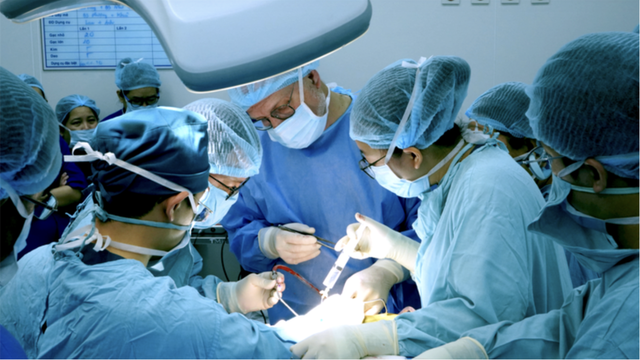
The surgical team performs an auditory brainstem implantation procedure in May 2026. Photo: Ho Chi Minh City Department of Health
On Friday, Tang Chi Thuong, director of the Ho Chi Minh City Department of Health, said Children’s Hospital 1 had successfully performed Vietnam’s first two Auditory Brainstem Implant (ABI) procedures, opening up a potential hearing treatment option for children with congenital deafness.
The technique is particularly significant for children with complex congenital deafness caused by the absence of cochlear nerves in both ears or severe inner-ear malformations, conditions that previously left them with few or no options for hearing restoration in Vietnam.
Auditory brainstem implantation (ABI) is a specialized technique developed for patients in this group.
Unlike a cochlear implant, which stimulates the cochlear nerve, an ABI delivers electrical signals directly to the cochlear nucleus in the brainstem.
This bypasses the damaged or missing inner-ear structures and cochlear nerve, creating a new pathway for the brain to receive auditory signals.
The procedure is considered one of the most complex hearing-restoration techniques currently available.
A successful ABI procedure involves more than the surgery itself, requiring close coordination among multiple medical specialties.
At Children’s Hospital 1, the program was built on more than 20 years of experience in hearing intervention for children.
The hospital has performed hundreds of cochlear implant procedures for children with congenital hearing loss, including patients from overseas.
For children with conditions that left them with virtually no hearing-restoration options in Vietnam, the hospital began preparing to introduce ABI, a highly specialized technique that had never previously been performed in the country.
In December 2025, the Ministry of Health authorized Children’s Hospital 1 to pilot the technique.
The first patient selected for an ABI was a 40-month-old girl from Hanoi who was born deaf and was found to have no cochlear nerves in either ear.
She had previously undergone surgery for a cochlear implant, but because no neural response was detected, the surgical team did not place the electrode.
The second patient was a 19-month-old boy from Dong Nai with profound bilateral sensorineural hearing loss.
He showed no response despite using hearing aids at maximum amplification.
Imaging showed severe inner-ear malformations and the absence of cochlear nerves in both ears.
On May 21 and 22, 2026, the two procedures were performed at Children’s Hospital 1 by the hospital’s multidisciplinary team, with direct guidance and support from specialists from Germany.
Both children showed auditory neural responses across all tested channels, with electrode impedance at good levels.
These were important intraoperative signs that the electrode arrays had been positioned appropriately and the systems were functioning stably.
After a monitoring period and once the surgical wounds had healed, the devices were activated on July 16 and September 9, respectively.
Follow-up tests showed that both electrode systems were functioning normally, with no signs of displacement.
The moment both families had been waiting for soon followed: both children began responding to sounds in their surroundings, including clear reactions to loud sounds such as drums.
The children will continue to undergo regular device adjustments and intensive auditory-verbal therapy, with ongoing monitoring by specialists in audiology, rehabilitation and speech-language therapy.
The initial success of the two ABI procedures marks the first successful implementation of this specialized technique in Vietnam.
More importantly, the technique offers a new hearing-restoration option for children born deaf who lack cochlear nerves in both ears or have severe inner-ear malformations and therefore cannot benefit from cochlear implants.
Previously, families of children with these conditions had to travel abroad for evaluation and treatment at considerable cost, or accept that no suitable hearing-restoration option was available.









Max: 1500 characters
There are no comments yet. Be the first to comment.