


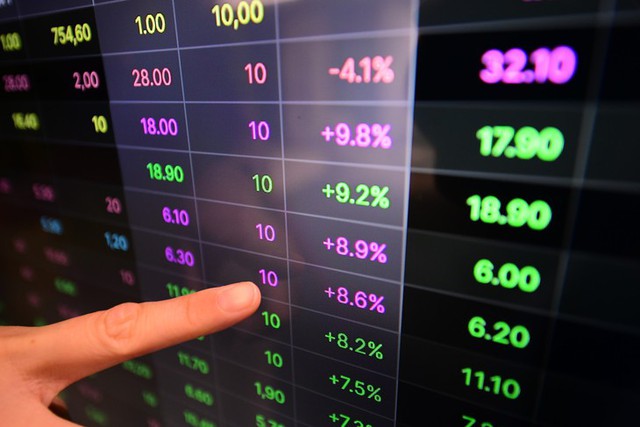
The impact of the Fed’s decision on the stock market depends on multiple factors. Photo: Quang Dinh / Tuoi Tre
The Fed, known as the central banking system of the United States, on Wednesday raised its benchmark rate by 25 basis points to 3.75-4 percent, its first increase since 2023, prompting renewed attention to the possible impact on Vietnamese equities.
Fed rate hikes do not always trigger foreign sell-offs
Historical data suggest that Fed rate hikes may put short-term pressure on Vietnamese stocks, but they do not necessarily trigger foreign sell-offs, with exchange-rate movements appearing to play a more important role.
FinSuccess Investment JSC reviewed data since 2000, covering three Fed rate-hiking cycles, four rate-cutting cycles, and 66 quarters of foreign capital flows on the Ho Chi Minh Stock Exchange.
Its findings suggest that the relationship between Fed moves and Vietnam’s stock market is not as simple as higher U.S. rates leading to foreign outflows and a falling VN-Index.
The benchmark VN-Index did enter a correction during the first one to three months of all three previous Fed tightening cycles.
However, the size of the declines and the pace of recovery varied considerably, suggesting that domestic conditions were also key drivers of market performance.
Foreign investors, meanwhile, did not consistently turn net sellers during periods of Fed tightening.
How would Fed rate hike affect Vietnam?
16/09/2026 21:54
Fed rate-hike risks mount as Vietnamese market braces for volatility
03/09/2026 17:40
Across 18 quarters when the Fed was raising rates, foreign investors remained net buyers of Vietnamese shares, purchasing an average VND4.76 trillion ($183 million) per quarter.
In 2022, despite the VN-Index tumbling 32.8 percent, foreign investors still posted net purchases of nearly VND25 trillion ($959 million) worth of shares.
FinSuccess said the exchange rate has been a more important variable to watch.
During the 2022 tightening cycle, when the VN-Index recorded its steepest decline among the three periods studied, the Vietnamese dong lost 8.1 percent against the U.S. dollar.
By contrast, the exchange rate was broadly stable during the 2015 cycle, and the Fed’s rate increase caused little disruption to either the VN-Index or foreign capital flows.
The company said investors should therefore monitor exchange-rate pressure alongside the Fed’s meeting schedule and Vietnam’s domestic economic conditions.
Domestic growth remains supportive
Yuanta Securities Vietnam said the latest Fed rate hike is likely to have only a limited impact on the Vietnamese stock market.
Data from three previous Fed rate increases show that the VN-Index tended to weaken before the decisions were announced, falling 4 percent, 1.3 percent, and 3 percent, respectively, during the preceding 20 trading days.
However, the index did not fall sharply in the five sessions after those hikes, suggesting that the immediate market impact was modest.
Performance over the following 20 to 60 sessions depended more on domestic interest rates and exchange-rate movements.
ACB Securities Co. (ACBS) said the latest Fed move would mainly reduce the State Bank of Vietnam’s room for policy maneuver rather than force an immediate tightening of monetary policy.
Vietnam’s economy remains strong enough that broad-based monetary easing is not considered necessary at this stage.
The manufacturing purchasing managers’ index reached 53.3 in August 2026, while disbursed foreign direct investment rose 12 percent year-on-year and public investment disbursement continued to accelerate.
Inflation has recently been concentrated mainly in fuel prices, with no clear evidence of a strong spillover into the broader consumer price level.
As a result, the State Bank of Vietnam does not currently need to raise policy rates sharply to curb aggregate demand.
However, a wider USD-VND interest rate differential would make monetary easing more difficult due to increased pressure on the exchange rate.
Banking-system liquidity has meanwhile improved, supported by record-high Treasury deposits and flexible liquidity management through open market operations.
For the stock market, ACBS said the negative impact of the Fed’s decision would mainly come through higher capital costs and discount rates, rather than an immediate deterioration in corporate earnings.
Vietnam’s current growth cycle continues to be supported by manufacturing, FDI, and public investment.
Still, higher global interest rates raise both investors’ required rates of returns on equities and companies’ refinancing costs.
Highly leveraged businesses and those with large refinancing needs are therefore more exposed, while companies with stable cash flows and low debt are likely to face less pressure.








Max: 1500 characters
There are no comments yet. Be the first to comment.