


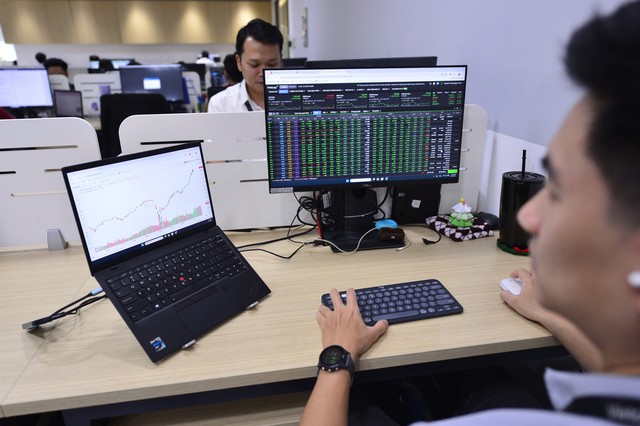
Investors watch closely as the U.S. Federal Reserve prepares for its September policy meeting, with markets predicting a 90-percent chance of a rate hike. Photo: Quang Dinh / Tuoi Tre
According to the CME FedWatch tool, markets are pricing in a more-than-90-percent chance of a 0.25-percentage-point Fed rate increase at its September policy meeting.
If the increase materializes, it would be the first Fed rate hike in more than three years.
Investors are also watching for signals about the policy path ahead, particularly whether the move would be a one-off occasion to counter inflation or the start of a new monetary tightening cycle.
The Fed's decision is expected early on Thursday (Vietnam time).
Hoang Thuy Luong, chief economist at Vietcap Securities, told Tuoi Tre (Youth) online newspaper that the immediate impact on Vietnam would be limited.
A stronger U.S. dollar could pressure the USD/VND exchange rate, but the dong remains supported by several factors, including falling unofficial-market exchange rates, cooling domestic gold prices and demand, stable foreign direct investment inflows, and prospects of attracting more foreign portfolio investment following the planned upgrade of Vietnam’s stock market.
FTSE Russell is scheduled to reclassify Vietnam's stock market from frontier to secondary emerging-market status on September 21.
Luong added that a Fed rate hike could narrow the gap between VND and USD interest rates, reducing the State Bank of Vietnam’s room to ease monetary policy.
However, domestic rates are unlikely to rise sharply unless the USD/VND exchange rate surges.
Tran Thi Khanh Hien, head of analysis at MB Securities, cautioned that the Fed is not the only factor.
After the Fed meeting on Tuesday and Wednesday, market attention will shift to the Bank of Japan's policy meeting on Friday and Saturday.
If the Bank of Japan continues tightening monetary policy, global financial-market liquidity could come under additional pressure.
Combined moves by the Fed and Bank of Japan may strain global capital flows, Hien said.
Domestically, inflation remains a challenge.
Vietnam faces price pressures from both external and domestic sources in the second half of this year, making it more challenging to keep the consumer price index (CPI) under control toward year-end, Hien added.
The Ministry of Finance has outlined three inflation scenarios for 2026, with average CPI growth projected at 4.5 percent, 5 percent, and 5.5 percent.
The State Bank of Vietnam forecasts average inflation for the year at 4.5-5.5 percent, while forecasts from international institutions range from 3.8 percent to 5.2 percent.
One positive sign is that short-term liquidity pressure in the banking system has eased somewhat as deposit growth has improved, Hien said.
As of August 22, VND deposits had risen 8.77 percent from the beginning of the year, exceeding the 8.38-percent growth in outstanding credit.
The figures represented a significant improvement from late July, when deposits had increased just 5.75 percent while credit had already grown 8.38 percent.
Nevertheless, banks still face substantial demand to strengthen medium- and long-term funding ahead of the year-end business season.
Some joint-stock commercial banks have offered relatively high interest rates on online deposits and certificates of deposit, indicating that competition for deposits remains intense.
Hien stressed that the final four months of 2026 leave little room for policy missteps.
Authorities will need to balance growth support, exchange rate stability, inflation control, and banking liquidity.
“Macroeconomic stability and inflation control are the foundation for sustaining high and sustainable growth,” Hien said.









Max: 1500 characters
There are no comments yet. Be the first to comment.