


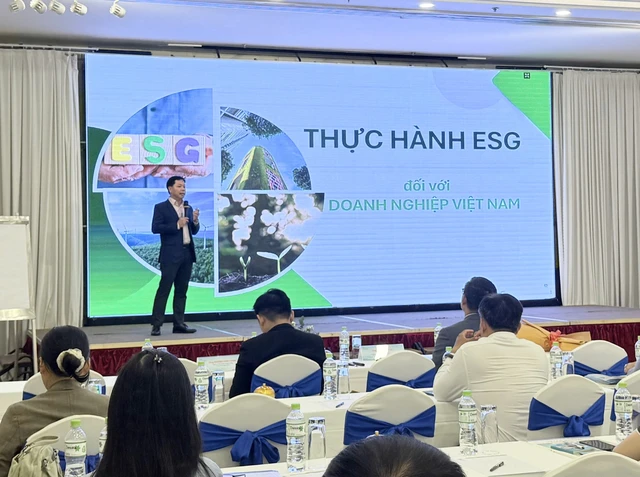
A photo supplied by event organizers shows an expert sharing his experience in implementing ESG practices in hotel operations at a training course on practicing green and ESG standards in management in Ho Chi Minh City on August 20, 2026.
The Ho Chi Minh City Department of Tourism on Thursday organized a training course on practicing green and ESG standards in management, which saw the participation of nearly 200 participants from hotels and accommodation establishments across the city.
The course was the first of a three-part training series aimed at improving management, operations and service development in the hotel sector in line with green standards and international integration trends.
Going green to cut costs
According to the Ho Chi Minh City Department of Tourism, the city welcomed more than 7.1 million international visitors and nearly 31.7 million domestic tourists in the first seven months of 2026.
Total tourism revenue was estimated at more than VND237 trillion (US$9 billion), up 55.3 percent from the same period in 2025.
Revenue from accommodation and food services exceeded VND139 trillion ($5.3 billion), up 13.7 percent, with accommodation services alone rising 12 percent.
The market’s growth is also placing new demands on accommodation providers.
Along with amenities and service quality, hotels must consider the efficient use of energy and resources, waste reduction and the environmental impact of their operations.
Le Truong Hien Hoa, deputy director of the Ho Chi Minh City Department of Tourism, said ESG should not simply be viewed as a set of criteria for obtaining certification.
More importantly, environmental, social and governance principles need to be translated into concrete solutions for management and operations.
Effective ESG practices can not only help protect the environment but also reduce business costs, improve service quality and create a competitive advantage.
According to an ESG practice report by the Vietnam Cleaner Production Center Co., Ltd. (VNCPC), an accommodation facility can directly save 13,504 kWh of electricity simply by reducing energy consumption in its lighting system.
Other solutions can start with very specific areas, such as optimizing ventilation for air-conditioner outdoor units, managing kitchen waste and adjusting water flow in urinals and hand-washing faucets.
The application of building management systems and smart measurement tools can also help hotels monitor energy consumption intensity and identify areas where resources are still being wasted.
Wooden room keys
An example shared by Thai Phuoc Vu, general manager of Novotel Saigon Centre, at the training program showed that the green transition can begin with very small changes.
The hotel has replaced plastic room keys with wooden ones and eliminated single-use plastic bottles in favor of glass bottles, while encouraging guests to reuse towels and bed linens.
Bathroom amenities have also been switched from small plastic bottles to larger dispensers to reduce the amount of packaging used.
Of particular note is how the hotel handles organic waste from its kitchen.
After being sorted, leftover food and fruit peels are sent to a partner for processing using black soldier fly technology.
The biomass generated through the process is then used as feed for free-range chicken farms.
Eggs from these farms are subsequently supplied back to the hotel’s restaurants.
Thus, leftover kitchen food is turned into part of a closed-loop process that both reduces the amount of waste requiring disposal and creates a source of ingredients for the hotel’s business operations.
Challenges of going green
According to Dr. Le Xuan Thinh of VNCPC, one of the challenges businesses face is that ESG data is often scattered across different departments.
Companies should not begin by “writing an ESG report” to track and communicate their environmental, social and governance performance.
Instead, they should first review the data they already have and determine who collects, verifies, compiles and approves it.
Accommodation establishments do not necessarily need to have complete data in their first report.
What matters is using the current situation as a baseline for setting improvement targets for the next phase and identifying data gaps.
For Thai Phuoc Vu, general manager of Novotel Saigon Centre, another major challenge is the initial capital expenditure (CAPEX).
Rather than viewing green criteria as an expense, managers need to demonstrate the return on investment (ROI) and long-term value generated by such solutions.
Changing the habits of employees and guests is also a challenge.
Sustainable practices need to be incorporated into standard operating procedures, daily briefings and performance evaluation systems so that they become part of routine work.
For guests, Vu said hotels need to carefully encourage their participation in the green journey without making them feel that they have to sacrifice comfort during their stay.

A tag in a hotel room in Hong Kong reads, “Stay green with us. If you want your linens changed, please put this on your pillow,” encouraging guests to avoid unnecessary linen changes. Photo: Dong Nguyen / Tuoi Tre News.
The Ho Chi Minh City Department of Tourism’s training series will continue on August 25 with a focus on customer experience management, intercultural communication and situation handling in hotels, addressing the characteristics, behaviors and expectations of international visitors, as well as skills for handling situations in guest services.
On September 8, a session on hotel operations and service provision is scheduled to update participants on management and operational trends and solutions to improve service quality in line with green standards and sustainable development.
Through the series, the Ho Chi Minh City Department of Tourism aims to connect management agencies, experts, businesses and training institutions, contributing to improving the quality of the hospitality workforce and the competitiveness of the city’s accommodation sector.









Max: 1500 characters
There are no comments yet. Be the first to comment.