


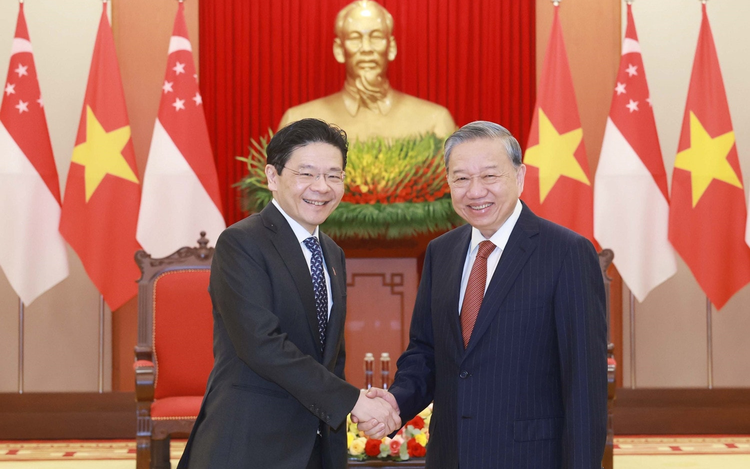
Vietnamese Party General Secretary To Lam receives Prime Minister of Singapore Lawrence Wong in March 2025. Photo: Thong Nhat / Vietnam News Agency
Pang Te Cheng, Consul General of Singapore in Ho Chi Minh City, sat down for an interview with Tuoi Tre News this month about the exciting journey of this relationship.
The interview is part of the first episode of The City Connect, a dialogue series debuted by Tuoi Tre News in September.
The conversation has been lightly edited for clarity and flow.
First things first, looking specifically at the Southern Economic Zone, trade and investment between our two nations have hit record heights. In your opinion, what is the fundamental pillar that has kept this trust and commercial momentum so robust year after year?
If I had to sum it up in one word, it would probably be 'complementarity' -- specifically, complementarity backed by trust and delivery. Over the course of development, Singapore has been able to contribute in various areas that Vietnam needed during different stages: in the earlier stages, industrial parks, urban solutions, finance and capital, services, and education and training.
Now, we are moving into newer areas like advanced manufacturing, the digital economy, low-carbon energy, and financial services. This is not a one-way relationship. Vietnam also offers our businesses a fast-growing market, a strong talent base, competitive manufacturing, and an increasingly critical supply chain. Both sides bring something valuable to the table.
Another very important factor regarding delivery is that both sides consistently convert political commitments into practical results. In March of last year, we elevated our relationship to a comprehensive strategic partnership.
A few months later, we agreed on a plan of action for it. Just this year, we have seen concrete results in cooperation across supply chain resilience, agrifood, and advanced manufacturing. Additionally, new VSIP developments have been approved, and the Vietnam International Financial Center was inaugurated.
When cooperation leads to fruitful, realistic results, trust grows. That builds the confidence required for both sides to accomplish even more together.
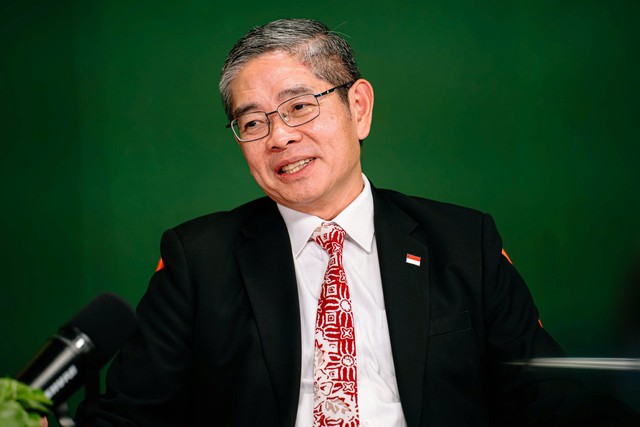
Pang Te Cheng, Consul General of Singapore in Ho Chi Minh City, is the guest speaker of the first episode of The City Connect, a dialogue series debuted by Tuoi Tre News in September 2026. Photo: Thanh Hiep / Tuoi Tre News
Pillar of success: Evolution of VSIP model
Let us turn to the cornerstone of our bilateral economic cooperation: the Vietnam-Singapore Industrial Park (VSIP) model, conceived in the 1990s through the shared vision of late Prime Minister Vo Van Kiet and late Minister Mentor Lee Kuan Yew. This initiative has expanded into dozens of projects nationwide. From your perspective, what has made this model such an enduring success rather than just a standard industrial park?
I think there are several reasons.
First is the strong partnership. On the Singaporean side, it is Sembcorp Development, and on the Vietnamese side, it is Becamex IDC from Binh Duong [now part of Ho Chi Minh City]. Both are formidable players. Over the past 30 years or so, they have worked exceptionally well together, forging genuine trust and building a resilient relationship.
Second, VSIP has maintained strict commercial discipline. They expand only when there is real market demand, making it a model that works in practice, not just on paper.
Third, of course, is the robust government support from both sides, especially from Vietnamese national and local authorities.
Finally, the model continues to evolve and adapt. Over the past 30 years, it has expanded to a nationwide portfolio of nearly 30 industrial and urban development projects. It used to provide basic utilities and reliable services.
Today, it has moved up the value chain toward integrated solutions. The newer generation -- what they call VSIP 2.0 -- is smarter, greener, and more technology-focused, with greater emphasis on digital infrastructure, low-carbon energy, and advanced manufacturing.
In short, the model succeeded because it was not frozen in 1996; it continues to adapt to meet the needs of modern investors and Vietnam's future.
The concept of VSIP as an evolving ecosystem rather than a standard industrial park is compelling. Bilateral economic ties have clearly grown hand in hand with deep political trust. Recent high-level visits, including those by Vietnam's Party General Secretary and State President To Lam and Standing Member of the Secretariat Tran Cam Tu, have reaffirmed this alignment. Alongside high-level diplomacy, VSIP stands as the most tangible symbol of this economic partnership. What does the combination of these high-level visits and the ongoing growth of VSIP signal about the future of our relations?
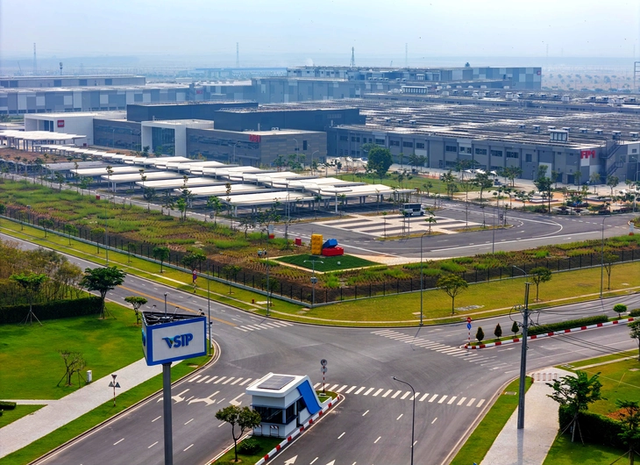
Infrastructure is underway at the VSIP III industrial park in Ho Chi Minh City as several factories begin operations. Photo: Tuoi Tre
VSIP is an iconic bilateral project, and we are celebrating its 30th anniversary this year. Beyond VSIP, however, we are also accelerating cooperation in other sectors, such as renewable energy.
There is an ongoing project off the coast of Ba Ria–Vung Tau [currently part of Ho Chi Minh City] to develop offshore wind power for export to Singapore. Singapore plans to import this renewable, low-carbon energy via subsea cables.
This project can help Vietnam develop a domestic renewable energy supply chain, including manufacturing wind turbines, subsea cables, and offshore platforms -- the entire ecosystem.
While economic relations remain fundamental, people-to-people ties are becoming equally vital. Governments can build frameworks and businesses can launch projects, but deep human connections are what make a relationship durable over time.
According to the Vietnamese Embassy in Singapore, at least 20,000 Vietnamese currently live, study, or work in Singapore, many with their families. I frequently encounter Vietnamese professionals who studied in Singapore 20 or 30 years ago, worked there for a time, and have since returned to contribute to Vietnam's economic development.
I take great pride in Singapore playing a part in nurturing Vietnamese talent, especially when they return home carrying a bit of Singapore's DNA with them. Those bonds are long-lasting.
Regional synergy of new Ho Chi Minh City
Ho Chi Minh City's development landscape is entering a new cycle, restructured as an expanded metropolitan region that connects the urban core with the industrial hub of Binh Duong and the maritime gateway of Ba Ria–Vung Tau. From the perspective of Singapore -- a country with deep expertise in industrial zones and port logistics -- what breakthroughs can this regional expansion bring to our bilateral economic and political cooperation?
The expanded Ho Chi Minh City region integrates different parts of the value chain that used to operate separately: a manufacturing powerhouse, a deep-sea maritime hub, and Ho Chi Minh City's large consumer market, financial system, talent pool, and tech ecosystem.
In Binh Duong, we have VSIP; in Cai Mep, PSA International has an established port presence. In Ho Chi Minh City proper, we are seeing fresh investments, such as UOB's US$450 million UOB Plaza project, which broke ground in July within the designated financial district. We are also seeing new ventures like Sembcorp's data center in the Saigon Hi-Tech Park.
The opportunity lies in integrating these pieces: linking advanced manufacturing directly with port logistics, research, and innovation. For instance, Singapore's Agency for Science, Technology and Research (A*STAR) Advanced Remanufacturing and Technology Centre (ARTC) is partnering with Becamex to establish the Vietnam Advanced Manufacturing Center.
Urban planning is another high-potential area. As Ho Chi Minh City develops its metro system, transit-oriented development (TOD) projects and underground space utilization will become priorities. These are areas where Singaporean firms and public agencies can share practical experience and advisory expertise.
It is not about one isolated project; it is about combining ports, finance, talent, education, and energy into an integrated solution.
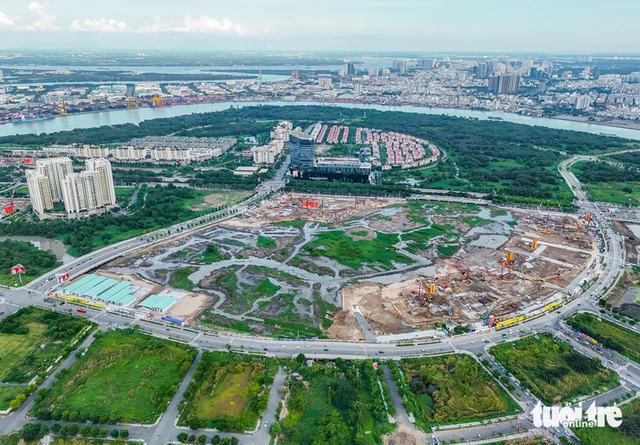
The greater Ho Chi Minh City region reflects seamless connectivity linking manufacturing hubs, maritime gateways, and financial districts. Photo: Chau Tuan / Tuoi Tre
Alongside expanding its economic footprint, Ho Chi Minh City is focusing significant effort on becoming an international financial center. As a leading global hub, how can Singapore support Ho Chi Minh City, from sharing regulatory sandbox expertise and capital flow governance to connecting fintech and green finance ecosystems?
Support can be delivered across three dimensions: experience, institutions, and connectivity.
First, experience: Singapore and Vietnam have held productive discussions, and we stand ready to support the development of the Vietnam International Financial Center (VIFC).
Singapore has operated as an international financial center for decades, learning valuable lessons along the way, both positive and negative. We are glad to share these insights to shorten Ho Chi Minh City's learning curve in market supervision, capital market structures, and risk management.
The Monetary Authority of Singapore and the Ministry of Finance of Vietnam have already engaged in substantive discussions on regulatory frameworks.
Second, institutions: A financial center is not just real estate, office towers, or tax incentives. It requires trusted institutions, a sound regulatory regime, and enforceable dispute-resolution mechanisms.
Singapore and Vietnam are actively collaborating on this. During Party General Secretary To Lam's visit, an MOU was signed to assist Vietnam in setting up an arbitration framework for the VIFC.
Recently, representatives from the Vietnam International Arbitration Center visited Singapore during Singapore Convention Week to discuss arbitration reforms directly with our legal experts.
Third, connectivity: Vietnam can leverage Singapore's capital markets, financial services, and professional networks to deepen its bond and equity markets. UOB, DBS, and OCBC all maintain an active presence here with strong credit profiles.
Furthermore, because the VIFC is exploring common-law elements, Singapore's long track record operating under a common-law commercial regime offers useful, direct reference points.
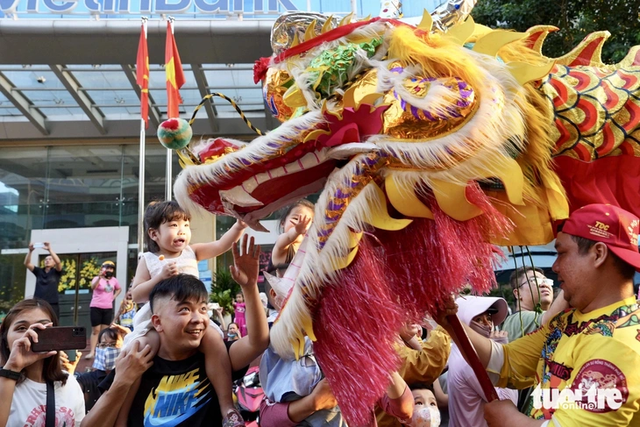
Locals enjoy a lion, dragon, and unicorn dance during the street art parade at the 2024 Lantern Festival in then-District 5, Ho Chi Minh City. Photo: Huu Hanh / Tuoi Tre
Beyond business: Life in Ho Chi Minh City
On a more personal note, you have lived and worked right here in Ho Chi Minh City for over two years. What has your personal experience been like immersing yourself in the city's energy?
It has been an enriching, fast-paced experience. Ho Chi Minh City is exceptionally dynamic; everything and everyone is constantly on the move, navigating the traffic and chasing the next opportunity.
In my role, I meet people across every sector, government officials, founders, students, diplomats, and academics. They are open, eager to share their perspectives, and frequently challenge my assumptions in constructive ways.
I have also gained a deeper appreciation for how Vietnamese society functions. It offers a fascinating contrast: economically, it is modern and fast-moving, but socially, it remains anchored in traditional values. Family, personal relationships, and trust carry enormous weight. That balance is distinct to Vietnam.
Every Southeast Asian city has its own rhythm. When you have a rare quiet weekend, how do you like to spend your time? Are there specific neighborhoods that have left an impression on you?
I keep things relatively simple. During downtime, I focus on fitness: hitting the gym, visiting the driving range, or playing a round of golf. One new sport I picked up in Ho Chi Minh City is pickleball. It has been great learning something new at this stage, and it has introduced me to people outside my professional circle -- locals, expats, and overseas Vietnamese (Viet Kieu) alike. Hearing their perspectives on life and work here is always illuminating.
I also enjoy cycling through the city, mainly [former] District 1, parts of Thu Duc along the Saigon River, Thao Dien, and the Sala urban area, just watching street life unfold. On quiet afternoons, I stay in, listen to music, or read.
Like many residents here, I love the local cafe culture. I often explore spots in Thao Dien, [former] District 7, and [former] District 1. I also venture into [former] District 5 (Cho Lon) for the food scene; the Chinese-Vietnamese cuisine there has distinct profiles that closely resemble Singaporean dishes, making it my go-to when I crave a taste of home.
Beyond the places themselves, people define the character of a city. What stands out to you most about the people you interact with daily, from officials and founders to local baristas and students?
Curiosity and optimism. The people here are genuinely eager to listen, learn, and seek out opportunities. There is a widespread, grounded belief that the future can be better, coupled with a drive to actively build it. They are hardworking and remarkably resilient. Vietnam and Ho Chi Minh City have developed at an extraordinary pace, and you feel that momentum whether you speak to senior officials, startup founders, or university students.
To conclude, what message would you share with the entrepreneurs, students, and citizens of both nations working toward a shared future?
My message is primarily for the younger generation: the next chapter of this relationship will be written by you. It will be defined by the companies you build, the research you lead, the ideas you exchange, and the friendships you maintain.
If we continue deepening our people-to-people ties, we create greater opportunities for both nations to grow together, deliver tangible benefits to our citizens, and strengthen the broader ASEAN community. It all circles back to the core idea of true complementarity.
Thank you very much, Consul General Pang! It has been an inspiring conversation!








Max: 1500 characters
There are no comments yet. Be the first to comment.