


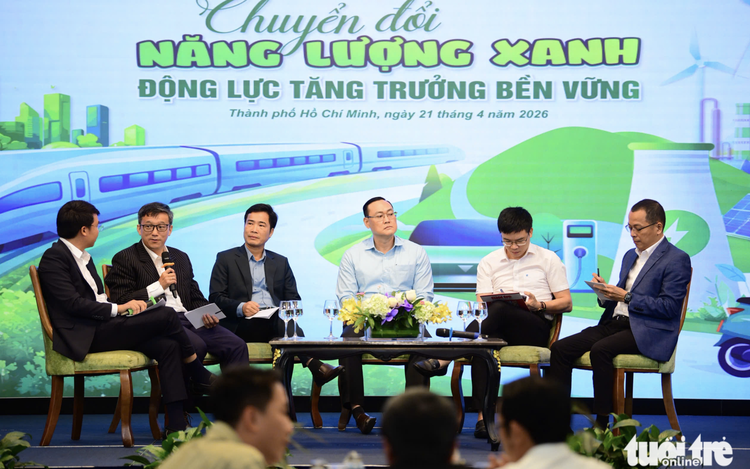
Speakers discuss green transition at a conference titled ‘Green Energy Transition - The Driver of Sustainable Growth,’ held in Ho Chi Minh City on April 21, 2026. Photo: Quang Dinh / Tuoi Tre
At a discussion session, as part of the ‘Green Energy Transition - The Driver of Sustainable Growth’ conference, held in Ho Chi Minh City on Tuesday, business leaders shared practical strategies for cutting emissions, optimizing energy use, and adapting to a more sustainable development model.
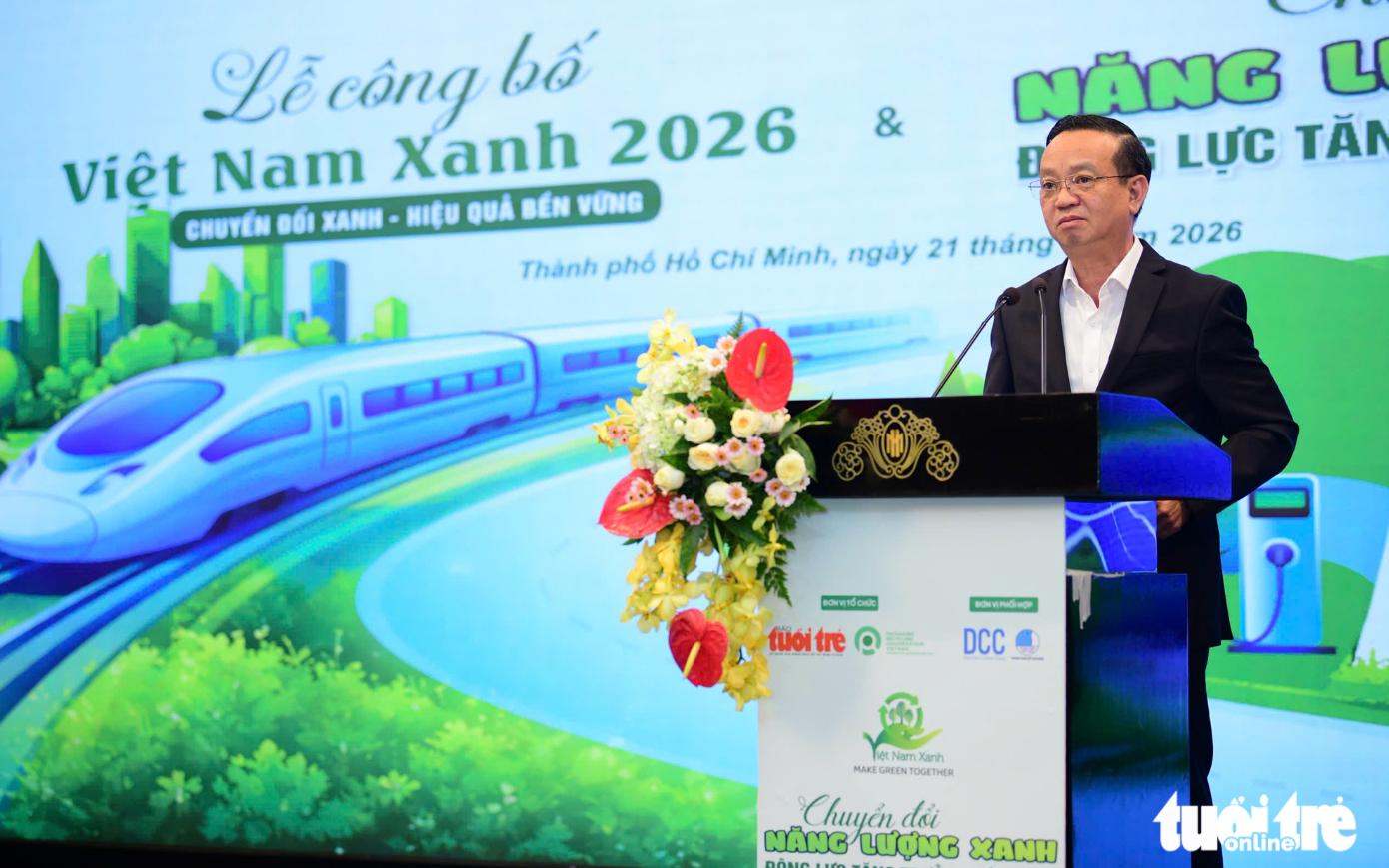
The conference was co-organized by the Ministry of Trade and Industry, the municipal administration, and Tuoi Tre (Youth) newspaper, marking the launch of the ‘Green Vietnam 2026’ campaign.
Despite persistent barriers in technology and cost, the green transition is already unlocking new avenues for growth.
Vo Van Huy Hoang, strategy and digital transformation director at Vinasoy, said that sustainability is no longer optional, but it is imperative.
He noted that the soybean industry holds a natural advantage beginning at the raw material stage.
Soybeans can fix nitrogen in the soil, improving fertility and reducing reliance on chemical fertilizers, he shared.
This ‘greenization’ process has been extended to operational activities.
“With a network of factories spanning the northern, central, and southern regions, we focus on optimizing the supply chain through solutions that save water and energy, control emissions, and minimize empty runs in logistics,” Hoang said.
The company has also invested in rooftop solar power systems across its facilities, significantly reducing carbon dioxide emissions.
Le Quoc Thuan, business director at Signify Vietnam, said that energy efficiency is emerging as a critical intersection between environmental responsibility and economic performance.
He highlighted the rapid advancement of lighting technologies.
Modern lighting systems now deliver efficiencies up to 20 times greater than traditional incandescent bulbs.
While earlier transitions focused on LED adoption, newer LED technologies can cut electricity consumption by around 70 percent compared to fluorescent lighting.
“This allows both businesses and consumers to significantly reduce energy costs while maintaining performance,” Thuan explained.
“Additionally, newer lighting products are designed for longer lifespans, reducing waste and improving operational efficiency."
Meanwhile, Le Ngoc Anh Minh, chairman of the Vietnam ASEAN Hydrogen Club, said Vietnam has already outlined clear hydrogen development goals for 2030 and 2050.
However, significant challenges remain, including high technology costs, the need for clean electricity inputs, incomplete policy frameworks, and the high cost of water electrolysis.
These factors have stalled many hydrogen projects worldwide.
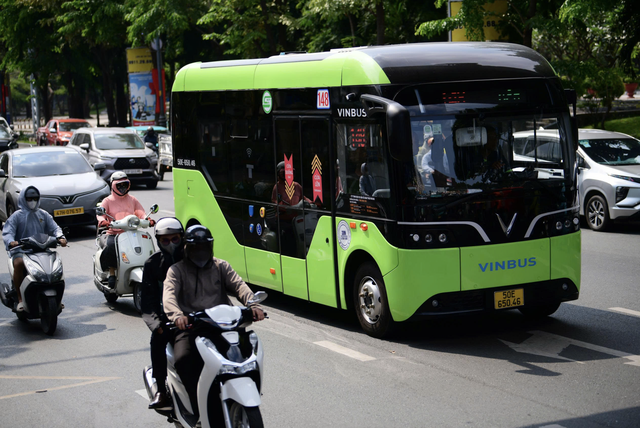
Electric buses help reduce urban pollution and are being widely used. Photo: Quang Dinh / Tuoi Tre
Ho Chi Minh City speeds up green transition
VinEnergo, a member of Vingroup, known as a notable player in renewable energy development, is pursuing large-scale wind and solar power projects across provinces such as Ha Tinh, Gia Lai, Dien Bien, and Lai Chau.
VinEnergo has also deployed advanced battery energy storage systems (BESS) produced by VinFast, forming a comprehensive green energy ecosystem that ensures stable and clean electricity supply while easing pressure on the national grid.
The firm has partnered with international stakeholders to expand renewable energy projects into regions including North America, Northern Europe, the Mediterranean, and Southeast Asia.
Within the next three years, the company aims to build a global project portfolio with a total capacity of up to 100 GW, with initial developments already underway in the Philippines, Denmark, and Sweden.
Cao Tung Son, deputy head of the Ho Chi Minh City environmental protection agency, identified traffic, industrial activity, and residential life as the three primary sources of pollution.
To address this, the southern metropolis is implementing a range of coordinated measures.
In transportation, low-emission zones will be piloted before broader expansion.
Authorities are also accelerating the transition to electric vehicles, targeting the full electrification of public and service transport by 2030.
Personal vehicles that fail to meet emissions standards will face gradual restrictions, with early implementation planned in areas such as Can Gio and Con Dao Special Zone, aiming for completion by 2027.
In addition, the city is promoting cleaner fuels, including E10 biofuel gasoline, as an interim solution for curbing transport emissions.
In the industrial sector, regulatory approaches are shifting from retrospective inspections to continuous monitoring.
Major emission sources are now required to install automated monitoring systems that transmit real-time data directly to authorities.
Over the long term, Ho Chi Minh City plans to relocate polluting industrial facilities away from residential areas and unsuitable zones.
The reclaimed land will be prioritized for public spaces and green areas, contributing to improved urban living conditions.
Moreover, environmental transparency is being enhanced.
Monitoring data will be integrated into a ‘digital citizen’ application, enabling residents to track environmental quality in real time.








Max: 1500 characters
There are no comments yet. Be the first to comment.