


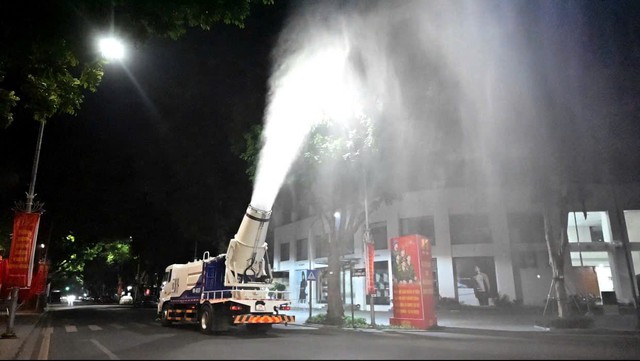
Hanoi Urban Environment Company (URENCO) conducts training on dust-suppression misting operations on streets within Ring Road 1 in Hanoi. Photo: URENCO
Ring Road 1 is a key route connecting Hanoi’s central areas and runs through the inner city, along Tran Khat Chan, Dai Co Viet, Xa Dan, Hoang Cau and Voi Phuc streets.
The training aims to improve operating skills, assess equipment performance, evaluate its practical applicability and refine deployment plans, helping reduce air pollution during the dry season.
URENCO previously proposed that the city deploy three specialized dust-suppression misting vehicles on six roads within Ring Road 1, operating from 11:00 pm to 6:00 am the following day.
Unlike traditional street washers, these specialized vehicles shoot high-pressure ultra-fine mist into the air, binding with airborne PM2.5 dust particles and forcing them to settle onto the ground.
Besides URENCO, Thanh Cong Cooperative has also been spraying mist to suppress dust in Thanh Xuan Ward twice a week, on Thursdays and Sundays, since late September.
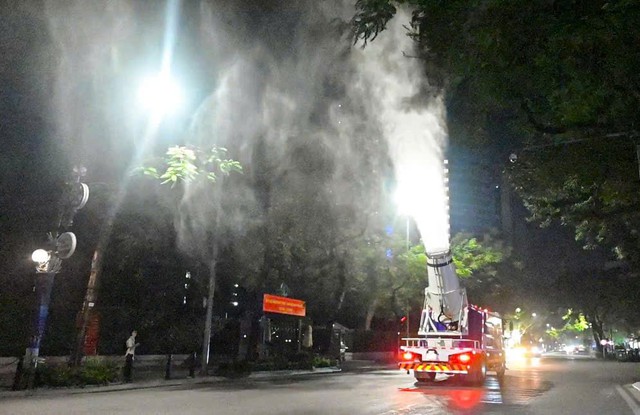
Specialized vehicles spray mist to suppress dust, alongside water spraying, street washing and vacuum sweeping. Photo: URENCO
PM2.5 fine dust is the main source Hanoi’s air pollution
Nguyen Minh Tan, deputy director of the Hanoi Department of Agriculture and Environment, said air pollution in the capital is mainly caused by PM2.5 fine particulate matter.
From 2023 to 2025, the annual average PM2.5 concentration frequently exceeded 40 micrograms per cubic meter (µg/m³), reaching 48.5 µg/m³ in 2025.
Pollution is concentrated during the dry season, which generally runs from September through April of the following year.
Tan said air quality during the first nine months of 2026 had improved significantly compared with the same period last year.
From January 1 to September 29, the proportion of days with good or moderate air quality reached 74.42 percent, nearing the target of more than 75 percent for the whole of 2026.
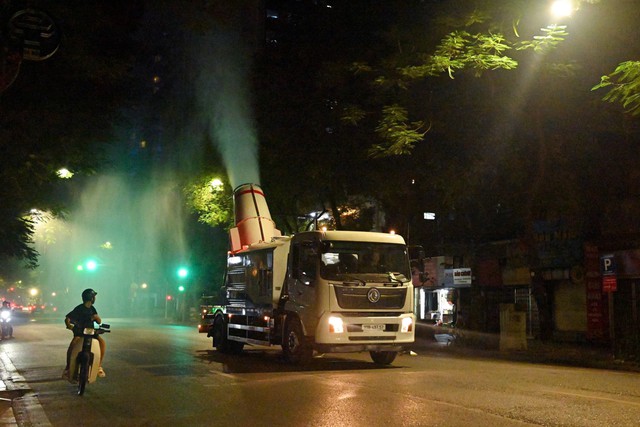
A man turns to look at a dust-suppression misting vehicle on a Hanoi street. Photo: URENCO
The reported daily average PM2.5 concentration stood at 37.89 µg/m³, below the limit of 45 µg/m³ set by national technical regulation on air quality QCVN 05:2023/BTNMT.
However, pollution episodes typically begin to emerge in October, particularly from November through March of the following year.
Hanoi identifies this as a period of heightened air pollution risk that requires focused control measures.
The city has identified three main sources of emissions that need to be addressed, including traffic, construction activities and uncontrolled open burning.
In the transport sector, a key concern is dust being kicked up from road surfaces in areas with heavy traffic.
Meanwhile, open burning needs to be controlled, particularly during the harvest season for crops.
Hanoi is also strengthening coordination with the Ministry of Agriculture and Environment and other provinces and cities in the region to share information and respond to air pollution during the dry season.
The municipal Department of Agriculture and Environment is advising the city on a plan to strengthen measures to control and respond to air pollution across Hanoi.
- REFERENCE MORE
- REFERENCE MORE
- REFERENCE MORE









Max: 1500 characters
There are no comments yet. Be the first to comment.