


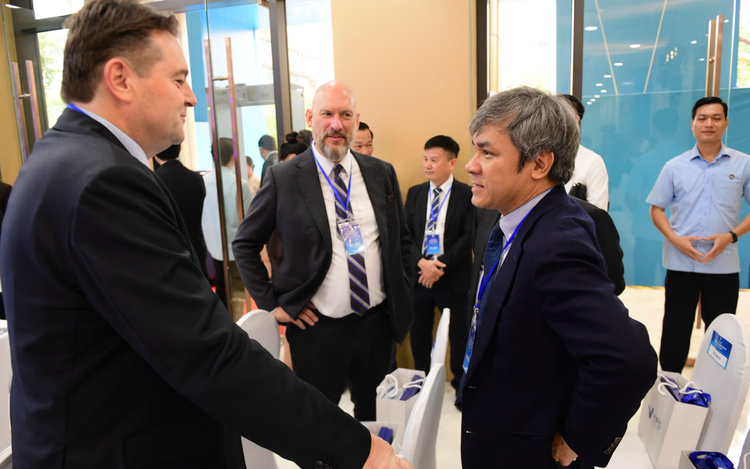
Richard McClellan (C), CEO of the Vietnam International Financial Center in Ho Chi Minh City, at a recent event in the city. Photo: Quang Dinh / Tuoi Tre
Richard McClellan, CEO of the center, told Tuoi Tre (Youth) online newspaper that the city’s improving position in global financial rankings was helping raise its profile and attract greater attention from the international financial community.
Ho Chi Minh City ranked 67th in the latest index, while also remaining among the financial centers expected to increase in importance in the coming years.
The results indicate that the city is gaining greater recognition internationally.
For a young international financial center such as the Ho Chi Minh City-based one, maintaining a presence and improving its position in a global ranking helps generate interest among international financial institutions and investors, said McClellan.
However, the more important task is to turn that interest into tangible market outcomes.
“We should not view rankings as an end in themselves,” he stressed.
“For a new financial center, a ranking is simply one indicator that international markets are beginning to take an interest in and recognize the foundations we are building.”
The true value of a financial center lies in its ability to build confidence, attract financial institutions, connect investors and ultimately generate real capital flows, financial products and transactions.
The ranking represents a step forward in international recognition, but the more important next step is to translate that recognition into genuine market competitiveness.
“The Ho Chi Minh City financial center needs to continue building an environment in which international financial institutions, investors and businesses can see clear opportunities to participate, invest, raise capital and conduct cross-border financial activities,” McClellan said.
More channels for international capital
To turn international attention into actual capital flows, Ho Chi Minh City is gradually moving the center from institution-building to operations and the preparation of specific market activities.
These developments signal that the financial center is beginning to establish a foundation for connecting international sources of capital with the city’s development needs, according to McClellan.
The National Assembly’s Resolution 222/2025 and related decrees have established a framework covering organizational arrangements, financial and banking policies, foreign exchange and dispute resolution.
The official launch of the center in Ho Chi Minh City in February, together with the introduction of procedures for registration and recognition of members, also gives financial institutions a clearer basis for considering participation and developing operational plans.
The new mechanisms are also increasingly linking the center with the city’s capital-raising requirements and broader development strategy.
The Urban Development Law, for example, allows the Ho Chi Minh City People’s Council to regulate the issuance of municipal and project bonds at the center, while establishing connections with the free-trade zone, logistics facilities, open ports and high-tech parks.
McClellan said these mechanisms could create additional channels for mobilizing international resources for infrastructure and other priority sectors in Ho Chi Minh City.
The city is also preparing the groundwork for international bonds, municipal bonds and capital mobilization for infrastructure projects.
Meanwhile, the center is expanding cooperation with international financial institutions, banks, professional organizations and universities, while also establishing an advisory group.
These partnerships are expected to bring international experience and standards into product development, capital-market connectivity and talent training, strengthening the operational capacity of the city’s financial ecosystem.
“These developments are helping make Ho Chi Minh City’s development prospects clearer to the international financial community,” McClellan said.
“The institutional framework is becoming more concrete, and access to sources of capital is expanding, while the conditions for market development are gradually being put in place.”
3 priorities for financial center
The Global Financial Centres Index evaluates financial centers across multiple groups of factors, demonstrating that competitiveness does not stem from a handful of indicators or individual products but from an entire ecosystem.
From this perspective, McClellan said the financial center in the southern metropolis should focus on three priorities in the next phase.
The first is to build a stable, transparent and highly predictable institutional environment, with clear regulations, one-stop mechanisms and consistent procedures to facilitate the participation of international financial institutions.
The second is to develop financial and technological infrastructure.
This goes beyond physical facilities to encompass data, payment systems, risk management, cybersecurity and the systems required to support modern financial activities.
The third is to develop high-quality human resources, particularly professionals capable of working across borders, familiar with international standards and equipped with expertise in finance, investment, law, accounting, risk management and technology.








Max: 1500 characters
There are no comments yet. Be the first to comment.