



Students at an elementary school in Ho Chi Minh City. Photo: Thao Thuong / Tuoi Tre
For the 2026-27 school year, which is set to start in early September, students in the southern metropolis have a growing range of English-learning options at school.
The programs differ in instructional time, organization and content, making it difficult for parents to determine which one best suits their children.
Tuoi Tre (Youth) online newspaper on Tuesday spoke with an English specialist, teachers and parents whose children have experienced different programs to provide parents with more information before making a choice.
How many periods of intensive English do students take?
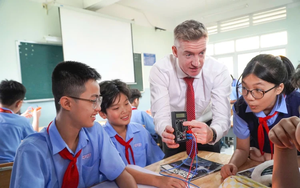
An English specialist from the Ho Chi Minh City Department of Education and Training said students enrolled in the intensive English program can study up to eight English periods per week, taught by both foreign and Vietnamese teachers.
At the elementary level, first- and second-graders study a maximum of six periods per week.
Two periods are elective English familiarization classes under the 2018 general education program, while the remaining four are additional intensive English periods.
For grades 3, 4 and 5, students can study up to eight periods per week, including four periods under the 2018 general education program and four additional periods.
At the secondary level, the intensive English program provides a maximum of seven periods per week, comprising three periods under the general education program and four additional periods.
"Amid the international integration and the goal of making English a second language in schools, intensive English has become the choice of many parents in Ho Chi Minh City who want their children to have a good English-learning environment within the public-school system," the specialist said.


Enrollment is voluntary, while schools have flexibility in their admission criteria.
Each year, schools assess students' performance and may remove those who are unable to keep up with the program.
The program aims for learning outcomes comparable to the levels represented by Cambridge English qualifications such as Starters, Movers and Flyers, the specialist added.
The most noticeable difference between intensive English and the standard English curriculum under the 2018 general education program is therefore the greater amount of instructional time.
The program is also delivered within public schools and involves both Vietnamese and foreign teachers.
iSMART, I-CLC: learning English through math, science
Alongside intensive English, some schools offer programs such as iSMART and I-CLC.
Doan Diem My, whose child has studied I-CLC for two years at Chu Van An Secondary School in Cau Ong Lanh Ward, said the program combines English, mathematics and experimental science.
Foreign teachers teach two periods per week using a separate set of textbooks provided by the organization working with the school, she said.
She noted that these programs take a different approach from English instruction focused primarily on grammar and vocabulary.
"iSMART, I-CLC and similar English programs basically belong to the same type, but they use different teaching materials provided by the organizations working with schools," My said.
"The common feature is that students learn English vocabulary and structures through subjects such as mathematics and science instead of studying grammar alone.
“This allows them to learn the language while also developing their understanding and thinking in the natural sciences."
Enrollment in these programs is voluntary, she said.
Under this approach, English serves as a tool for learning additional mathematical and scientific knowledge.
Students develop language skills while becoming familiar with terminology and ways of expressing concepts related to other subjects.
Parents should note that iSMART, I-CLC and similar programs are not necessarily identical in terms of curricula, teaching materials or the organizations involved.
Before enrolling their children, parents should find out exactly which program is being offered at their child's school.
Tuition is another major concern for parents
Ai My, a secondary-school teacher in Ho Chi Minh City who has served as a homeroom teacher for many years, said fees for additional foreign-language instruction are determined for each school year based on the fee framework issued by the municipal Department of Education and Training.
In general, fees for intensive foreign-language instruction are capped at VND100,000 (US$3.8) per month for elementary students, VND200,000 ($7.6) per month for secondary students and VND300,000 ($11.4) per month for high-school students.
When choosing an English program for their children, parents should look beyond the program's name.
The number of instructional periods, teaching approach, teachers, learning materials, fees and the student's ability to keep up with the program are all factors that should be considered.
In particular, for voluntary programs, parents should carefully examine the actual content and organization of the program at their child's school before enrolling.
Ultimately, the goal is not simply to increase the number of English periods, but to create an environment in which students can use English in a way that matches their abilities, needs and educational goals.








Max: 1500 characters
There are no comments yet. Be the first to comment.