


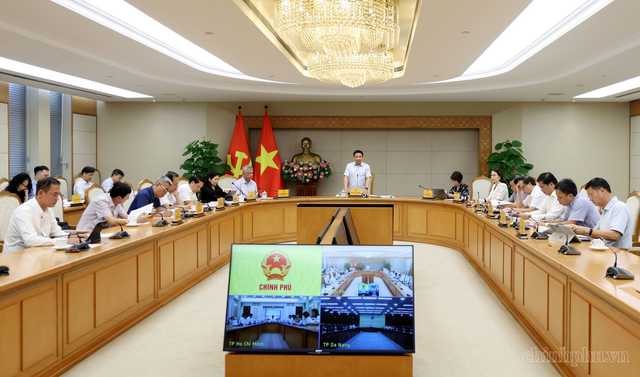
Deputy Prime Minister Nguyen Van Thang chairs the meeting. Photo: VGP
The information was announced at the third meeting of the Executive Council of Vietnam International Financial Center on Monday afternoon, chaired by Deputy Prime Minister Nguyen Van Thang and held online with Ho Chi Minh City and Da Nang.
Reporting at the meeting, Nguyen Thi Bich Ngoc, deputy minister of finance, said the institutional framework and organizational structure of the financial center had basically been established.
Moving from establishment to practical operations
Vietnam officially launched VIFC, with operations spanning Ho Chi Minh City and Da Nang, as part of its ambition to establish a regional financial hub and attract international capital, with the Da Nang center inaugurated on January 9 and the Ho Chi Minh City location officially launched on February 11.
Six groups of products and services have been proposed for the financial center, including investment funds and asset management, real-world asset-backed digital assets, international carbon credits, commodity and derivatives trading infrastructure linked to trade and supply-chain financing, fintech, and bond issuance.
As these product groups are at different stages of readiness, they will be rolled out in phases rather than simultaneously.
In the immediate term, the Ministry of Finance has proposed focusing on three key programs: selecting a number of energy, infrastructure, logistics and green-transition projects in cooperation with partner banks and strategic investors; developing an ecosystem for international investment funds and asset management; and developing commodity markets linked to trade and supply-chain financing.
The ministry also proposed continuing to operate the financial center under the current model while establishing common standards for services, procedures, data and coordination between Ho Chi Minh City and Da Nang.
The aim is to ensure that VIFC in Vietnam operates as a single entity rather than developing into two separate markets.
A representative of the center's executive authority in Ho Chi Minh City said the city was shifting from the establishment phase to 'practical operations,' with a focus on four pillars: institutions, members, products, and infrastructure.
Of the seven procedures that need to be issued, the procedure for admitting members was completed in August, while the remaining six are expected to be finalized in September and October.
Ho Chi Minh City is also screening potential members, with a focus on selecting organizations tied to specific products and real-economy projects instead of expanding membership indiscriminately.
Between now and early 2027, around seven to 12 members are expected to be licensed, with each linked to specific products and objectives.
Regarding products, the city is working with investors to mobilize capital for infrastructure projects and preparing the groundwork for international and municipal bond issuance.
A pipeline of more than 21 projects has been prepared, of which five to seven projects with high feasibility are expected to be selected for priority promotion to strategic investors.
Meanwhile, the executive authority in Da Nang said it was focusing on implementing several specific projects.
The two executive authorities are also coordinating to finalize procedures, criteria for selecting members and the necessary legal framework, following the principle that VIFC is a unified entity while allowing each locality to capitalize on its own strengths.
Specific products, deals expected by November
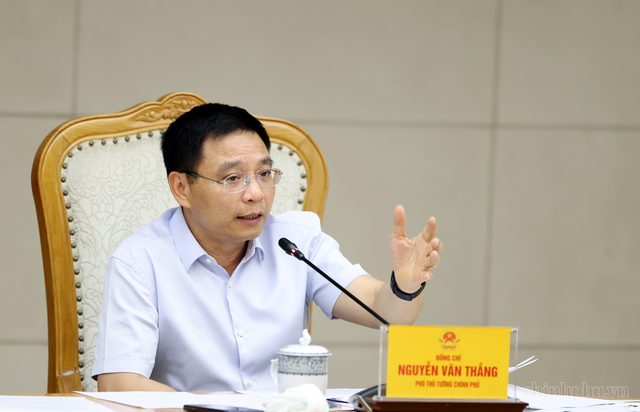
Deputy Prime Minister Nguyen Van Thang. Photo: VGP
Concluding the meeting, Deputy Prime Minister Nguyen Van Thang stressed that establishing and putting VIFC into operation was an important task that needed to be carried out urgently, comprehensively and substantively.
The executive authorities in Ho Chi Minh City and Da Nang have officially begun operating, so they should not wait until all conditions are fully completed before taking action, he said.
Instead, institutional development should proceed in parallel with the selection of products that already have both supply and demand so that the authorities can work and negotiate with investors.
Thang urged the executive authorities to proactively work with investment funds and businesses.
Products that are ready and meet all necessary conditions should be proposed for immediate implementation.
For the development of financial products, the government should clearly identify the mechanisms and policies required for each product, the drafting agency, the authority responsible for issuing regulations and the implementation deadline so that progress can be monitored.
At the same time, a feasible and effective inspection, examination and supervision mechanism should be established without creating excessive additional procedures.
Thang asked the two executive authorities to urgently complete the conditions needed for the center to operate fully, while simultaneously finalizing its institutions, organizational structure and human resources and negotiating and bringing deals to fruition.
By November, the two executive authorities must have specific products and deals in place, he said.
Regarding information technology infrastructure, Thang assigned the executive authority in Ho Chi Minh City to consider hiring consultants to develop the architectural design for VIFC's IT platform.








Max: 1500 characters
There are no comments yet. Be the first to comment.