


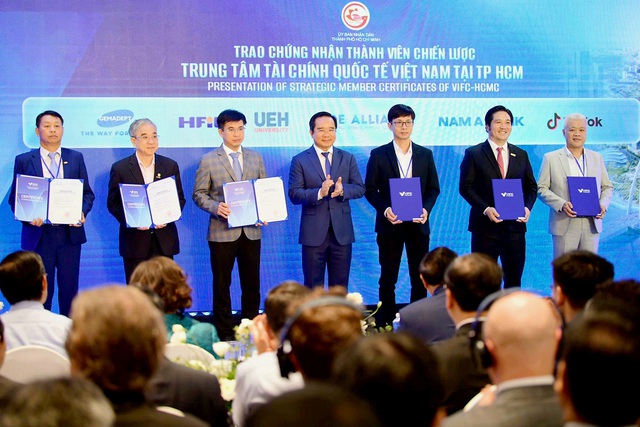
Nguyen Van Duoc (C), chairman of the Ho Chi Minh City People’s Committee, presents certificates of strategic membership for Vietnam International Finance Center-Ho Chi Minh City. Photo: Quang Dinh / Tuoi Tre
Speaking to Tuoi Tre (Youth) newspaper, Pham Nguyen Thanh Tam, vice-president of product and technology at Hydra X Pte Ltd, a Singapore-headquartered fintech group, said Vietnam’s advantage lies in its ability to design a new financial center model from the ground up, leveraging emerging technologies and financial trends.
Vietnam enters the race at a time when several major trends including artificial intelligence, digital infrastructure, cross-border payments, green finance, and digital assets are developing simultaneously.
This creates a late-mover advantage for Vietnam to build a modern financial ecosystem from the beginning if the country clearly defines which standards must align with global norms and where it can innovate.
However, she emphasized that institutional trust and execution capacity are decisive factors in attracting international investors.

Pham Nguyen Thanh Tam, vice-president of product and technology at Hydra X Pte Ltd, a Singapore-headquartered Fintech group
Institutional trust, she explained, is built not by eliminating risks but by demonstrating that risks are managed through transparent and consistent systems.
For an IFC, this requires clear rules, transparent operations, and effective enforcement.
The way early disputes are resolved will shape investor confidence more than initial incentives.
Vietnam’s biggest challenge, Tam said, is translating determination into a clear framework for cross-border financial operations.
The system must be strong at its core, including transparent rules, consistent oversight and accountability, while being flexible at the edges to allow different levels of risk under a unified operating structure.
Vietnam, she said, does not need to make everything perfect immediately.
Instead, it should focus on maintaining consistency in core principles while expanding gradually.
International financial centers are typically anchored in a specific city. For Vietnam, that role is widely expected to fall to Ho Chi Minh City.
She emphasized that Ho Chi Minh City must combine ‘hardware’ such as transport, airports, and office infrastructure with ‘software’ like digital systems, payment networks, international connections, and efficient procedures.
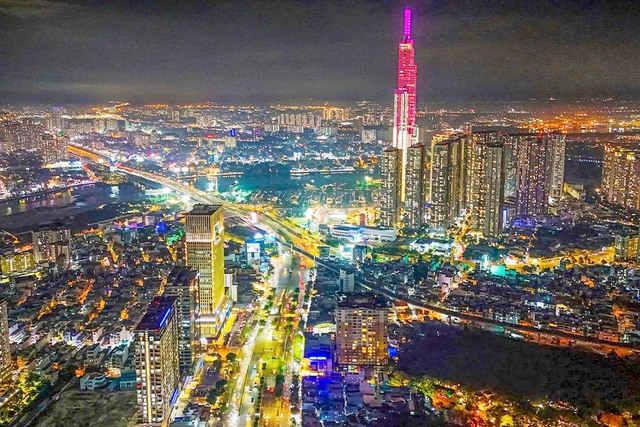
An aerial view of Ho Chi Minh City. Photo: Quang Dinh / Tuoi Tre
An IFC, she said, is not just about skyscrapers and capital flows but about a city with both physical strength and institutional maturity.
Tam also warned that IFCs risk attracting capital that circulates only within secondary financial transactions without benefiting the real economy.
To avoid this, Vietnam should prioritize core products tied directly to trade and enterprise activity, such as export-import payments, invoice financing, and transport settlements.
She added that investors need clear exit routes through IPOs or mergers and acquisitions to recycle capital and talent for future growth.
The Hydra X executive concluded that a sustainable IFC must accept volatility but manage it within a clear governance framework, with layered risk controls, real-time monitoring, and sandbox testing for new activities.








Max: 1500 characters
There are no comments yet. Be the first to comment.