


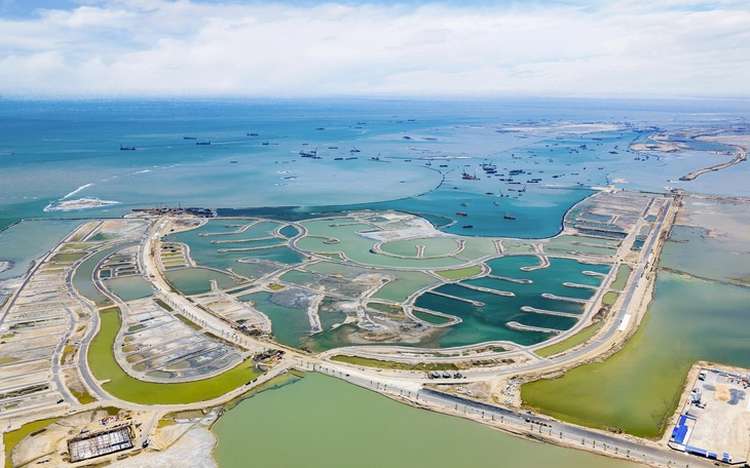
The Can Gio land-reclamation urban project. The Urban Development Law opens the way for modern marine economic models, including modern, green and smart land-reclamation projects. Photo: Chau Tuan / Tuoi Tre
The law gives the city broader authority over staffing, urban planning, TOD projects, land reclamation, free trade zones and policy pilots, while introducing tougher measures to enforce urban regulations.
30 days to close legal gaps
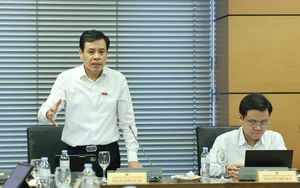
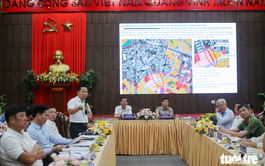
Chairman of the Ho Chi Minh City People’s Committee Nguyen Van Duoc launched the campaign at a conference on Wednesday, saying that implementing the law is not merely a legal exercise but a particularly important political task aimed at developing the city in the new era.
The goal is to help Ho Chi Minh City accelerate growth, strengthen its role as a leading growth engine and innovation center, and improve local governance.
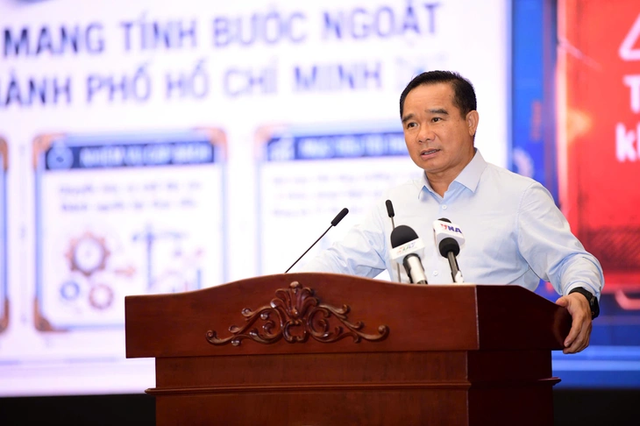
Chairman of the Ho Chi Minh City People’s Committee Nguyen Van Duoc launches a 30-day campaign to accelerate the issuance of documents guiding implementation of the Urban Development Law. Photo: Quang Dinh / Tuoi Tre
He ordered agencies to clarify personnel, tasks, timelines, responsibilities, deliverables and authority. He also warned against shifting responsibilities between agencies, overlapping functions and delays.
The city is expected to quickly put new mechanisms covering decentralization, marine, underground and above-ground spaces, transit-oriented development (TOD), free trade zones, digital logistics and regulatory sandboxes into operation.
Under the city's implementation plan, work is divided into three broad areas: public communication and dissemination of the law; drafting and issuing legal documents; and exercising the powers assigned under the law.
Drafting and issuing documents guiding the implementation of the law is considered the most urgent task.
The city wants the entire system of detailed legal documents to be in force on October 1, avoiding any gap between the effective date of the law and its implementing regulations.
Officials measured by results
The 30-day drive will continue as an emulation campaign through the end of 2026, with the first phase focused on completing the legal framework and the second on putting the new regulations into practice.
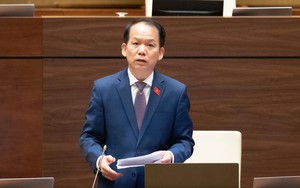
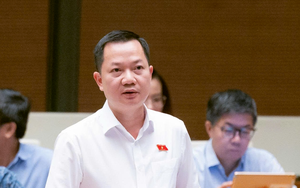
Performance will be tied to key performance indicators (KPIs) for agency and unit heads, with an emphasis on measurable results rather than simply completing procedures.
The campaign is open not only to officials and public employees but also to experts, scientists, lecturers, lawyers, legal professionals, residents, overseas Vietnamese and businesses.
Individuals and organizations that deliver outstanding results or develop effective innovative solutions may receive certificates of merit from the city.
The Department of Home Affairs will monitor the performance of agency heads. Units that exceed deadlines may receive rewards, while those that fall behind or fail to complete their tasks may be criticized and excluded from awards.
Turning new powers into action
Duoc ordered departments and agencies to take direct responsibility for both the quality and progress of draft regulations, working with the municipal People's Council and Department of Justice from the earliest drafting stages.
For policies with complicated or far-reaching effects, agencies must conduct careful impact assessments and coordinate closely with relevant ministries.
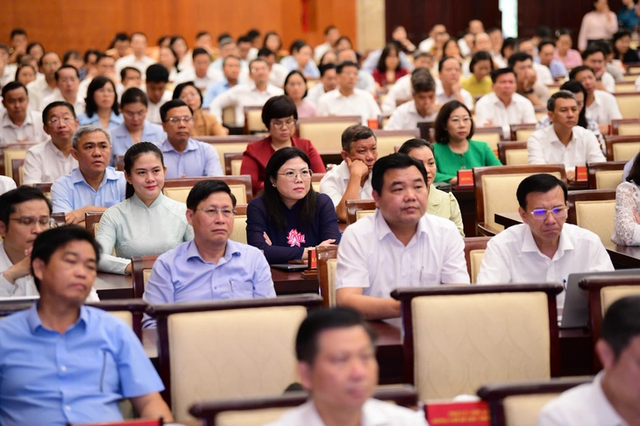
Delegates attend a conference on the implementation of the Urban Development Law on August 26, 2026. Photo: Quang Dinh / Tuoi Tre
The Department of Justice will monitor implementation on a daily and weekly basis and report periodically to the chairman, while the Department of Finance will ensure funding for institutional development work.
The standing board and committees of the People's Council have been asked to engage with drafting agencies early in the process.
Vietnam’s National Assembly passed the Urban Development Law on August 24 with a majority of attending lawmakers voting in favor.
The law is expected to give Ho Chi Minh City greater flexibility in governance, resource mobilization and urban development while creating a framework that could also be used by other cities and special economic zones.
Greater control over staffing, agencies
A central feature of the law is comprehensive decentralization and a clearer division of authority between the central government and city authorities.
For Ho Chi Minh City and other special-grade cities covered by the law, the municipal People's Council will have greater powers to determine how the local administration operates.
The city may increase its total number of civil servants and public employees by up to 20 percent above the number assigned by the central government, provided it can finance the additional salaries from its own budget.
It will also be able to decide on the establishment, reorganization and dissolution of specialized agencies and other administrative organizations under its management, as well as set income policies for civil servants and public employees using local funds.
The city may also pilot new mechanisms and policies that differ from existing laws or National Assembly resolutions, or address areas not yet regulated by law. Such pilots can last for up to five years, excluding defense, security, foreign affairs and religious matters.
One integrated plan, wider room for TOD
The law seeks to reduce overlapping planning layers by requiring a single integrated city master plan.
The plan will cover the city's underground, low-rise and high-rise spaces, providing a single framework for managing development across different layers of the urban environment.
TOD is also given a clearer legal basis.
The city may use its own budget for separate compensation, assistance and resettlement projects to acquire land and create clean land funds around railway stations and depots. Those land funds can then be auctioned or used to make payments to investors under build-transfer contracts.
Land-use quotas in TOD areas may be set higher than general planning standards, and planned land-use quotas may be transferred.

A container ship in waters off Vung Tau, Ho Chi Minh City. Photo: Quang Dinh / Tuoi Tre
Land reclamation, free trade zones, casinos
The law creates new room for large-scale economic and urban development projects.
Land-reclamation projects: Modern, green and smart urban projects built through land reclamation will be permitted, with strategic investors eligible for project terms of up to 70 years.
Free trade zones and integrated logistics: Goods and services exchanged between eligible functional areas under non-tariff arrangements can receive preferential tax treatment.
Businesses inside free trade zones may also list, price and settle transactions with one another in foreign currencies through bank transfers.
Casinos in special economic zones: Strategic investors developing high-end integrated tourism complexes with casinos and investment capital of at least US$2 billion may count capital already disbursed for related infrastructure and urban projects in the special economic zone toward the investment requirement for a casino business license.
Legal safeguards for officials taking risks
The law also introduces legal safeguards to encourage officials to experiment with new policies and pursue innovative solutions.
Heads of agencies and organizations, civil servants and public employees involved in drafting implementation documents or piloting new policies may be exempt from legal liability when they act without personal gain, follow the required authority and procedures, but losses nevertheless occur.
Officials who cause losses while carrying out duties assigned by superiors for the common good may also be considered for exemption if competent authorities determine that their actions were not motivated by personal gain and were aimed at the development of the city or a special economic zone.
The mechanism is intended to give officials greater confidence to make decisions, innovate and pursue breakthrough approaches without being paralyzed by the possibility of unintended losses.

Residents complete land-related procedures at Land Registration Office No. 2 in Ho Chi Minh City. Photo: Quang Dinh / Tuoi Tre
Special economic zones enter legal framework
For the first time, the law establishes a dedicated framework for special economic zones, defined as communes, wards or special administrative units meeting criteria including a strategic location, an international airport or a Class-I seaport.
Authorities in these zones will receive greater autonomy over investment, land and planning.
To attract highly qualified experts and talent, provincial-level People's Councils may use public funds to develop social housing for experts to rent or buy, provide free health checkups for them and their families at public hospitals, and waive tuition fees at public schools for their biological or adopted children under 18.
Foreign tourists and people waiting to leave Vietnam who visit special economic zones will also be eligible for enhanced duty-free shopping policies.
Tougher enforcement of urban rules
The law combines greater development flexibility with stronger enforcement powers.
The municipal People's Council may regulate the immediate suspension of electricity and water supplies to construction works that violate planning rules, lack permits or fail to comply with their permits, as well as works built on encroached or illegally occupied land.
Dance clubs and karaoke establishments that fail to meet fire prevention and firefighting safety requirements, as well as manufacturing and business establishments that seriously violate environmental protection regulations and refuse to comply with orders suspending their operations, will also be subject to the same measure.
The city may also impose administrative fines of up to twice the national limits for violations in areas including land, construction, environmental protection, fire prevention and firefighting, and transportation.








Max: 1500 characters
There are no comments yet. Be the first to comment.