


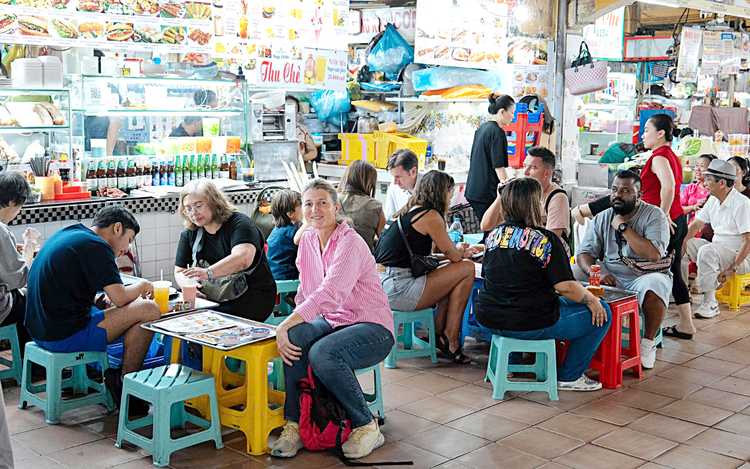
Foreign tourists explore nighttime dining at Ben Thanh Market in Ho Chi Minh City. Photo: Huu Hanh / Tuoi Tre
At the event, several participating experts and industry representatives laid out a roadmap for transforming the city after dark.
Removing bottlenecks, integrating nighttime activities into modern urban landscape
Nguyen Nguyen Phuong, deputy director of the municipal Department of Industry and Trade, acknowledged that while policies supporting the nighttime economy have been consistently promoted from central to local levels, implementation remains the biggest hurdle.
A key issue is the absence of a designated agency to act as a ‘commander-in-chief’ overseeing and coordinating nighttime economic activities across the city, he noted.
Although numerous proposals and programs have been drafted, only a limited number have been successfully implemented.
The challenge lies not in a lack of ideas or resources, but in regulatory bottlenecks.
Current legal frameworks do not clearly distinguish between daytime and nighttime activities.
Sectors integral to the night economy such as food services, entertainment, and alcohol-related businesses are still governed by regulations designed for daytime operations, complicating licensing procedures and limiting innovation.
Associate Professor Dr. Dinh Tien Minh from the School of Business under the University of Economics Ho Chi Minh City emphasized that the city possesses significant advantages as it is Vietnam’s largest economic, commercial, service, and tourism hub, with a vibrant urban lifestyle, strong purchasing power, and rich cultural and culinary assets.
Demand is fueled by both residents and tourists.
However, the city’s nighttime economy remains underdeveloped, characterized by fragmented offerings, lack of dedicated spaces, weak connectivity, and limited product diversity.
Concerns over public safety, noise, waste management, and counterfeit goods persist, while governance mechanisms remain incomplete.
“Viewing the nighttime economy simply as extending business hours is far too narrow,” he said.
“It should be understood as a comprehensive urban experience ecosystem, encompassing spatial planning, experience design, security, night transport, environmental management, cultural programming, and city branding.”
Turning culture into measurable value
Vo Viet Hoa, director of the outbound tourism division of Saigontourist, described the nighttime economy as the ‘missing link’ in Ho Chi Minh City’s current tourism product structure.
He stressed that offerings must reflect the city’s unique identity instead of replicating models from other regional destinations.
He proposed developing two product segments: high-end experiences tailored for business and MICE travelers, and mass-market offerings centered on street food and sidewalk culture.
It is vital to map out a comprehensive master plan that prioritizes transport infrastructure and connectivity between attractions and safety.
Organizing night spaces into clusters would enable the creation of seamless night tours, extending visitor stays and boosting spending, Hoa said.
Tran Le Nguyen Khang, deputy head of retail operations at SATRA, highlighted the importance of extending the ‘daily consumption cycle’ of tourists.
Integrating sightseeing, dining, and shopping into cohesive packages, developed in partnership with travel companies, could unlock cross-sector value chains.
He also pointed to the need to expand the evening economy beyond physical spaces into e-commerce and digital platforms, supported by strong coordination between businesses, tourism authorities, and regulators.
Meanwhile, Luu Nhat Tuan, vice-president of the Ho Chi Minh City Food Association, underscored the absence of a clear overarching design guiding development.
He called for the establishment of a dedicated inter-agency steering body to unify efforts across tourism, cuisine, culture, and entertainment.
Such coordination would enable synchronized resource deployment and facilitate the development of integrated ‘all-in-one’ nighttime zones combining dining, art shows, shopping, and entertainment.
Pilot projects in selected areas could serve as testing grounds for scalable models.
Ensuring benefits for residents
Nguyen Quoc Ky, chairman of the Vietnam Culinary Culture Association and Vietravel, urged a broader reassessment of the city’s development philosophy.
He stressed the importance of defining a clear cultural identity rather than pursuing scattered initiatives.
He proposed a framework built on three pillars – interaction, dynamism, and openness – emphasizing flexibility, diversity, and experiential value.
When the nighttime economy pays off, it will benefit residents in Ho Chi Minh City.
“We must turn culture into economic value,” he said, advocating for a multi-axis economic model that strengthens regional connectivity and builds a large-scale urban tourism ecosystem.
Nguyen Thi Thanh Thao from the municipal Department of Tourism noted that a new tourism development plan through 2030 is being drafted, expanding beyond the city center following a recent administrative merger.
The new Ho Chi Minh City was formed by merging the old city with Binh Duong and Ba Ria-Vung Tau Provinces in July last year.
In 2026, the department will conduct surveys on tourist spending patterns to guide business strategies.
“In developing the nighttime economy, it is not sufficient to simply isolate models or focus solely on investment, as the fundamental foundation remains the local community,” Thao said.
It is essential to avoid negative impacts and ensure that residents truly benefit, she underlined.
Nighttime Economy: Driving growth in Ho Chi Minh City
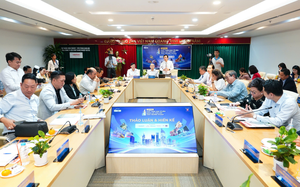
To identify bottlenecks and unlock resources for the nighttime economy, Tuoi Tre (Youth) newspaper and the Ho Chi Minh City Food Association co-hosted a thematic seminar titled 'Nighttime Economy: Driving Growth in Ho Chi Minh City' on Wednesday in Ho Chi Minh City.
The event was held as the city is drafting a special urban law and a resolution on specific policy mechanisms, creating opportunities for the city to proactively plan, attract investment, and develop its evening economy.
The seminar brought together government officials, policymakers, leading economists, the Ho Chi Minh City Food Association, and representatives of major companies such as Saigontourist Group, Vietravel, Satra, and Viettel.
Discussions focused on spatial planning, diversifying culturally distinctive arts and entertainment products, and gathering direct feedback from businesses on policies for developing the nighttime economy.
The event was expected to showcase successful international models and propose effective pilot roadmaps, helping position the night economy as a new growth engine for the city.









Max: 1500 characters
There are no comments yet. Be the first to comment.