


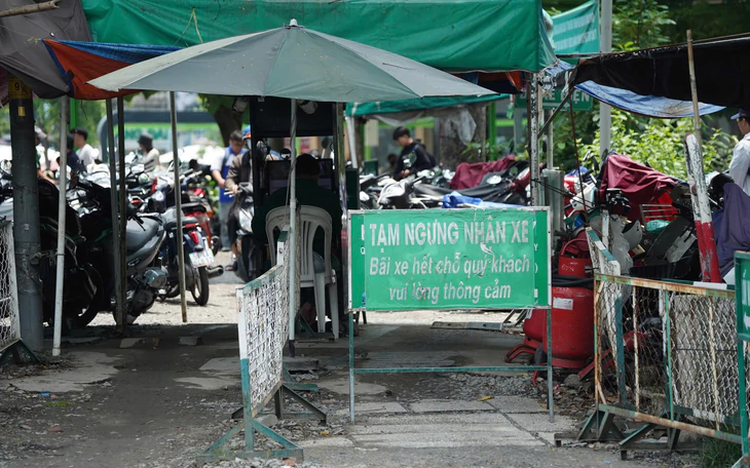
Parking lots in downtown Ho Chi Minh City are frequently full. Photo: Huu Duy / Tuoi Tre
The law allows Ho Chi Minh City to proactively arrange temporary facilities, including parking lots and public toilets, on public land.
Parking, public toilets in short supply downtown
On a recent weekend, Thu Thao and a group of friends drove to Nguyen Hue Walking Street but spent nearly 30 minutes looking for a parking space.
Parking lots in the downtown area quickly fill up when crowds arrive. Thao eventually had to drive around to find another private parking lot.
Parking a car for one or two hours can cost around VND20,000 (US$0.8), while the fee can rise to VND30,000-40,000 ($1.2-1.5) during holidays, the Lunar New Year or major events.
For visitors to downtown Ho Chi Minh City, finding a parking space may seem like a minor issue, but it can become one of the first things they need to plan. Thao’s experience is far from unusual.
Parking facilities around Ben Thanh Metro Station are frequently overcrowded, particularly during morning rush hours when commuters leave their vehicles before continuing their journeys by metro. At times, long lines of vehicles wait outside even though the parking lot is already full.
Truong Nhat, who regularly takes the metro to work, said there are days when he arrives to find no parking spaces available.
To avoid being late, he has had to use informal parking spots near Ben Thanh Market, paying around VND20,000-30,000 ($0.8-1.2) per visit.
“If the downtown area had more parking lots or expanded existing ones, accessing the metro would be more convenient, especially for people who commute to work or school every day,” Nhat said.
Parking is not the only essential need in the city center. Public toilets are another concern.
The public toilet at September 23 Park is relatively clean and does not appear to be heavily used, with most users being workers and ride-hailing drivers.
However, first-time visitors to Ho Chi Minh City may find it hard to spot a public toilet.
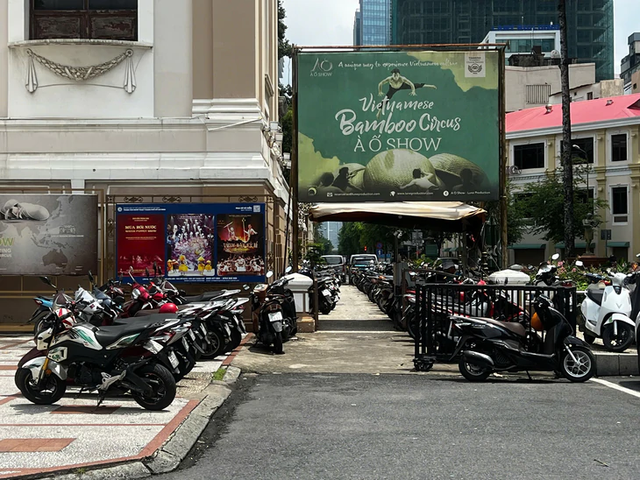
The parking lot at the Saigon Opera House is frequently overcrowded, forcing many people to park their vehicles on the theater’s grounds. Photo: Huu Duy / Tuoi Tre
Opening door to private investors in public facilities
Architect Huynh Xuan Thu said the mechanism under the Urban Development Law offers a different approach to the shortage of parking lots and public toilets in downtown areas.
Instead of waiting for major infrastructure projects, the city could review public land that is not being used effectively and identify locations with high demand for temporary facilities.
An unoccupied public site could be used as a temporary parking lot, while a suitable area in a park could accommodate a public toilet.
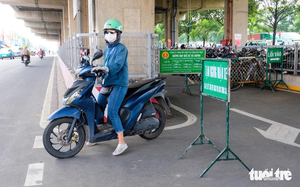
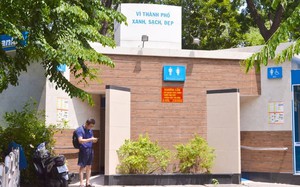
“These facilities can be designed to be assembled and dismantled, with minimal impact on urban spaces, and can be relocated when the land is needed for another purpose,” Thu suggested.
Architect Nguyen Dinh Hoa, an urban planning expert, said the Urban Development Law also opens opportunities to attract private investment, particularly for large-scale projects, alongside state resources.
Under the law, independent investment projects, or projects combining public green parks, public parking facilities and clean-energy infrastructure, with investment of VND2 trillion ($77 million) or more are included among the projects prioritized for strategic investors.
This means parking facilities do not necessarily have to be viewed solely as a budget expense. They can instead be incorporated into broader urban infrastructure development, combining parks, parking facilities, clean energy and urban services.
Under this approach, the key issues are how public land can be put to use, what sources of capital can be mobilized and how the facilities will be operated.
Hoa said that under the current mechanism, building more parking lots and public toilets is not necessarily a matter of a lack of land or funding, but of mobilizing resources from society.
Ho Chi Minh City could start by mapping locations where parking lots and public toilets are lacking around metro stations, walking streets, parks, public squares, tourist attractions and event venues.
The city could then identify public land lots that are temporarily unused.
“In places where demand is regular, the city could consider larger facilities with longer operating periods. Where demand rises sharply during festivals or events, more flexible temporary facilities could be arranged,” Hoa said.
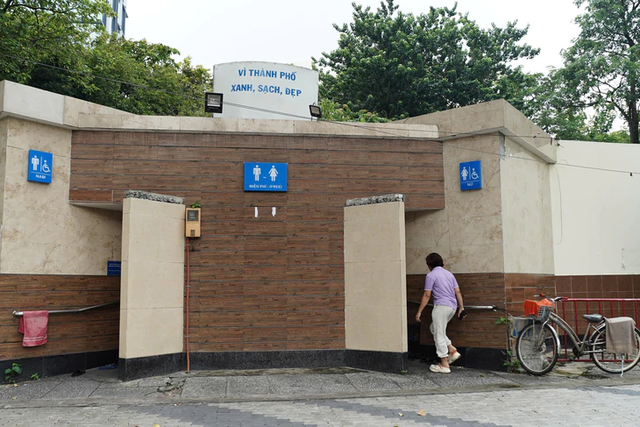
Ho Chi Minh City is building more public toilets, but the downtown area still faces a shortage. Photo: Huu Duy / Tuoi Tre
The 2026 Urban Development Law was passed by the National Assembly on August 24, 2026, and is scheduled to take effect on October 1, 2026.
The law gives Ho Chi Minh City greater authority to take the initiative in organizing urban spaces and developing infrastructure.
Notably, Article 14 gives the Ho Chi Minh City People’s Council the authority to set policies and measures for developing public passenger transport systems, bus stations and multifunctional parking facilities.
More importantly, the Ho Chi Minh City People’s Committee will be allowed to decide on the construction of temporary facilities without having to follow existing plans, including bus and parking facilities, smart parking structures, public toilets and electric vehicle charging stations.
These facilities can be built on state-managed public land, roads, parks as well as river and canal protection corridors, provided they ensure traffic order and safety, preserve urban aesthetics, maintain water flows and do not cause landslides.








Max: 1500 characters
There are no comments yet. Be the first to comment.