


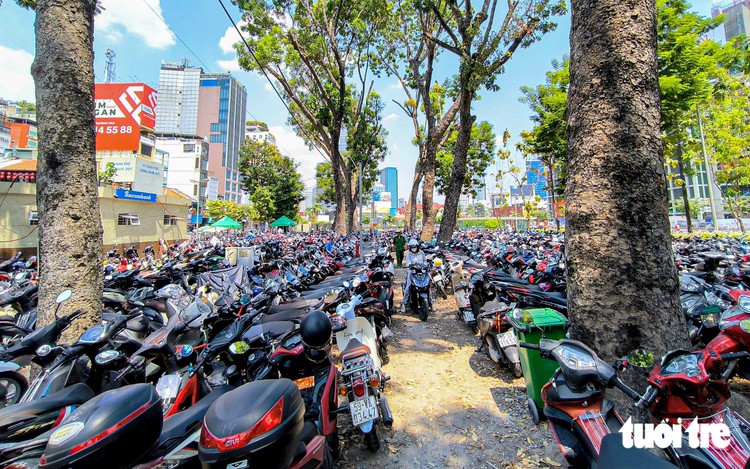
The parking lot for metro line No. 1 commuters in the September 23 Park area in Ho Chi Minh City is often packed, especially on weekends and holidays. Photo: Chau Tuan / Tuoi Tre
The law, which will take effect on October 1, is expected to help address major obstacles to parking projects, including limited land availability, high investment costs, and long capital recovery periods.
Under its Article 39, underground and multi-story parking facilities will be exempt from land rental and underground-space use fees for the entire project duration.
The law also allows investors to use up to 25 percent of a project's floor area for supporting services to generate additional revenue.
Businesses will also receive interest-rate support from the city budget and import-duty incentives for high-tech equipment used directly for the projects, according to the law.
Public parking projects with investment capital of at least VND2 trillion (US$77 million) will be included on a list of projects eligible for priority investment from strategic investors, with broader incentives.
Article 14 of the law also gives the municipal People's Council the authority to issue specific policies and measures to develop multifunctional parking facilities.
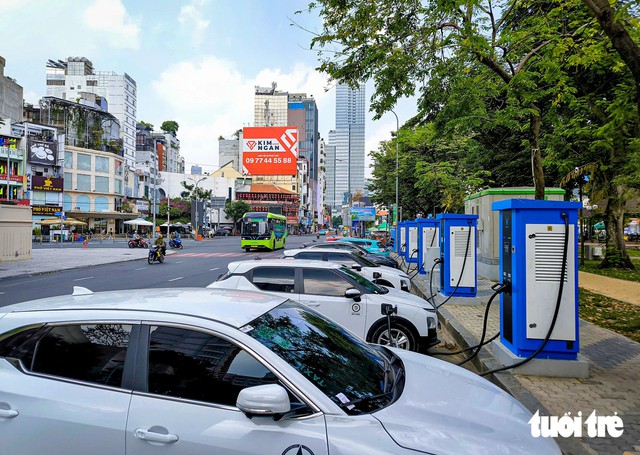
A charging and parking area for electric cars in Ho Chi Minh City. Photo: Chau Tuan / Tuoi Tre
A representative of the construction department said the agency is advising on and drafting a resolution on incentives for commercial facilities and underground spaces, including exemptions or reductions in land rental and underground-space use fees, interest-rate support, and import-duty incentives for high-tech equipment.
The new mechanisms are expected to help revive parking projects that have struggled to move forward in the city.
Several underground and multi-story parking projects had previously been considered at locations such as Le Van Tam Park, Trong Dong Theater and Tao Dan Park, but failed to proceed because land rental costs and proposed operating models were not attractive enough to offset investment costs.
At a September 8 meeting with the Ho Chi Minh City Business Association, chairman of the municipal administration Nguyen Van Duoc asked relevant departments to mulll over parking solutions tailored to different areas.
Areas around the airport with available land could be considered for elevated parking facilities, while underground parking combined with commercial and service facilities could be studied in central areas where land is scarce.
The city also needs to plan for connections between underground facilities from the outset, Duoc said.
For example, a metro station built first could later need to connect with a commercial project, potentially creating complications if the two facilities are managed by different investors and no connection mechanism has been established in advance.
Duoc asked relevant departments to complete the mechanisms needed to implement the Urban Development Law from October 1, including policies related to planning, land, taxation, and finance for parking facilities.
Vo Thanh Hai, chairman and CEO of Total Parking, a company specializing in consulting and manufacturing smart multi-story parking facilities, told Tuoi Tre (Youth) online newspaper that the law provides a policy framework for businesses to reconsider investments in multi-story parking facilities instead of relying solely on parking fees for revenue.
Hai said the law's provisions on multifunctional parking facilities, temporary structures on public land, land-rental exemptions and exemptions from underground-space use fees could improve the financial viability of such projects.
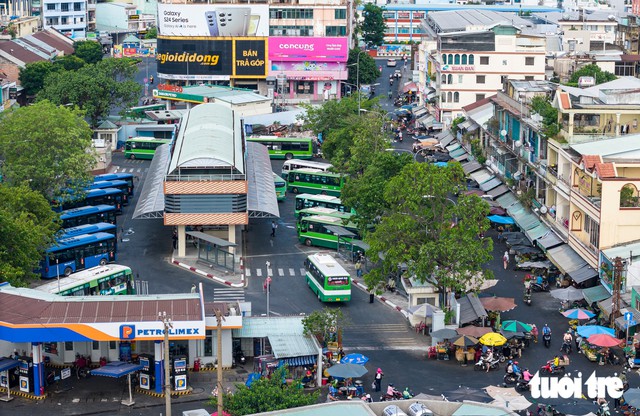
The Cho Lon bus station area in Ho Chi Minh City, which was once proposed as the site for a multi-story parking garage, has yet to see the project implemented. Photo: Chau Tuan / Tuoi Tre
The provision allowing investors to use up to 25 percent of floor area for supporting services could provide an additional source of revenue, while interest-rate support could reduce financing pressure during the initial stage.
However, Hai noted that the VND2 trillion investment threshold could affect the number of businesses eligible to attract strategic investors.
If a fixed requirement for investors to have at least 15-20 percent of the capital in equity is applied, the number of eligible businesses could be limited, he said.
Hai suggested that investors' capacity should instead be assessed comprehensively, including their ability to mobilize capital, obtain credit, secure bank guarantees, and manage cash flow.
"The appeal lies in the combination of incentives and clear procedures. If the time frame and level of support are reasonable, the policies can provide additional motivation for investors to participate," he said.
Total Parking and other businesses in the sector have proposed simplifying procedures for temporary, smart and modular parking facilities, facilitating changes in land-use purposes and planning approvals, and providing clearer planning frameworks.
For electric vehicle charging stations, businesses have suggested considering the land-rental exemption period based on the time needed to recover investment and providing corporate income tax incentives during the initial years.
Clear criteria, conditions, and procedures would help businesses make investment calculations and accelerate project implementation, businesses said.
- REFERENCE MORE
- REFERENCE MORE
- REFERENCE MORE








Max: 1500 characters
There are no comments yet. Be the first to comment.