


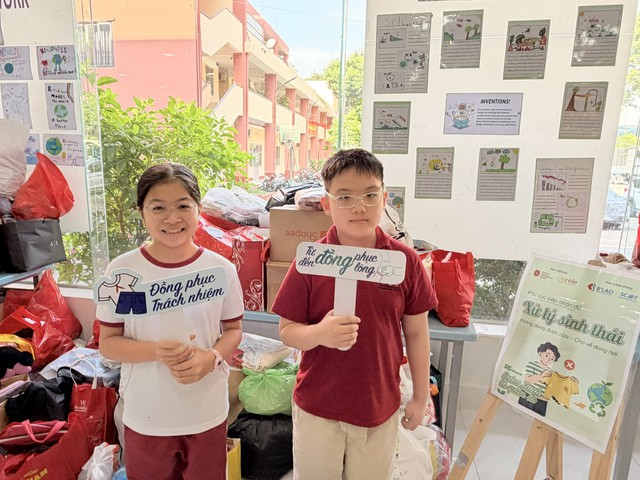
Tran Thi Thanh Binh (left) and Nguyen Ngoc Khang Nam, students at the Vietnam Australia International School’s Hoang Van Thu campus in Ho Chi Minh City, take part in a 'Green Detox for the Wardrobe' activity. Photo: Nghi Vu / Tuoi Tre
“I realized that we shouldn’t waste clothes, and that what we buy should be used for a longer time,” said Nguyen Ngoc Khang Nam, a fifth grader, after taking part in a lesson on the life cycle of fashion.
According to the United Nations, more than 92 million tonnes of textile waste is discarded globally each year, with only about 12 percent recycled.
The rapid rise of fast fashion, particularly low-cost clothing sold on e-commerce platforms, has made the handling of used garments increasingly challenging, including in Vietnam.
Amid these concerns, students at the Vietnam Australia International School (VAS) and several other schools in Ho Chi Minh City are being introduced to sustainable fashion consumption through a project called 'Green Detox for the Wardrobe.'
For clothes no longer suitable for use, the program guides students to recycle fabric scraps into gloves, socks, decorative items, or souvenirs.
When garments reach the end of their life cycle, students are encouraged to bring them to collection points, where they are transferred to units that process textiles in line with environmental standards.
As future consumers, students should be equipped with an awareness of responsible consumption, which is seen as more effective than trying to change long-established habits among older generations.
B’Lao – Scavi – Corèle Group, which is implementing the initiative, said school-based activities aim to help students build awareness and habits of responsible fashion consumption, thereby positively influencing future purchasing behavior.
According to the group, each student discards three to five kilograms of old clothing annually.
If not properly handled, this waste places a significant burden on the environment.
At a school with 8,000 students, if each discards five kilograms of uniforms per year, the total could reach 40 tonnes.
The company said it is also working on solutions by focusing on sustainable materials and designs tailored to the activities of Vietnamese students.
“When students have well-fitted and attractive uniforms, they tend to take better care of them,” a representative of the group said, adding that helps extend the lifespan of the garments and reduces both consumer and environmental costs.
Meanwhile, donating clothes that are no longer needed remains one of the easiest ways to handle old garments responsibly.
Sharing her experience from South Africa, Claire, an English and science teacher at VAS, said schools there often organize donation drives before winter for disadvantaged students.
Having lived in Vietnam for four years, she added that she continues to recycle clothes by bringing unwanted garments to collection points run by recycling organizations.








Max: 1500 characters
There are no comments yet. Be the first to comment.