


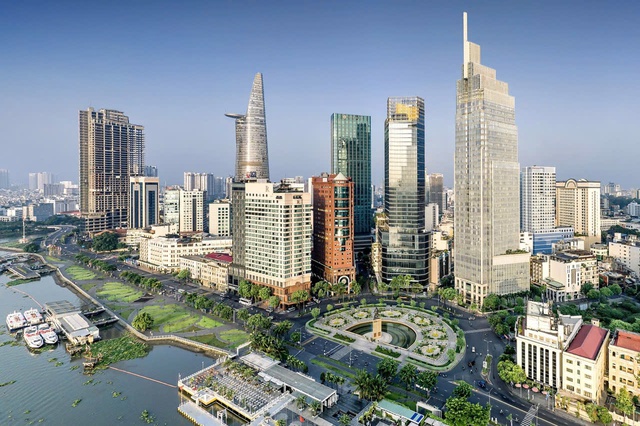
Office towers in the former District 1 area are seen as a prime location for Ho Chi Minh City's International Financial Center. Photo: Van Trung
The commitment was announced by Nguyen Cong Vinh, vice-chairman of the Ho Chi Minh City People's Committee, at a conference on Tuesday reviewing the city's financial sector performance in 2025 and outlining tasks for 2026.
Reporting on economic results in 2025, Vinh said the city's economic scale continued to expand strongly, with total output estimated at VND3.3 quadrillion (US$125.5 billion), accounting for 23.5 percent of national GDP.
Budget revenue surpassed VND800 trillion ($30.4 billion) for the first time, while foreign direct investment reached $8.1 billion.
Average per-capita income in the city rose to $8,940, about 1.7 times the national average, reflecting improving living standards and economic resilience.
Looking ahead to 2026, Vinh said the city has identified three strategic breakthroughs to sustain high growth, including the International Financial Center, urban rail development, and the establishment of a free trade zone.
According to Vinh, the International Financial Center has officially been established with a breakthrough legal framework.
Beyond attracting foreign capital, the center is expected to drive innovation, strengthen national competitiveness, and connect Vietnam more deeply with global value chains.
"Ho Chi Minh City is determined to complete the International Financial Center in 2027 to create a working environment that meets international standards," Vinh said.
He added that the city is prioritizing the development of a high-quality workforce, including professionals trained overseas with strong expertise in technology and finance.
To date, the city has engaged with more than 50 major investors, including Nasdaq, major Vietnamese lender VietinBank, and technology group FPT.
On urban rail development, Vinh said the city's planned metro network totals 1,012 kilometers.
The metro system is seen as the backbone of public transport, helping to ease congestion, improve connectivity among key areas, and support economic and social development.
To realize this vision, the city must mobilize large-scale resources, with an emphasis on public-private partnerships and direct investment.
Ho Chi Minh City plans to reinvest about 35-40 percent of the capital generated from transit-oriented urban development, land use, and commercial services around metro stations.
The city expects to allocate roughly $30.5 billion to complete nine metro lines before 2035 and is considering establishing a dedicated Urban Railway Corporation to manage investment, operations, and real estate development linked to metro stations.
Regarding the free trade zone, Vinh described it as a strategic move to strengthen logistics infrastructure in the southeastern region, attract foreign direct investment, and add value within global supply chains.
The southern metropolis aims to attract high-tech projects with a minimum investment of $100 million each.
The free trade zone is expected to contribute an additional 1.5-2 percent to the city's GRDP.
"When the International Financial Center and the free trade zone are implemented together, they will form a strong corridor linking the flow of goods, capital, and investment, enhancing Vietnam's position in global trade networks," Vinh said.
City leaders reaffirmed Ho Chi Minh City's role as the economic engine of southern Vietnam and the country as a whole, pledging to fully deliver assigned tasks in 2026 and accelerate international integration under new policy frameworks.








Max: 1500 characters
There are no comments yet. Be the first to comment.