


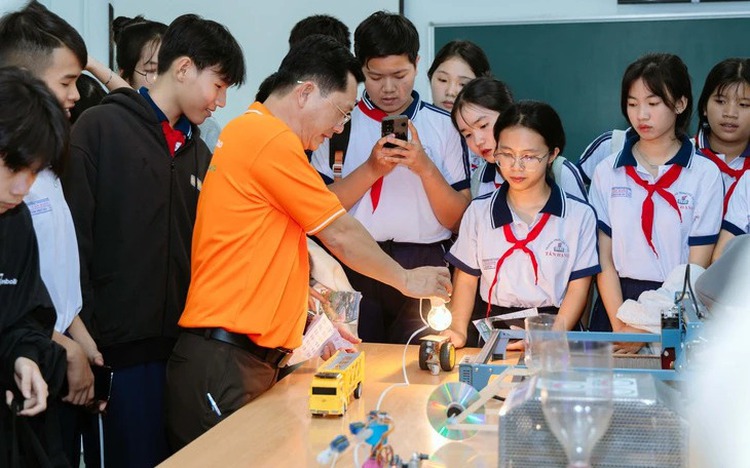
High school students explore technology-oriented career pathways during a hands-on guidance activity at Dong An High Technology College in Ho Chi Minh City, southern Vietnam. Photo: Khoa Le / Tuoi Tre
The target is set out in a newly issued plan by the municipal administration to improve the quality of vocational education across the city in 2026.
By the end of 2026, Ho Chi Minh City aims for at least 20 percent of its labor force to hold college or university qualifications, while ensuring that a minimum of 28 percent of students pursue studies in basic science, engineering and technology.
Besides, vocational education has been identified as a priority area for modernization to help develop a workforce with advanced technical skills.
Vocational education institutions have been tasked with significantly expanding enrollment in basic science, engineering and technology programs, which must account for at least 30 percent of total new admissions in 2026.
Beyond these targets, the city seeks to gradually position itself as a major national hub for education and training.
Career guidance and student streaming will also be strengthened, particularly at the secondary level, to create clearer pathways from school to vocational and technical training.
To support this approach, Ho Chi Minh City will step up public communication through mass media and professional events to highlight the role and contribution of vocational education graduates in production and business activities.
At the same time, the city will develop a modern labor market information system in line with technical standards and the national digital architecture framework.
Labor market data will be shared among state management agencies, vocational education institutions, businesses and learners, enabling training programs to better reflect actual demand.
Job fairs, employment exchanges and career events will be organized in flexible formats to improve labor market connectivity.
In 2026, vocational education counseling and career orientation activities will also be carried out for lower- and upper-secondary students across wards, communes and special administrative areas to support more informed study and career choices.









Max: 1500 characters
There are no comments yet. Be the first to comment.