


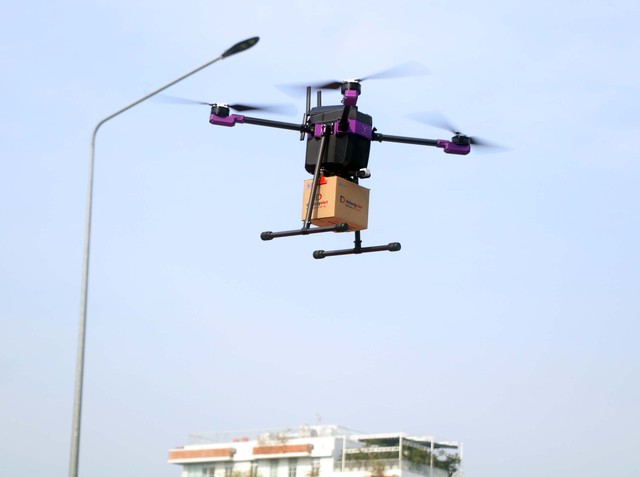
A UAV delivers a smartphone package during a test flight at the Saigon Hi-Tech Park in Ho Chi Minh City, January 5, 2026. Photo: Trong Nhan / Tuoi Tre
According to the city’s Department of Science and Technology, upcoming tests will build on the January 5, 2026 pilot program conducted in cooperation with the Saigon High-Tech Park Management Board, technology firms, and retail businesses.
That initial trial demonstrated UAVs could successfully take off with packages, follow programmed routes, drop deliveries at designated points, and return to base.
The drones showed stable performance, high automation, and precise navigation.
Delivery and pickup processes ran smoothly, reducing reliance on ground traffic.
Real-time monitoring and control systems also proved effective.
Participating units also demonstrated strong technological capabilities, from design and operation to handling technical issues arising during flight.
Officials said the next phase will push UAVs into more demanding conditions to gather practical data for improving technology and informing future regulations.
Current limitations include the absence of radar or lidar sensors for collision avoidance, restricted payload capacity and flight range, and broad no-fly zones.
Vietnam also lacks a registration system, identification codes, UAV monitoring framework, and dedicated air traffic management for drones.
By testing UAVs under adverse weather and technical stress, authorities aim to refine safety standards and support policymakers in drafting appropriate rules for UAV operations.
The Department of Science and Technology emphasized that the trials are to be conducted in controlled areas with full safety, security, and technical compliance, under permits issued by the Ministry of National Defense.








Max: 1500 characters
There are no comments yet. Be the first to comment.