


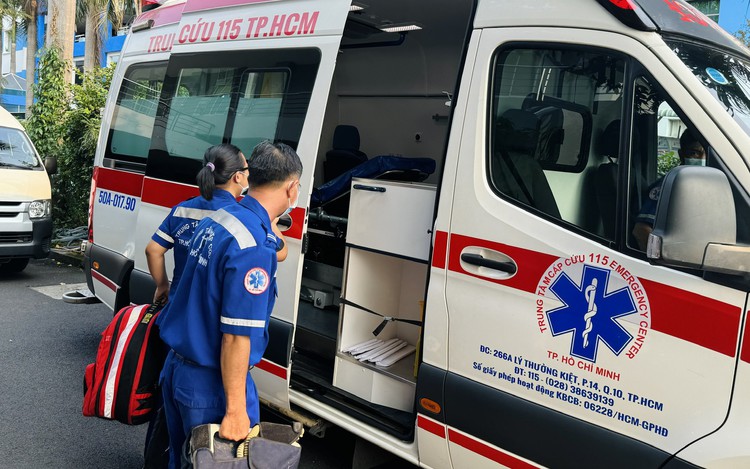
Emergency medical personnel at the 115 Emergency Center carry equipment as they prepare to board an ambulance. Photo: Thu Hien / Tuoi Tre
The city’s emergency center has seen the number of calls to its emergency hotline 115 rise steadily year after year, with more than 400,000 calls recorded in 2025, compared to around 8,700 in 2015, according to center director Nguyen Duy Long.
The center recorded 25,384 out-of-hospital emergency cases in 2025 and 15,239 in the first half of 2026.
General medical conditions—ranging from breathing difficulties, severe abdominal pain, and head pain, accounted for the vast majority of emergency dispatches. Other frequent call reasons included acute trauma, strokes, cardiac arrests, and road accidents.
Despite the growing workload, the average time from receiving a call to an ambulance reaching the scene was 6.9 minutes in the first five months of 2025.
This included 1.9 minutes for receiving the call, 2.1 minutes for dispatching and 2.9 minutes for the ambulance to reach the scene.
The average time from reaching the scene to transporting a patient to hospital was 13.6 minutes.
Following the merger of Ho Chi Minh City with the former provinces of Binh Duong and Ba Ria - Vung Tau in July 2025, the emergency network has been expanded to cover the enlarged city and now comprises 73 satellite emergency stations, Long said.
From 2026 to 2030, the city plans to integrate the emergency networks across the two former provinces.
The plan includes 12 satellite stations and 60 additional ambulances in the former Binh Duong area, and six satellite stations and 27 ambulances in the former Ba Ria - Vung Tau area.
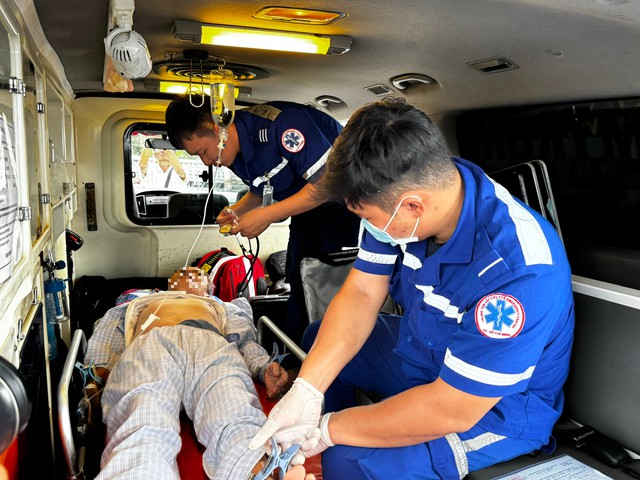
Medical workers at the 115 Emergency Center provide first aid to a patient inside an ambulance. Photo: Thu Hien / Tuoi Tre
Under the city’s out-of-hospital emergency care plan, the 115 Emergency Center will serve as the hub for receiving, triaging and dispatching emergency calls across the network.
The system will connect professional satellite stations with public and private hospitals and medical centers, while all commune- and ward-level health stations will participate in initial first aid.
Hotline calls surpass 2,000 a day
The growing demand was particularly evident on September 19, when the 115 hotline received 2,003 calls in a single day, marking the first time its daily call volume exceeded 2,000.
From September 14 to 22, the hotline received 15,684 calls, an average of more than 1,740 calls per day, nearly 16 percent higher than its previous average.
During the nine-day period, 1,482 calls showed signs of requiring emergency medical assistance, prompting 1,242 ambulance dispatches across the network, or an average of 138 dispatches per day, nearly 10 percent higher than the previous average.
Long said the recent increase came as Ho Chi Minh City experienced frequent heavy rain, flooding and traffic congestion, which contributed to a rise in demand for emergency services.
By 2030, Ho Chi Minh City aims for at least 90 percent of its population to have access to out-of-hospital emergency care within the ‘golden period,’ with response times of no more than 15 minutes in urban areas and 30 minutes in rural areas.
The city also aims to ensure that all health stations have basic emergency and first-aid capabilities and at least one standard ambulance is available for every 100,000 people.








Max: 1500 characters
There are no comments yet. Be the first to comment.