


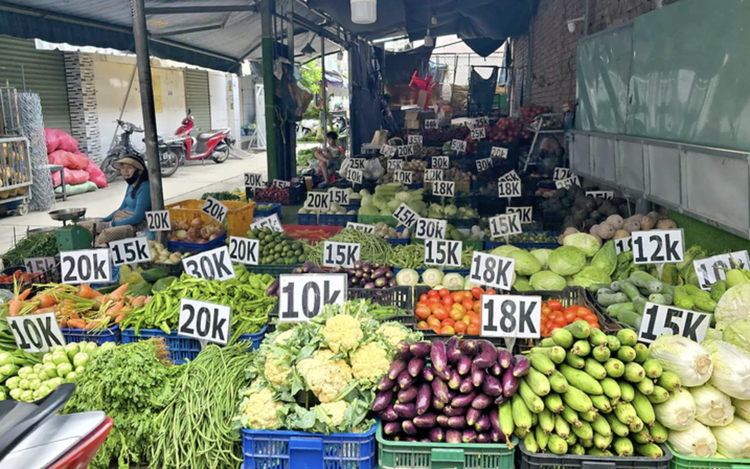
Fruits and vegetables are put on sale at a wet market in Vietnam. Photo: Cong Trieu / Tuoi Tre
The enormous loss does not occur in financial markets, but it is reflected in produce spoiling on trucks, at collection points, and along transportation routes.
Figures from the Vietnam Fruit and Vegetable Association, cited by experts, indicate that post-harvest losses can reach 35-45 percent.
This is no longer simply a matter of unpredictable weather or consumer behavior.
It is a systemic failure to manage economic efficiency across the agricultural value chain.
Why, despite years of recognizing the problem, has Vietnam yet to find a lasting solution to agricultural losses?
The question was at the center of a dialogue on food innovation held in Hue City, central Vietnam on Friday, alongside the launch of the Food System Innovation Challenge 2026 in response to World Food Day, which fell on the same date.
Research presented at the event by a team comprising Dr. Nguyen Thi Van Anh, Dr. Le Thanh Long, and Associate Professor Dr. Nguyen Van Toan of the University of Agriculture and Forestry under Hue University identified high upfront investment costs as the biggest barrier to technology adoption, accounting for 57 percent of the obstacles cited.
Investing in standardized cold-storage facilities, installing Internet of Things (IoT) sensors to monitor temperatures, and deploying transport management software remain financially out of reach for many cooperatives and small- and medium-sized enterprises.
The consequences extend throughout the supply chain.
Agricultural goods are often transported by truck in tropical weather without adequate preservation systems.
Fragmented supply-and-demand data mean vehicles frequently return empty, while insufficient cold-chain infrastructure has become a bottleneck that constrains profitability across the sector.
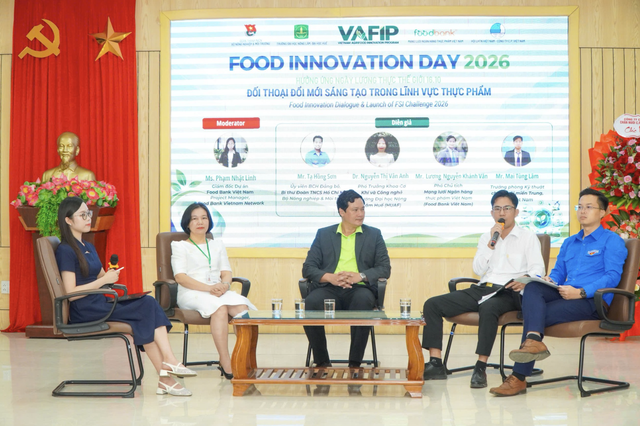
Experts take part in a dialogue on food innovation in Hue City, central Vietnam, October 16, 2026. Screenshot: P. Duyen
According to experts, closing the $4-billion gap requires a fundamental shift in how agricultural businesses operate: moving away from repeatedly compensating for losses through emergency market interventions and toward optimizing profit margins through technology and circular economic models.
The first priority is to accelerate digital transformation across the supply chain.
Smart sensors, IoT-connected cold chains, and big data analytics can help businesses forecast supply and demand, monitor storage conditions, and optimize transportation routes.
This is not a luxury technology race.
It is an economic calculation.
Even a five-percent reduction in agricultural losses during transportation could preserve hundreds of millions of dollars in net value across the sector.
The second priority is to reassess the value of agricultural by-products.
Under conventional farming practices, rice husks, straw, and residues from agricultural processing are often treated as waste, creating additional collection and disposal costs.
Under a circular economy model, however, these materials can become low-cost inputs for new products and revenue streams.
Potential applications include extracting bioactive compounds, manufacturing biodegradable packaging, producing biogas, and developing microbial organic fertilizers.
Closing the food production loop can also support emissions-reduction targets while improving the overall economic efficiency of agricultural operations.
The key is to move beyond viewing waste management as a cost and recognize it as an opportunity to create value.
The third priority is to strengthen public-private partnerships through a collaborative incubation model involving four key stakeholders: government agencies, research institutes and universities, businesses, and startups.

Each participant has a distinct role to play.
Businesses can identify real market needs and provide seed funding, while universities and research institutes contribute research and development facilities.
Startups, in turn, can develop algorithms, digital platforms, and other innovative technologies to address practical supply-chain challenges.
Annual agricultural losses of $4 billion represent an enormous opportunity cost for Vietnam.
Sustainable profitability in Vietnamese agriculture will not come solely from expanding cultivated land or increasing output.
It will depend increasingly on the ability to preserve the value of what farmers already produce, from the moment crops leave the field to the moment they reach consumers.


Max: 1500 characters
There are no comments yet. Be the first to comment.