


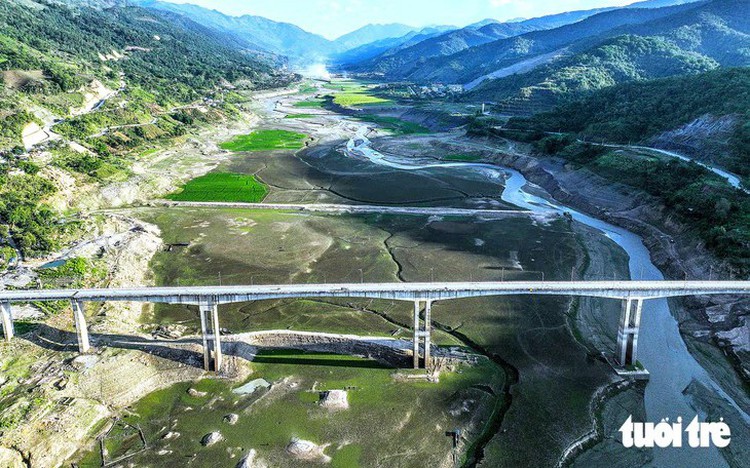
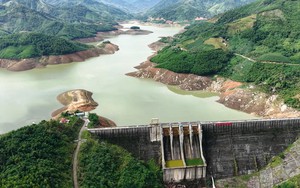
The bed of the Son La hydropower reservoir in Dien Bien Province, northern Vietnam, is almost completely exposed in early June 2023. Photo: Nguyen Khanh / Tuoi Tre
The Ministry of Agriculture and Environment has issued the warning and outlined water resource scenarios for the Red River–Thai Binh river basin for the 2026-27 dry season, covering November 2026 to June 2027.
El Nino brings lower rainfall and river flows
The ministry forecasts that El Nino will remain very strong through January 2027 before gradually weakening in the first half of summer and eventually returning to neutral conditions.
Temperatures from now through April 2027 are expected to average 1-2 degrees Celsius above the multi-year average, while those in May and June could be 0.5-1.5 degrees higher.
Hot weather may begin in the northwestern region in late March and spread across northern Vietnam from April.
Rainfall across the Red River–Thai Binh basin is also expected to remain below the multi-year average through June 2027, resulting in significantly lower river flows.
In particular, flows into Hoa Binh Reservoir on the Da River are projected to be 20-33 percent below average in November and December 2026, and 5-15 percent lower from January to June 2027.
The seven major hydropower reservoirs covered by the forecast are Lai Chau, Son La, Hoa Binh, Ban Chat, Huoi Quang, Thac Ba and Tuyen Quang.
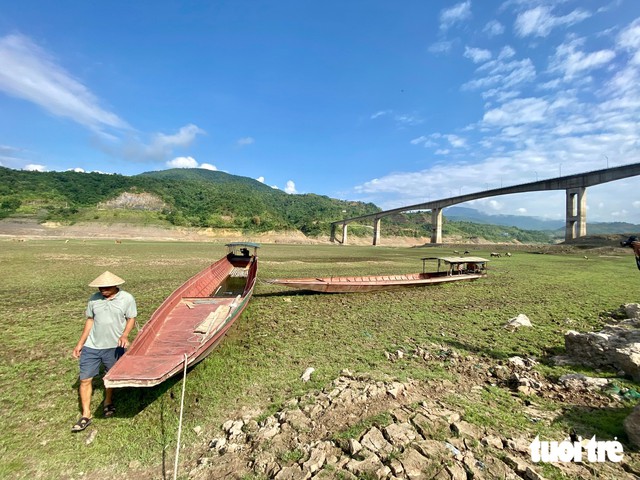
A resident of Muong Lay Ward in Dien Bien Province, northern Vietnam walks along the dried bed of the Son La hydropower reservoir during the 2023 El Nino event. Photo: Nguyen Khanh / Tuoi Tre
By the end of October, their combined water storage stood at around 25.6 billion cubic meters, approximately 500 million cubic meters below the multi-year average and equivalent to 92 percent of their total capacity.
Worst-case scenario puts most reservoirs at dead water levels
The ministry has outlined two scenarios for the seven reservoirs' ability to meet water and power generation needs.
Under the first scenario, their combined storage is expected to fall to around 22.4 billion cubic meters after the January-March 2027 irrigation water release period, about 1 billion cubic meters below the minimum required to meet electricity demand during the peak hot season and support socio-economic development.
By April 1, 2027, storage could decline further to around 21.4 billion cubic meters, widening the shortfall to approximately 1.39 billion cubic meters.
If hydropower demand rises during April-July or other power sources face shortages, the reservoirs may fail to meet electricity system requirements from early June, with a water deficit of around 1.5 billion cubic meters for domestic use and environmental needs.
If inflows from April to June decline at rates similar to those recorded in 2019-2020 and 2023-2024, the risk of insufficient water for power generation could emerge as early as May.
Under the second, more adverse scenario, the reservoirs could face a water shortfall of around 1.48 billion cubic meters after the January-March irrigation period, equivalent to 240 million kWh against the minimum storage required to meet power generation needs.
By early April, the shortfall could widen to 1.89 billion cubic meters, equivalent to 310 million kWh against the minimum storage required to meet electricity demand during the peak hot months..
If hydropower demand rises during the hot season, the reservoirs may fail to meet electricity system requirements from late May, with a water deficit of approximately 2.1 billion cubic meters for domestic use and environmental needs.
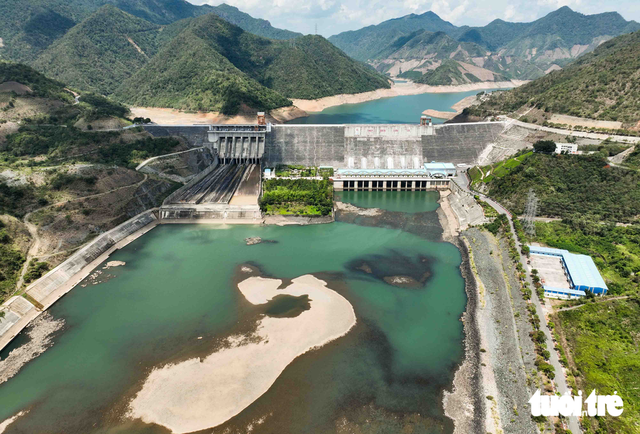
The Son La Hydropower Plant operates below its dead water level in early June 2023. Photo: Nguyen Khanh / Tuoi Tre
The situation could worsen further if inflows continue declining from April to June, potentially leaving the reservoirs unable to meet power generation requirements from early May and facing a water shortfall of up to 4.2 billion cubic meters for domestic use and environmental needs.
Most of the reservoirs could reach their dead water levels, below which they cannot release water for normal power generation, by early June 2027.
Authorities urged to prepare for water shortages
The ministry has urged other ministries, sectors and local authorities to draw up water use plans that prioritize conservation, prevent losses and waste, and take contingency measures for the final months of the dry season.
Reservoir operators have been asked to adjust operating schedules flexibly, prioritize water supplies for domestic use and essential downstream production, and retain enough water for power generation during peak hot weather while maintaining minimum river flows throughout the dry season.
The Ministry of Industry and Trade has been required to develop flexible operating plans for major hydropower reservoirs, adjust the power generation mix according to available water supplies, and increase the use of other energy sources to ease pressure on the reservoirs.
Meanwhile, very strong El Nino conditions are expected to increase the risk of widespread drought and saltwater intrusion in the Mekong Delta, the Central Highlands and southeastern Vietnam from November onward.



Max: 1500 characters
There are no comments yet. Be the first to comment.