


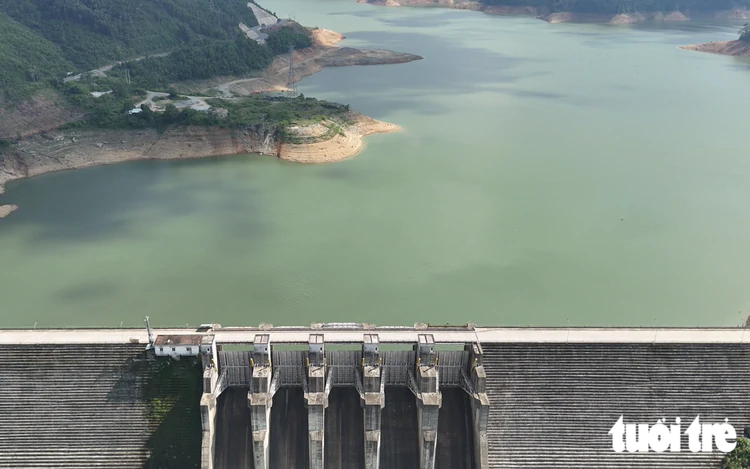
Hydropower Reservoir Dak Mi 4 in Da Nang City, central Vietnam, is nearing its dead storage level. Photo: Tran Thuong / Tuoi Tre
October is typically the peak of the rainy and flood season in central Vietnam, when many hydropower reservoirs begin storing water or regulating flood flows.
However, this year, several major reservoirs in the central coastal city remain critically low, with some water levels just a few dozen centimeters above their dead storage thresholds.
Major hydropower reservoirs, including Song Tranh 2, Dak Mi 4, A Vuong and Song Bung 4, are facing severe water shortages.
At the Dak Mi 4 hydropower reservoir, a dark waterline along the base of the concrete dam reveals a long stretch of exposed gray wall, showing how far the water has receded below the standard level for water storage.
Along the winding path around the reservoir, steep slopes of bare reddish-orange and gray earth have emerged where the hillsides meet the water.
As the water retreats, sections of the riverbed and lower hillsides that were once submerged now lie exposed, revealing eroded surfaces and layers of dry soil and rock.
In several wide sections of the reservoir, the falling water level has exposed an entire island of dry, gray earth, along with stretches of bare mud and sediment surrounded by greenish water.
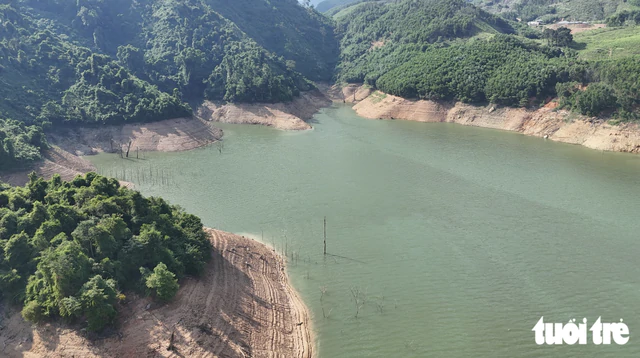
Water levels at a hydropower reservoir in Da Nang City have dropped significantly. Photo: Tran Thuong / Tuoi Tre
Nguyen Thanh Binh, deputy general director of Dak Mi Hydropower JSC, said inflows into the reservoir had dropped sharply, leaving the water level only about 70 centimeters above the dead storage level.
The limited inflow is insufficient to meet the operational requirements of the generating units, making it hard for electricity production and business operations, he said.
At the Song Tranh 2 hydropower reservoir, the water level stood at 148 meters above sea level on Tuesday, 27 meters below its normal full supply level of 175 meters.
Vu Duc Toan, director of Song Tranh Hydropower Company, said rainfall had been unusually low this year, leaving inflows well below expectations.
“The rainy season is not over yet, and we are still hoping for more rainfall in the coming months,” Toan said.
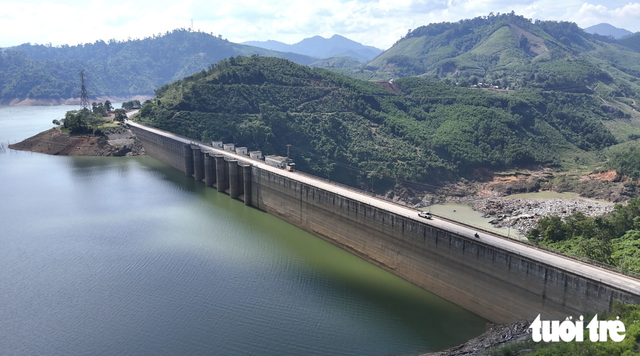
The scene at Hydropower Reservoir Dak Mi 4 is unusual for this time of year. Photo: Tran Thuong / Tuoi Tre
Concerns grow over water shortages in 2027 dry season
Truong Xuan Ty, deputy director of the Da Nang Department of Agriculture and Environment, described the depletion of hydropower reservoirs in the middle of the rainy and flood season as unusual.
He said the situation was associated with the effects of El Niño.
Although two or three spells of heavy rain could occur during the final two or three days of October and in November, the extent to which reservoir levels recover will depend on actual weather conditions, he said.
The department is closely monitoring rainfall, river flows and water levels at hydropower reservoirs to prepare appropriate management and operating plans.
Temperatures across Da Nang from September 26 to October 25 were generally 0.5 to 2 degrees Celsius above the long-term average for the same period, according to data from the central regional center for hydrology and meteorology.
Total rainfall across the city was also some 20 to 40 percent below the long-term average, underscoring the severity of the rainfall deficit.
El Nino is a climate phenomenon marked by the periodic warming of surface waters in the central and eastern equatorial Pacific Ocean, which can disrupt weather patterns worldwide, affecting rainfall and temperatures in Vietnam.


Max: 1500 characters
There are no comments yet. Be the first to comment.