


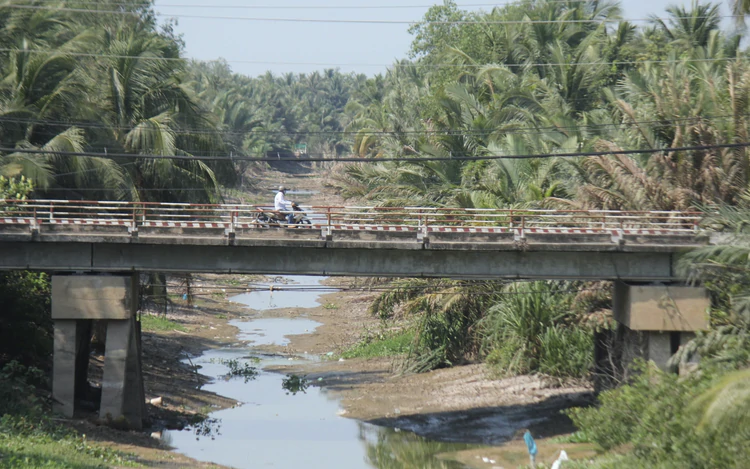
An irrigation canal in Vietnam’s Mekong Delta runs dry during the 2020 dry season. Photo: Mau Truong / Tuoi Tre
El Nino is a climate phenomenon marked by the periodic warming of surface waters in the central and eastern equatorial Pacific Ocean, which can disrupt weather patterns worldwide, affecting rainfall and temperatures in Vietnam.
A report by the Ministry of Agriculture and Environment showed that El Nino is currently at a very strong level and is forecast to persist until early summer 2027, Dr. Nguyen Ngoc Ha of the National Center for Water Resources Planning and Investigation told a workshop on water regulation and operational efficiency held in Hanoi on Tuesday.
Under its influence, river and stream flows across most of Vietnam’s major river basins were 10 to 75 percent below their long-term averages between June and August, with the Red River and the main channel of the Ma River being exceptions.
The situation resembled conditions recorded in 2015 and 2019.
For late 2026 and early 2027, rainfall deficits are forecast in the Central Highlands, the south-central region and southern Vietnam.
Saltwater intrusion in the Mekong Delta could reach levels comparable to those seen in 2015-16.
“Water resources are particularly vulnerable during El Nino years because rainfall is scarce and river levels fall,” Dr. Ha said.
He described the 2026-27 dry season as the first major real-world test of water-resource scenarios developed for river basins, particularly those in the south-central, Central Highlands and Mekong Delta regions.
To prepare for the challenges, the ministry should publish water-resource scenarios for all 13 major and strategically important river basins while strengthening forecasting and early-warning systems in central Vietnam, the Central Highlands and the Mekong Delta.
Local authorities should then develop plans to regulate and allocate water in basins facing shortages.
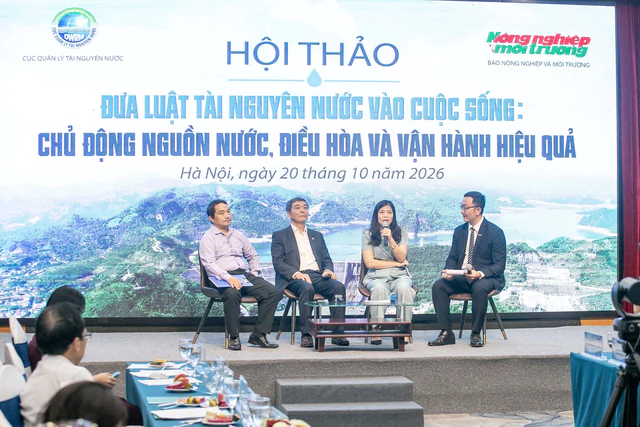
Experts exchange views at the workshop, titled ‘Bringing the Law on Water Resources into Practice: Proactively Securing Water Supplies and Improving Water Regulation and Operational Efficiency,’ held in Hanoi, October 20, 2026. Photo: C. Tue / Tuoi Tre
Meanwhile, the Ministry of Industry and Trade should prepare contingency power-supply plans for periods when hydropower plants need to retain water in their reservoirs.
Other proposed measures include restructuring crops and adjusting planting seasons, reducing cultivated areas in high-risk zones, and revising rice-sowing schedules to avoid peak saltwater intrusion.
Also, authorities should develop reliable water-supply plans and alternate between surface water and groundwater sources to ensure more sustainable use.
Water-resource scenarios would serve as a basis for ministries, agencies, local authorities and infrastructure operators to proactively plan water extraction and use, said Nguyen Thi Phuong Hoa from the Department of Water Resources Management.
“Water-resource scenarios need to be updated throughout the dry season, particularly in the delta and central Vietnam, where the dry season can last around eight months, to ensure that water can be regulated as effectively as possible,” Hoa noted.
Associate Professor Dr. Nguyen Mai Dang said that improving water-resource management would require the application of technology and the deployment of decision-support systems.
However, Dang emphasized that operational decisions must be based on a flexible set of criteria tailored to specific circumstances, timing, actual water availability and forecasting capabilities.


Max: 1500 characters
There are no comments yet. Be the first to comment.