


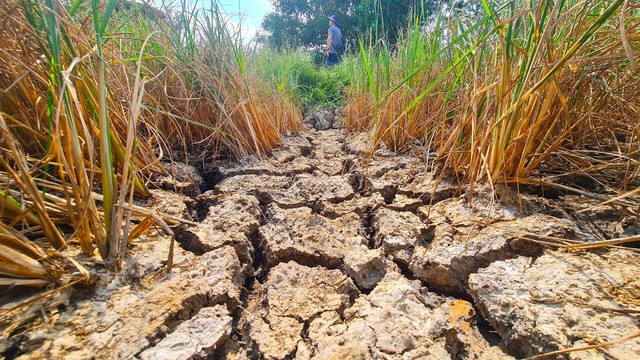
According to Duong Duc Huy, director of the Plant Production and Protection Department, about 85,800 hectares of winter-spring rice in the 2026-27 crop in the Mekong Delta are at risk from drought and saltwater intrusion. Photo: Mau Truong / Tuoi Tre
Southern Vietnam is facing the risk of severe drought and early saltwater intrusion during the 2026-27 dry season.
With hundreds of thousands of hectares of rice and fruit crops under threat, on Friday, the Plant Production and Protection and the Department of Hydraulic Works Management and Construction, both under the Vietnamese Ministry of Agriculture and Environment, joined the Dong Thap provincial Department of Agriculture and Environment to hold a conference to review crop production and drought and saltwater intrusion prevention efforts in 2026 and outline plans for 2027 in the southeastern region and Mekong Delta.
Severe El Nino forecast
According to Tran Van Hung, deputy director of the Southern Regional Hydrometeorological Center, weather and hydrological conditions across the region from late 2026 to early 2027 will be heavily affected by a strong El Nino event, similar to the historic scenario in 2015-16.
Notably, there is a 98 percent probability that El Nino will maintain very strong intensity from October to December 2026.
It could peak in November 2026, surpassing the record set during the historic 2015-16 dry season.
El Nino is expected to remain strong into early 2027 and continue through the first months of summer.
Meanwhile, the rainy season in southern Vietnam may end early, around the first to middle week of November, 10-20 days earlier than the multi-year average.
Total rainfall across the region is forecast to be 10-30 percent below average, while average temperatures are expected to be higher than the multi-year norm.
The 4 grams-per-liter salinity boundary at river mouths in the Mekong Delta is forecast to extend 50-70 kilometers inland.
Saltwater intrusion along the Vam Co River system could reach 110-130 kilometers inland, beginning as early as late December 2026 and peaking between January and April 2027.
Early and deeper saltwater intrusion will put greater pressure on freshwater supplies for the country's southern rice and fruit-producing regions.
According to sector assessments, about 85,800 hectares of winter-spring rice in the 2026-27 crop across the Mekong Delta are at risk from drought and saltwater intrusion.
The largest affected areas are in Ca Mau Province, with 30,000 hectares; Can Tho City, 22,000 hectares; Dong Thap Province, 20,000 hectares; Vinh Long Province, 12,000 hectares; and Tay Ninh Province, 1,800 hectares.
In addition, about 120,000 hectares under rice-shrimp farming systems that depend on rainfall face a serious risk of water shortages.
For fruit crops, around 45,000 hectares in coastal areas are at risk of irrigation water shortages during the dry season as saltwater penetrates further inland.
The most vulnerable areas include durian-growing regions, as the crop is highly sensitive to salinity, in Vinh Long Province, with 25,000 hectares; Dong Thap Province, 14,000 hectares; Can Tho City, 3,000 hectares; and Tay Ninh Province, 3,000 hectares.
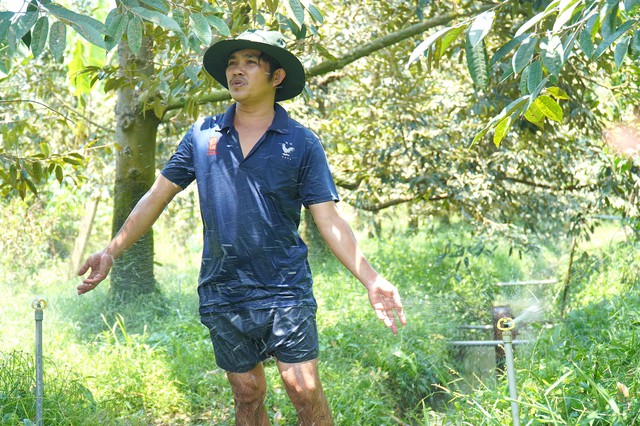
Durian trees are highly sensitive to saltwater, prompting the agriculture sector to advise local authorities to guide farmers in storing freshwater and preventing saltwater intrusion well in advance. Photo: Mau Truong / Tuoi Tre
In the southeastern region, more than 70 percent of cultivated land lies outside the service areas of irrigation infrastructure.
As a result, an estimated 35,000-40,000 hectares of perennial crops will face water shortages if hot weather persists from February to April 2027.
Race to avoid drought, saltwater intrusion
In response to unfavorable weather forecasts, the Ministry of Agriculture and Environment has called for drought and saltwater intrusion prevention plans to be activated under a very high-risk scenario, with preparations drawing on the dry seasons of 2015-16 and 2019-2020.
To protect rice production, a key measure is to adjust planting schedules to avoid saltwater intrusion.
The Cuu Long Delta Rice Research Institute has recommended that localities prioritize ultra-short-duration and short-duration rice varieties, which mature in 85-95 days and have good tolerance to drought and salinity, such as OM2517, OM380 and OM5451.

Duong Duc Huy, director of the Plant Production and Protection Department, the Ministry of Agriculture and Environment. Photo: Mau Truong / Tuoi Tre
For fruit growers, the top recommendation is to strictly avoid off-season flowering treatments in areas at risk of drought and saltwater intrusion unless freshwater supplies are secured.
Farmers should urgently dredge irrigation ditches, reinforce embankments, store as much freshwater as possible before the rainy season ends, and closely check salinity levels before each irrigation intake.
Coastal localities have also been advised to prepare temporary dams and dredge canals.
They should plan to progressively close sluice gates from the coast upstream beginning in November 2026 and bring the Cai Lon-Cai Be irrigation system into operation early to retain freshwater and protect agricultural production.
- REFERENCE MORE
- REFERENCE MORE
- REFERENCE MORE









Max: 1500 characters
There are no comments yet. Be the first to comment.