



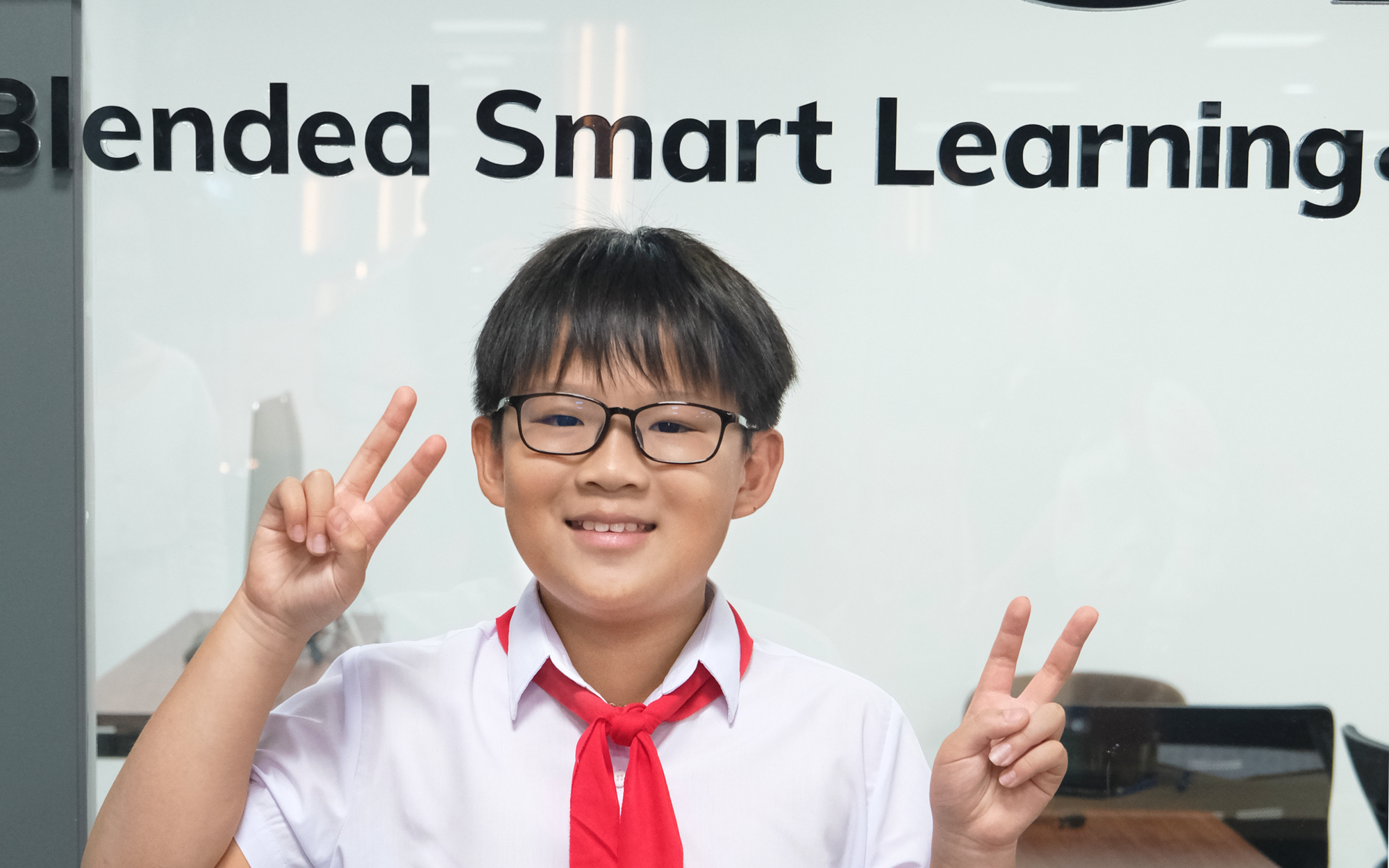
Education experts advise parents to choose courses that help elementary school children develop comprehensive language skills rather than rush into IELTS preparation, which they say is too early to deliver the expected results. Photo: Thao Thuong / Tuoi Tre
Some families spend hundreds of millions of Vietnamese dong on what they see as a steady climb up the IELTS ladder.
Yet education experts warn that pushing an international certificate at a very young age may backfire.
Parents should align their children’s abilities with the right developmental timeline.
On social media groups such as ‘Cung con vao tieu hoc’ (Accompanying children into elementary school) or ‘Hoc tieng Anh cung con’ (Learning English with children), as well as in real life, parents frequently exchange information about IELTS preparation courses for young learners, all in search of reputable training programs.
“My child started learning English at four,” said N.T.X., a resident of Xuan Hoa Ward in Ho Chi Minh City.
“My child, who is in fourth grade, already had certificates like Flyers and Movers.
“In early 2025, we enrolled him in IELTS courses. Each three-month course costs around VND70 million [US$2,660].
"I’ve already paid nearly VND140 million [$5,320]."
She also revealed that after the Lunar New Year festival, due in mid-February, she would register him for an IELTS test and hope he can reach IELTS 4.0-5.0.
Hoping her child can achieve IELTS 5.0 before entering sixth grade at a middle school operating under an advanced, internationally oriented model in Binh Hung Hoa Ward in the 2026-27 academic year, Le Thi Thu hired a private American tutor to teach the kid at home.
Her child studies four sessions a week, with two hours each focusing on listening, speaking, and writing, at a cost of VND16 million ($609) per month.
“I’m not even sure if next year’s middle schools will prioritize IELTS certificates,” Thu said.
“However, even if they don’t, we’ll apply through the standard process.
"Once in middle school, English will no longer be difficult for my child as he has already conquered it."
Similarly, the son of Le Huu Thanh, a fifth grader at a bilingual international school in Thu Duc Ward, has been exposed to English from an early age.
Thanh aims for his child to reach at least IELTS 6.5 to prepare for studying abroad.
“My child’s pronunciation and communication are good, but the kid's grammar is still weak,” he said.
“I hired a well-known IELTS tutor to teach at home. Eight sessions a month cost about VND10 million [$380]."
Many parents are urgently pushing their elementary school children into IELTS preparation, hoping for a dramatic leap in English proficiency aligned with this popular certificate.
In response, numerous English centers have launched pre-IELTS courses or programs marketed as ‘tailored for elementary students,’ often based on Cambridge materials, with durations ranging from three to six months or even a full year.
Too young for IELTS training
While many parents believe starting early gives children more time to conquer IELTS, education experts caution that no gains are achieved if children are pushed to learn too early.
Parents are advised to carefully identify their children’s aptitudes and nurture them in the most natural way.
Pham Thi Xuan Oanh, an English teacher at Le Van Tam Middle School in Binh Thanh Ward, said early planning is not wrong, but age appropriateness is crucial.
At the elementary level, English should be about exposure – absorbing the language naturally through emotions and daily activities, learning through play, she explained.
“IELTS is an academic form of English and generally unsuitable for elementary-school students, except in truly exceptional cases,” Oanh noted.
She said that the most suitable age to begin IELTS preparation is around grades 7 or 8, when students have a stronger foundation and better cognitive readiness.
Sharing this view, master's degree holder Chau The Huu, a lecturer at the Ho Chi Minh City University of Foreign Languages - Information Technology, acknowledged that IELTS training for elementary students is becoming increasingly popular.
However, he urged parents to think carefully, citing three key reasons.
First, IELTS is designed to assess language proficiency for purposes such as overseas study, immigration or higher education admissions – goals that are still distant for elementary school children.
Second, many IELTS topics are not age-appropriate, sometimes even challenging for university students.
Themes like sustainable agriculture, consumer psychology or decision-making processes can feel alien and confusing to young learners.
Third, as IELTS serves academic and immigration purposes, its skill focus is narrow.
Forcing children into this framework can undermine natural language development and the versatile use of English.
Speaking in IELTS differs from real-life communication, and IELTS writing is highly academic rather than practical.
“IELTS tests language, but language must be understood in context and substance,” Huu emphasized.
“Rote learning only leaves students confused and disinterested.”
Building comprehensive language skills
Instead of steering children toward IELTS too early, parents are encouraged to choose age-appropriate programs that foster comprehensive language development.
Children can focus on pronunciation, storytelling, and everyday conversations around familiar themes such as school, family, and friends.
Later, toward the end of middle school or the start of high school, parents can select suitable English certificates based on their children’s interests and strengths.
At that stage, IELTS may become a realistic option.
“By then, students are accustomed to age-appropriate English programs, so transitioning to IELTS becomes easier and more effective,” Huu said.
Booming IELTS preparation
Education expert Dr. Nguyen Thi Thu Huyen observed that the booming market for IELTS preparation courses is closely tied to what she described as parental ‘obsession’ with the term IELTS, prompting centers to brand their courses accordingly.
She argued that IELTS training at elementary level offers little benefit.
Both academic and general IELTS tests are heavily academic, covering in-depth topics such as history, geography, neuroscience, culture, and media – areas far beyond the comprehension of most elementary students.
“Through test-taking tricks, some children may score well and feel proud,” Huyen said.
“However, their actual listening, speaking, reading, and writing abilities in real-life contexts do not necessarily match those scores.”
IELTS tasks are rarely applied in daily life, making them of limited practical value for young learners.
“Children need age-appropriate language programs that build reading comprehension, writing and creative expression. That foundation will prepare them to study IELTS much more effectively at a later stage,” she concluded.








Max: 1500 characters
There are no comments yet. Be the first to comment.