


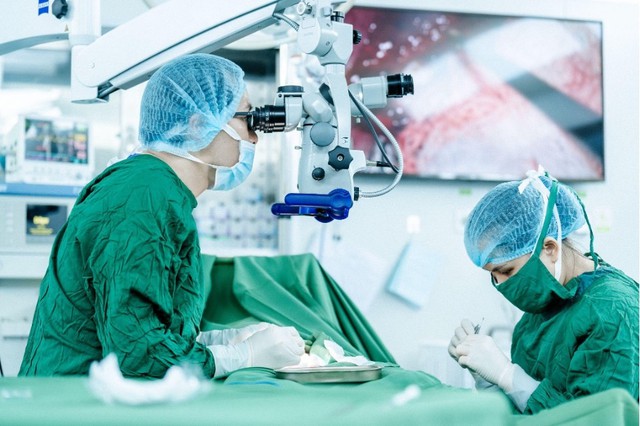
Doctors perform a MicroTESE procedure to retrieve sperm from a patient. Photo: Supplied
Under the latest draft of the Law on Donation, Retrieval and Transplantation of Human Tissues and Organs and Donation and Recovery of Cadavers, dated October 6, 2026, a wife could use her late husband’s sperm for assisted reproduction if she wishes to do so.
The draft also covers cases in which a husband has been declared brain-dead or has suffered circulatory death.
In such cases, sperm could be retrieved after brain death or circulatory death has been formally confirmed and then used for in-vitro fertilization.
Detailed conditions, documentation and procedures would be set by the government.
The proposal comes after several cases in Vietnam raised questions over reproductive rights and the use of sperm after death.
In 2019, the family of a 28-year-old man who died suddenly asked a hospital to retrieve and preserve his sperm.
Experts said sperm can technically be retrieved within around 24-36 hours after death, but Vietnamese law at the time did not allow relatives to use sperm from a deceased person for reproduction.
Other families have also sought access to stored sperm from deceased husbands for childbirth but were denied.
The cases have fueled debate over reproductive rights, the wishes of the deceased and the legal boundaries of posthumous reproduction.
Single women may receive sperm, embryos
The draft also clarifies the right of single women and infertile couples to receive donated sperm and embryos.
Donations and receipt of sperm, eggs and embryos for assisted reproduction must be carried out at authorized facilities.
Men aged 20 or older would be allowed to donate sperm, while women aged 18 or older could donate eggs.
Couples with surplus embryos they no longer wish to use could also donate them.
Recipients must be in suitable health and undergo independent counseling. Donated sperm, eggs or embryos may be used for only one woman or one couple to have a child.
Under the proposal, women undergoing infertility treatment with their husbands and single women may receive donated sperm, while single women may also receive donated embryos.
Sperm and embryo donation would remain anonymous between donors and recipients.
Vietnam has already allowed single women to receive sperm and embryos for assisted reproduction under Decree 207, which took effect on October 1, 2025.


Max: 1500 characters
There are no comments yet. Be the first to comment.