


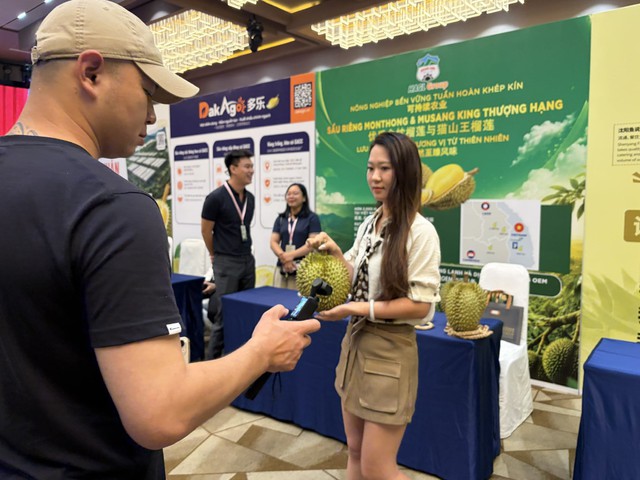
Durians are increasingly being promoted through online channels and e-commerce platforms. Photo: Nghi Vu / Tuoi Tre
According to the 2026 Douyin E-commerce Durian Consumption Trends Report released by Douyin E-commerce on May 22, the platform sold more than 30 million orders of fresh durians over the past 12 months.
The platform's gross merchandise value (GMV) surged 142 percent, while the number of orders rose 148 percent year on year.
The report also ranked Vietnamese Monthong and Vietnamese Ri6 as the second and third, respectively, among the favorite durian varieties on Douyin.
Vietnamese Monthong recorded an impressive 779-percent growth rate, while Vietnamese Ri6 has earned a reputation among Chinese consumers as the "king of value" thanks to its high price-to-performance ratio.
Speaking at a recent Vietnam-China durian supply chain connectivity seminar in Ho Chi Minh City, Cai Jianfei, representative of China's iFresh Asia Fruit B2B platform, said e-commerce and livestreaming have become key sales channels in China's durian market.
She said a Chinese company now operates a model that combines livestreaming with in-store pickup at nearly 12,000 outlets nationwide.
Consumers can watch sellers select durians during livestreams, interact with them in real time, and later collect their purchases at nearby stores for added peace of mind.
The trend has also spread to Singapore.
Speaking to Channel News Asia, Austin Quak, co-founder of Rolling Durian, said livestreaming allows businesses to serve many customers simultaneously rather than selling to individuals one by one.
During last year's peak season, some Singaporean durian businesses generated hundreds of thousands of Singapore dollars in revenue through TikTok livestream sessions.
Against this backdrop, Cai said Vietnamese durians are entering a growth phase and are gaining momentum to catch up with, and potentially surpass, Thailand.
She urged Vietnamese durian companies to seize the opportunity.
Seizing opportunities without competing on price
Almost all durians consumed in China are imported from Southeast Asia.
According to data from the General Administration of Customs of China, the country imported around 156,000 metric tons of fresh durians in the first quarter of 2026, up 294 percent from the same period last year.
Vietnam and Thailand remained the two largest suppliers.
However, the rapid increase in supply has pushed prices lower.
According to Singapore's Lianhe Zaobao newspaper, the retail price of Thai and Vietnamese Monthong durians in China fell from RMB35 to 45 per 500 grams last year to around RMB20 to 30 in June 2026. (RMB1 = US$0.15)
On e-commerce platforms featuring livestream sales, consumers can now purchase a durian weighing more than two kilograms, containing six well-filled segments, with free delivery, for just RMB168.
Cai Jianfei advised that as supplies from more countries enter the Chinese market, Vietnamese companies should avoid engaging in a race to lower prices.
Instead, they should focus on maintaining consistent quality, keeping prices at reasonable levels, and gradually building strong brands to increase the value of Vietnamese durians.










Max: 1500 characters
There are no comments yet. Be the first to comment.