


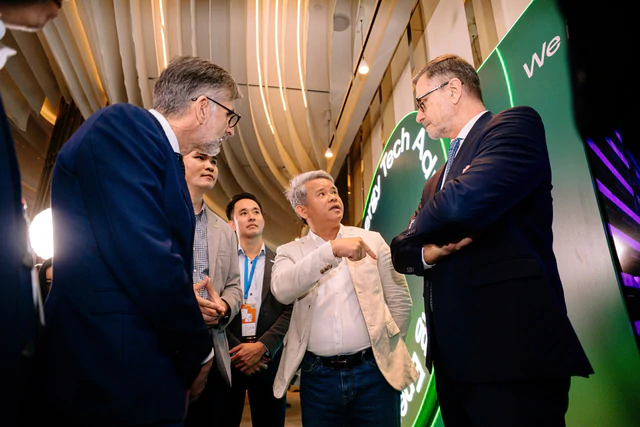
French Ambassador to Vietnam Olivier Brochet (R) talks with Dang Nguyen Ngu, general director of Schneider Electric Vietnam and Cambodia. Photo: Thanh Hiep / Tuoi Tre
“Vietnam needs more than capital. It also needs technology, know-how, and a shift toward higher-value activities,” Adam Koulaksezian, CEO of the French Chamber of Commerce and Industry in Vietnam (CCIFV), told Tuoi Tre (Youth) online newspaper.
Vietnam seeks French capital, technology
According to Adam Koulaksezian, France has strengths in technology, engineering, and training, while Vietnam has a large market and growing demand for infrastructure, energy, and new technologies.
These complementary strengths create room for the two countries to deepen cooperation, moving beyond the supply of products and services toward technology transfer, R&D, and greater participation in global value chains.
After Vietnam and France upgraded their relationship to a comprehensive strategic partnership in 2024, the two countries established a new framework for cooperation.
Party General Secretary and State President To Lam's visit to France provides an opportunity to turn that framework into concrete projects.
CCIFV has studied Resolution 10 on attracting and improving the quality of foreign investment, with a clear message: Vietnam needs more than capital. It also needs technology, know-how, and a shift toward higher-value activities.
The question, therefore, is not simply where French capital can be invested, but where French technology and expertise can help Vietnam achieve these goals.
Among the areas highlighted in the resolution, including semiconductors and electronics, AI and data, biotechnology, energy and advanced materials, green industries, logistics and financial services, three groups stand out for French businesses, according to Koulaksezian.
The first is infrastructure, including railways, urban metro systems, the North-South high-speed railway, energy, water, and urban services.
French companies have already taken part in metro projects in Hanoi and Ho Chi Minh City, and have strengths in transferring technical expertise and operational experience.
In nuclear energy, France has one of the world's most complete nuclear industry supply chains, Koulaksezian said.
At this stage, he believes France's most appropriate contribution would be to train Vietnamese engineers, technicians, and nuclear safety specialists before Vietnam's first nuclear facilities are built.
The second area is innovation and technology, including semiconductors, aerospace, AI, data infrastructure, and training.
France has strengths in aerospace, satellites, secure electronics, and industrial software, as well as a network of engineering schools working with Vietnam, Koulaksezian said. The University of Science and Technology of Hanoi is one example.
The third is the Vietnam International Financial Center locations in Ho Chi Minh City and Da Nang.
A financial center needs more than a legal framework, he said. It also needs banks, asset management firms, insurers, auditors, fintech companies, and law firms ready to establish teams there.
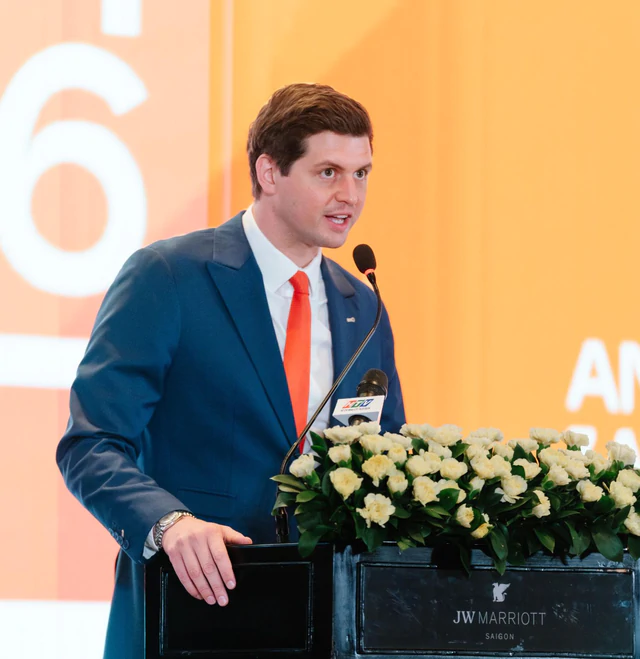
Adam Koulaksezian, CEO of the French Chamber of Commerce and Industry in Vietnam (CCIFV). Photo: CCIFV
Healthcare, including vaccines, hospitals, and pharmaceuticals, as well as agriculture, food and the green transition remain areas where French companies have competitive strengths, Koulaksezian said.
Retail is also often overlooked when major investment projects are discussed, but CCIFV is seeing a number of French companies enter the Vietnamese market in this sector each year, he said.
Koulaksezian said the aerospace industry is a clear example of Vietnam-France technology cooperation. Airbus has a presence in Vietnam, with activities ranging from aircraft maintenance to pilot and engineer training and cooperation on engines and equipment.
Energy and industry are another major area of contribution, with many plants operated by Vietnamese teams, the development of local suppliers and the gradual localization of capabilities.
The VNREDSat-1 satellite was developed with the participation of French industry, while Vietnamese engineers received training in France.
In healthcare, vaccine production cooperation between Sanofi and VNVC is an example of technology transfer, Koulaksezian said.
Education is another important contribution.
French-Vietnamese programs, from the University of Science and Technology of Hanoi to management and engineering training programs, have trained thousands of students, many of whom now work for Vietnamese and international companies.
The common thread, he said, is a long-term presence, with Vietnamese teams and an increasing number of domestic companies joining the supply chain.
Koulaksezian said this is how investment should be assessed in line with the spirit of Resolution 10, not simply by looking at registered investment capital, but at the technology transferred and the extent to which Vietnamese companies participate in value chains.
Three conditions for attracting French high-tech investment
To move from projects focused mainly on products and services toward deeper investment in R&D and the production of higher-value components, Vietnam and France need to focus on three areas, according to Koulaksezian.
Continued administrative reform and greater regulatory predictability come first. French investors tend to take a long-term view, but large-scale high-tech projects require stable and clear rules on licensing, land, energy, data, and intellectual property protection.
Reforms to simplify procedures, reorganize provinces, and develop a legal framework for science and technology are moving in the right direction.
What investors are watching now is how these reforms are implemented at the provincial level and how long it takes to complete procedures for a specific project.
Second is talent. Vietnam has many good engineers but still lacks skilled workers in semiconductors, aerospace, nuclear energy, and advanced software.
Joint training programs between Vietnamese and French universities and companies, including vocational training, are areas where the two governments could quickly step up cooperation.
Market signals rank third. High-tech investors need to see a clear market for their products.
This requires clear public procurement schedules for railways, energy, and digital infrastructure, along with equal treatment for foreign contractors in bidding.
At the invitation of French President Emmanuel Macron, Party General Secretary and State President To Lam and his wife are making an official visit to France from September 9 to 12.
During the visit, the top Vietnamese official will attend the Space Summit and meet with French leaders and business representatives to promote cooperation in trade, investment, technology, and innovation.
The visit comes as Vietnam seeks to attract more high-quality foreign investment and deepen cooperation in high-tech industries.









Max: 1500 characters
There are no comments yet. Be the first to comment.