



A foreign tourist poses for photos at a Lunar New Year cultural event in Da Nang, central Vietnam, February 6, 2026. Photo: Thanh Nguyen
A recent social media post described a Russian woman who speaks Vietnamese and lives in Ho Chi Minh City. She purchased sticky rice from a street seller, as she had done many times before, and was suddenly overcharged. The regular price of VND30,000 (US$1.16) jumped to VND50,000 ($1.93) without explanation. When she questioned the change in Vietnamese, she received verbal abuse from the seller.
This is not a new story, but it is one that needs to be called out if Vietnam truly wants to lead the Southeast Asian tourism market in 2026.
I have had my own experiences over the years with this practice. One such incident happened in a back lane in the former Binh Thanh District, Ho Chi Minh City. I stopped to buy a bread roll only 50 meters from my office. The elderly street seller charged me VND20,000 ($0.77). At the time, I didn’t think much of it because it wasn’t an unreasonable price.
However, a few days later, in the same week, I stopped at the same vendor again. She had four customers waiting, and in the rush she called her adult daughter to help. I took the bread roll from the daughter and gave her VND20,000. She immediately placed VND5,000 in my hand and moved on.
Later, at lunchtime, I returned to my friend’s café nearby. I asked the woman, in Vietnamese, why she charged me VND20,000 when she charged everyone else VND15,000 ($0.58). She began shouting offensive words and stormed off.
Similarly, on the street near my home, I used to buy vegetarian rolls on my way to work. The girl selling them was friendly and spoke good English. But after about three months, she got an office job and handed the stall over to her mother.
The first time I stopped to buy my usual roll which had been VND10,000 ($0.39) for three months, the mother charged me VND15,000. Then, right in front of me, she took VND20,000 from a Vietnamese woman buying the same item and gave her VND10,000 in change. I never returned to that shop again.
Pricing based on skin color seems to stem from a time when the country was in conflict and life was desperate. With food scarce and money limited, taking a little extra from a foreigner could mean the difference between eating and going hungry.
In today’s world, it is more about disrespect and passive racism. Vietnam’s economy is growing at rapid, double-digit rates. The middle-income group is wealthier than it’s ever been in the history of the country, although a significant lower-income population still exists in pockets of mostly rural Vietnam. So why is it necessary to charge non-Asian people more for the exact same product in the middle of Ho Chi Minh City?
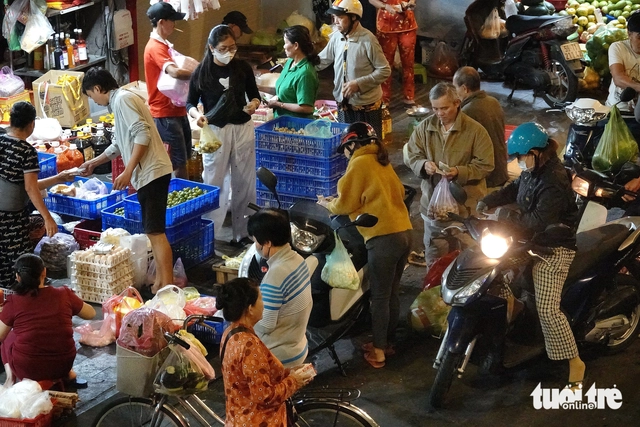
Vendors and shoppers trade through the night into early morning at a market in Cau Ong Lanh Ward, Ho Chi Minh City, January 10, 2026. Photo: T.T.D. / Tuoi Tre
Unrelated to this, but with a similar outcome, I have seen tourist attractions over the years, mostly referring to 2012-18, display separate pricing for residents and non-residents. I recall arguing with a ticket seller in 2018 because I showed my resident card, only to be met with apathy and a firm, race-based response.
Thankfully, many of these dual-price tourist attractions are disappearing as tourism increases and logic prevails. But I was always confused about how the pricing was determined, because they never asked for an ID. It seemed ticket sellers simply looked at you, and if you didn’t look or sound Vietnamese, you were charged more.
Vietnam is definitely improving. Tourist services have advanced dramatically over the past five years. World-class attractions now line the coastline and mountain regions, and Vietnam deserves to be considered the most amazing place to visit in Southeast Asia.
Street sellers, small businesses, and taxi services have also modernized. Many now see the idea of treating people differently based on appearance as outdated and incompatible with the future of a modern Vietnam. For that, I thank the wonderful people of Vietnam for showing such respect to me and to the 25 million visitors expected in 2026.
However, there is still a small, hidden group of street sellers, taxi drivers, and small businesses who believe it is acceptable to overcharge people based on appearance. It is up to both the Vietnamese and expat communities to call out this dishonest behaviour and stop it, because it does not reflect the spirit of the Vietnam I know.
The funniest part, for me, is similar to the overpriced sticky rice story mentioned above. As a Vietnamese speaker and long-time resident, it is hilarious when you call out the dishonest behaviour in Vietnamese as it happens. Their shock at your ability to speak Vietnamese is the trigger to them having nowhere to run, and their embarrassment is often worthy of a viral video. It is wrong, and it should be called out as wrong.
This is not about losing VND5,000 or VND20,000. It is about respect within the community and treating all humans equally. Vietnam’s compassion, wisdom, and sense of community should lead the way and become an example for other countries. The choice is yours.
I will continue to support street sellers and small businesses, and I will continue to avoid those who overcharge me because of my appearance. We can only hope that sellers realise a small cash grab today can result in a lifetime of missed opportunity.








Max: 1500 characters
There are no comments yet. Be the first to comment.