
2 Vietnamese boys survive severe hand, foot, mouth disease
Doctors at Children’s Hospital 2 in Ho Chi Minh City have saved two young boys in critical condition from hand, foot, and mouth disease caused by Enterovirus 71 (EV71), a strain known for its rapid and severe neurological complications, a hospital official confirmed on Friday.
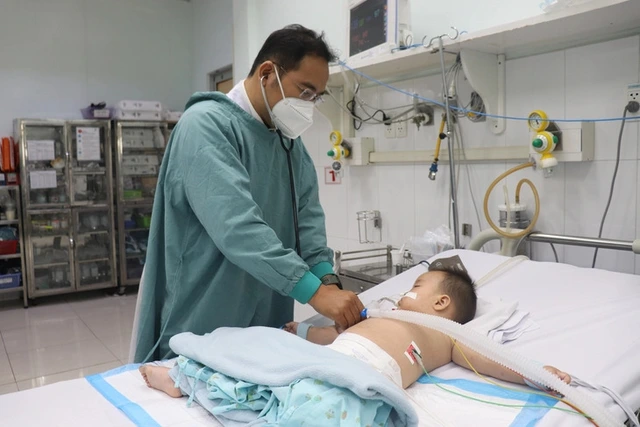
Do Chau Viet, head of the infectious intensive care unit at Children’s Hospital 2 in Ho Chi Minh City, examines a child with hand, foot, and mouth disease. Photo: Supplied
Do Chau Viet, head of the infectious intensive care unit at the hospital, said the first case involved P.D.K., a one-year-old from the city’s Dat Do Commune.
Initially diagnosed with throat inflammation, K. later developed rashes and was confirmed to have hand, foot, and mouth disease.
His condition quickly worsened, leading to respiratory failure.
After being intubated at a local hospital, he was transferred to Children’s Hospital 2, where doctors diagnosed him with stage-4 hand, foot, and mouth disease.
He was placed on a ventilator, given heart support medication, and underwent blood filtration.
After three days of intensive care, he stabilized and was able to breathe with CPAP (continuous positive airway pressure) support, though doctors continue to monitor possible neurological after-effects.
The second case was D.H.T., a three-year-old from Khanh Hoa Province, south-central Vietnam.
T. developed fever and rashes, but soon showed alarming neurological signs, including startling reflexes and loss of balance.
Despite initial treatment, his condition deteriorated with pulmonary edema, severe tachycardia at 230 beats per minute, and respiratory failure.
When he was transferred to Children’s Hospital 2, his oxygen saturation had dropped to 75 percent.
Doctors immediately placed him on a ventilator, administered vasopressors, and performed blood filtration.
After six hours of treatment, his heart rate improved, and after three days, he was stable enough to discontinue intensive interventions, though neurological monitoring continues.
Viet stressed that stage-4 cases often leave neurological complications ranging from mild to severe.
The Ho Chi Minh City Center for Disease Control reported that EV71 accounted for 56 percent of the samples collected in early 2026.
The virus spreads mainly through the digestive tract and direct contact with patient secretions.
EV71 infections can be deceptive, with few or no rashes or mouth ulcers.
Many children arrive at hospitals already in critical condition, suffering respiratory failure, heart shock, or even acute brain damage.
The disease can cause death within 12-24 hours if not treated promptly.
Doctors warn parents to seek immediate medical care if children show danger signs, even without visible rashes, including frequent startling reflexes (two or more times within 30 minutes); high fever above 39 degrees Celsius lasting over 48 hours and resistance to medication; motor disturbances such as unsteady walking, tremors, or weakness.; and persistent vomiting, irritability, or lethargy.
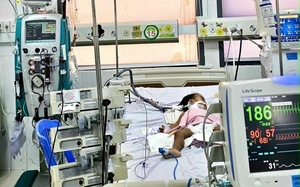
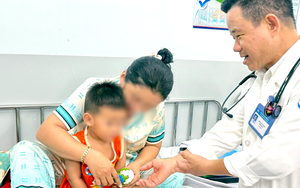
Minh Duy - Thuy Duong / Tuoi Tre News
Link nội dung: https://news.tuoitre.vn/2-vietnamese-boys-survive-severe-hand-foot-mouth-disease-103260410165913021.htm