
A scholar's take on making Vietnam's talent visa work
Talent visas bring people in. Institutions make them stay.
A "talent visa" is a smart policy -- and one Vietnam particularly needs. But making talent institutions -- entities that turn policy into action -- actually work in the AI race will require much deeper changes.
A leading artificial intelligence (AI) expert can return to Vietnam on a single flight. But on their first Monday at a new workplace, they may ask: Can I choose my collaborators? When will I have access to sufficient computing power and data? How long does it take to procure a technical service? Who owns the intellectual property? And if a serious experiment fails, will I be considered to have done something wrong?
These questions may sound mundane, but they determine whether talented people can accomplish anything significant.
Titles and compensation matter, but those holding a "talent visa" will surely look for something more basic: Can ideas here actually become research, products or businesses?

A talent visa is necessary, but not enough
Vietnam is studying a "talent visa," along with a one-stop mechanism and policies covering residency, employment, taxation, housing, healthcare and education for talented people and their families.
This is necessary as countries compete to attract AI talent. But a visa only opens the door. What keeps people there is a working environment with autonomy, adequate resources, strong colleagues and rules they can trust.
Vietnam is not short of sound policy directions. Resolution 57 puts science, technology and innovation at the center of the country's development breakthroughs, while new policies allow for more competitive compensation.
Yet by mid-2026, the Ministry of Home Affairs had to issue a directive urging faster implementation because progress remained slow, with obstacles ranging from identifying needs to ensuring proper working conditions. The challenge now is to make those policies actually "work."
In Vietnamese, thể chế and thiết chế are closely related terms, but they describe two distinct things. I understand thể chế as the framework -- the rules of the game, powers, incentives and accountability -- while thiết chế refers to the institutions that turn that framework into action: universities, research institutes, funds, businesses and coordinating bodies.
Policies only come alive when organizations can operate. If an institute is given autonomy on paper but still needs multiple layers of approval to hire people or buy equipment, autonomy has not reached the laboratory.
AI talent is not limited to scientists with long publication records. A strong ecosystem also needs engineers who can put models into operation, domain experts who understand real-world problems, founders who know how to commercialize ideas, and many people skilled in data work and safety oversight.
Making the most of domestic and international talent
For Vietnam at this stage, I believe the starting point should remain identifying and nurturing domestic talent.
Programs for gifted students should focus on creativity, the ability to ask questions and independent judgment -- qualities that become more valuable as AI makes answers increasingly cheap. This means early research and interdisciplinary projects rather than another race of academic competitions.
International collaboration programs should also be strengthened. This means more concrete arrangements, such as mission-driven joint laboratories, dual appointments and inviting experts to work in Vietnam for part of each year. Not everyone can return or relocate permanently, so "brain circulation" can sometimes be more realistic than a complete return.
Singapore has linked flexible visas to strong working environments. Its ONE Pass is valid for five years and tied to the individual rather than a single employer, allowing holders to work, run a business or establish multiple companies simultaneously.
The AI Singapore "100 Experiments" program co-funds up to S$150,000 (US$117,800) per project. Companies contribute money and personnel, while engineering teams build prototypes over six months. The program says it has completed more than 300 projects, directly connecting talent with real-world problems.
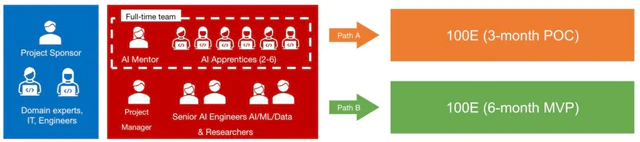
How AI Singapore "100 Experiments" program works. Source: aisingapore.org
In the UK, the Turing AI Global Fellowships recently announced funding of up to £4.5 million over five years for researchers from outside the UK to relocate, build teams and pursue long-term programs. What is worth learning from these examples is not simply the money, but the time, autonomy and organizational "launchpad" they provide.
In China in 2004, Tsinghua University persuaded Turing Award winner Andrew Yao to leave the United States and work full-time in China, giving him the authority to establish the "Yao Class" and later the Institute for Interdisciplinary Information Sciences. From 2010, the younger cohort of China's Thousand Talents Plan required applicants to return full-time, offering 500,000 yuan ($74,000) in personal support and 1–3 million yuan in research funding.
The lesson is not just about money: talented people were brought back with the authority to build teams, resources and a sufficiently ambitious mission.
From these three examples, Vietnam can learn the underlying principles without copying any one model.
Each key expert should receive a complete work package: clear objectives, the authority to choose a team, multi-year funding, data and computing capacity, fast procurement, clear intellectual-property rules, family support and evaluation milestones.
If we only pay individuals without giving their teams the resources they need, we may attract famous people without creating schools of thought or viable products.
Autonomy and accountability
Autonomy for universities and research institutes has been discussed extensively, but has yet to become substantive.
It must mean real autonomy: the ability to hire and pay people according to the value of their work; choose research directions; reallocate funding within an approved mission; sign contracts with businesses; establish companies based on research results; and share intellectual-property benefits.
If a laboratory head is held responsible for outcomes, they must also have the authority to decide who and what goes into the laboratory.
But autonomy is not a blank check. Accountability should shift from scrutinizing every invoice to evaluating milestones and results. The more important questions should be: Has the team been built? Has the work passed independent peer review? Are younger researchers developing?
Academic integrity and conflicts of interest must also be transparent. Crucially, honest failure must be distinguished from fraud. If every failure is punished, the safest choice will be not to try anything new.

Photo illustration: AFP
Talent policy must ultimately reach production -- the area where Vietnam remains weak and where it has the greatest need. Vietnam could select several priority missions -- such as Vietnamese-language AI, medical diagnosis, air-pollution monitoring, chip design and power-grid optimization -- and have universities, research institutes and businesses work on them together.
The United States shows that a country can be an AI superpower while companies such as OpenAI and Anthropic serve as the spearheads. The government primarily creates a supportive environment rather than managing individual projects; it can provide seed funding, data and pilot procurement, among other support.
A trusted private fund or company could recruit teams, manage them against milestones and provide matching investment. When projects succeed, the government's capital could return to the fund for the next round, while businesses contribute problems, engineers and markets. Not every research project needs to be commercialized immediately, but applied research needs a path beyond the academic paper.
How much does investing in a talented person "pay off"? There is no universal answer, especially in universities, where value also comes through patents, spin-off companies and people trained. But Taiwan offers a successful lesson.
In 1985, Taiwan invited Morris Chang to lead the Industrial Technology Research Institute (ITRI). TSMC was established two years later, with 48 percent from state capital, 28 percent from Philips and 24 percent from Taiwanese businesses.
Since its listing, TSMC's revenue and profit have grown by an average of nearly 19 percent a year; its return on equity (ROE) reached 35 percent in 2025. Its achievements today are the product not of a single talented individual, but of an ecosystem built and nurtured over four decades.
Making institutions actually work
To make these institutions actually work, I think Vietnam can start with a few things: find the right people; nurture talent early; recruit through complete work packages; grant authority together with responsibility; connect talent with teams and real production challenges; and measure final outcomes.
There should be a single coordinating body, clear processing deadlines and a public tracking dashboard. Pilot programs should begin with a few missions and capable organizations before being scaled up, followed by an independent evaluation after three years.
Success should not be measured primarily by the number of visas issued, centers opened or scientific papers published.
More meaningful questions are: How many strong teams have become sustainable? How many young engineers have been trained? How many technologies have been adopted and used by businesses in practice? And how have productivity and technological self-reliance changed?
Vietnam's recent directive on the "talent visa" also moves in this direction: measure results, and hold leaders accountable if talented people are lost because of poor working environments. When the right things are measured, organizations have an incentive to do the right things.
Talented people do not return simply to receive the title of "talent."
They return -- or choose to stay connected from afar -- because they can do meaningful work alongside capable colleagues and see their knowledge create value for society and for a country.
A visa may bring them through the border. But only institutions that actually work can turn research, technology, businesses and new policies into things that truly enter the real world.
* Dang Hoang Hai Anh is an economist and Senior Visiting Fellow at the London School of Economics and Political Science and the University of Economics Ho Chi Minh City. This article was written exclusively for Tuoi Tre (Youth) online newspaper.
Dang Hoang Hai Anh
Link nội dung: https://news.tuoitre.vn/a-scholars-take-on-making-vietnams-talent-visa-work-10326090121033664.htm