
Cheap Indian buffalo meat gains popularity in Vietnam
Frozen buffalo meat imported from India is priced 40-50 percent lower than fresh domestic buffalo meat, making it increasingly attractive to Vietnamese consumers.
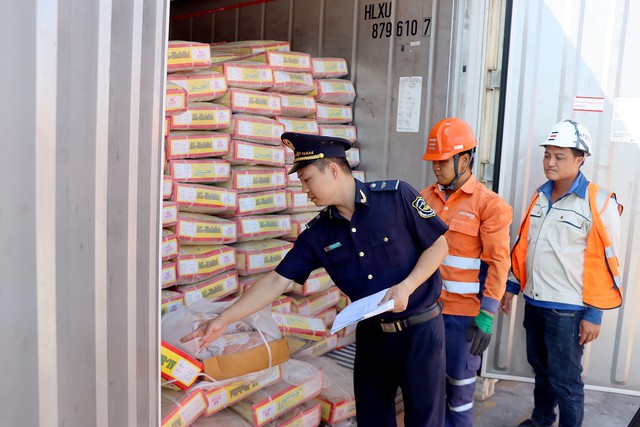
Customs officers inspect an imported buffalo meat shipment in Vietnam. Photo: Thanh Binh / Tuoi Tre
In August, police in Lao Cai Province, northern Vietnam prosecuted and detained Vu Hoang Hai, known as Hai Sapa TV, and two others for allegedly deceiving customers and violating accounting regulations.
According to police officers, Hai used his social media influence to direct his wife to distribute dried buffalo meat made from frozen buffalo meat imported from India, which was allegedly marketed as a specialty from northwestern Vietnam popular with foreign tourists.
The popularity of imported buffalo meat has drawn renewed attention following the case, raising questions over why Indian buffalo meat is so cheap and how it is being used in Vietnam.
Cheap buffalo meat imported from India sold nationwide
Vietnam spent US$494.5 million importing frozen beef and buffalo meat from India in the first seven months of 2026, accounting for nearly 70 percent of the country's total imports of these products.
Speaking to Tuoi Tre (Youth) online newspaper, an employee at a supermarket at Me Linh Plaza Ha Dong in Hanoi said imported meat, especially buffalo meat, sells relatively slowly.
Most buyers are foreigners living and working in the area, the employee said.
The supermarket sells buffalo meat only from India, with prices ranging from VND165,000 ($6.27) to VND265,000 ($10.08) per kilogram, depending on the cut.
Tenderloin is the most expensive at VND265,000 ($10.08) per kilogram, followed by sirloin at VND195,000 ($7.41), round at VND185,000 ($7.03), and shoulder at VND165,000 ($6.27).
At some imported frozen food stores, Indian buffalo meat is sold in a wider variety of cuts.
Buffalo rump costs VND160,000 ($6.08) per kilogram, round VND145,000 ($5.51), lean thigh VND140,000 ($5.32), and tenderloin flap VND120,000 ($4.56).
Some cuts, including brisket and short ribs, are priced below VND100,000 ($3.80) per kilogram, while buffalo tail costs VND79,000 ($3.00).
In Ho Chi Minh City, imported buffalo meat can also be found at a number of food companies, with prices ranging from VND76,000 ($2.89) to VND160,000 ($6.08) per kilogram depending on the cut.
One food company lists buffalo lean thigh at VND122,000 ($4.64) per kilogram, sirloin head at VND115,000 ($4.37), tail at VND151,000 ($5.74), brisket at VND76,000 ($2.89), and rump cap at VND109,000 ($4.14).
At several other businesses importing buffalo meat from India, sirloin costs VND157,000 ($5.97) per kilogram, neck brisket VND105,000 ($3.99), shoulder VND125,000 ($4.75), lean neck meat VND95,000 ($3.61), and round VND130,000 ($4.94).
Fresh domestic buffalo meat much more expensive
Cheap imported buffalo meat is attractive to consumers partly because fresh buffalo meat in Vietnam is considerably more expensive and is mainly sold at traditional markets.
Lam Cam Thuy, owner of Thuy Luc buffalo slaughterhouse in An Xuyen Ward, Ca Mau Province, said the purchase price of live buffalo is around VND240,000 ($9.13) per kilogram, depending on the time.
A buffalo typically weighs 300-400 kilograms when raised for meat.
To maintain a stable supply, Thuy works with traders in many provinces and cities across the country, including Do Son in Hai Phong City.
Long distances and transportation costs push up the selling price, she said.
Depending on the cut, excluding long-distance transportation costs, brisket sells for VND200,000 ($7.60) per kilogram, ribs VND170,000 ($6.46), untrimmed thigh VND250,000 ($9.51), trimmed thigh VND280,000 ($10.65), and trimmed loin VND330,000 ($12.55).
She sells directly to retail customers and wholesale buyers such as restaurants and food stores.
Her shop sells about one buffalo per day, as customers prefer fresh buffalo meat to frozen meat, she said.
According to Thuy, buffalo raised for meat in Vietnam are generally kept for two to three years.
They should not be raised for too long because the meat can become dark and tough, making it less appealing to customers.
Overall, domestic buffalo meat is sold at considerably higher prices than imported buffalo meat, which is one reason why imported buffalo meat has a large consumer market.
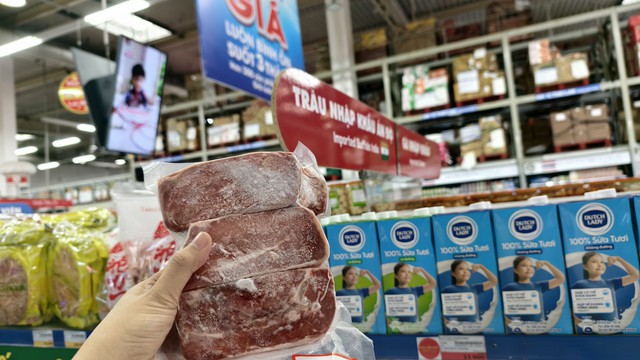
Imported buffalo meat is displayed at a separate counter in a supermarket in Vietnam. Photo: T.N. / Tuoi Tre
Cheap buffalo meat may be used as beef, restaurant owner says
Speaking to Tuoi Tre, T., the owner of a chain of pho restaurants overseas, said beef pho and chicken pho remain the two most popular varieties.
Buffalo pho also exists but is generally considered a specialty dish and uses high-quality domestic buffalo meat, he said.
Based on his years of experience in the industry, T. said there are cases where buffalo meat is used but sold as beef pho.
"I think this exists at many low-cost eateries. Buffalo meat can easily be used to substitute for beef," T. said.
According to T., consumers can hardly distinguish buffalo meat from beef with the naked eye without professional testing equipment.
Even if customers have doubts, they may have no clear basis to confront restaurant owners.
"Buffalo meat is very difficult to distinguish when stir-fried with seasonings, cooked in hotpot dishes or marinated for grilling. The more heavily it is seasoned, the greater the risk of it being mixed in," T. said.
Based on his experience operating restaurants overseas, T. advised consumers to choose reputable eateries that provide clear information about food origins.
Restaurants can also proactively disclose the origins of their ingredients, including the source of the meat used at the establishment.
"Where I operate, eateries are required to disclose such information. If customers have doubts, they can file a complaint with the authorities, and inspectors will come to check immediately," T. said.
Regarding cheap imported meat, T. said different products may be imported for different purposes, but controlling how they are used afterward is not simple.
"A supermarket can sell buffalo meat, and no one can stop people from buying it to make pho. But if they use buffalo meat without labeling it as buffalo pho and sell it as beef pho, that is misleading customers," T. said.
Vietnam's buffalo herd faces shrinking farming space
Vietnam has many areas suitable for buffalo farming, but relatively few areas raise and sell buffalo for meat on a large scale.
Dr. Nguyen Ngoc Son, vice-chairman of the Animal Husbandry Association of Vietnam, said fluctuations in supply and demand are a major factor, along with the lower price of imported buffalo meat.
Buffalo can still grow well in Vietnam when farming conditions are suitable for each locality, Son said.
Vietnam's total buffalo and cattle herds have tended to decline in recent years compared with poultry and pigs.
The main reasons are shrinking space for livestock farming due to urbanization and increasingly limited land for growing green feed.
Countries such as Australia, India, and the U.S., meanwhile, have large areas suitable for livestock farming and have invested heavily in buffalo and cattle production.
As for whether consumers prefer imported products to domestic ones, Son said this depends on individual tastes.
Consumers who seek high-quality meat have their own criteria for choosing products.
Meat quality depends on factors including breeds, care and feeding, slaughtering and preservation, while the way meat is processed into dishes can also have a significant impact.
Son advised businesses to comply with regulations when importing buffalo meat and other animal products.
The state allows businesses to import meat to meet consumer demand, but strict controls on legal compliance and product quality are necessary to prevent smuggling and illegal imports from affecting the domestic market.
India supplies nearly 70 percent of Vietnam's frozen buffalo, beef imports
According to data from Vietnam Customs, Vietnam continues to import frozen buffalo and beef under HS code 0202, with India remaining the main supplier.
Vietnam spent about $708.1 million importing frozen buffalo and beef in the first seven months of 2026.
Of this amount, imports from India totaled $494.5 million, accounting for nearly 70 percent of the total.
Imports from other markets were much smaller.
Australia supplied $83 million worth of frozen buffalo and beef, followed by Canada with nearly $56 million, the U.S. with $29.5 million, and Japan with $5.4 million.
Both imports of frozen buffalo and beef from India and total imports of these products have grown strongly since 2024.
In 2024, Vietnam imported nearly $869 million worth of frozen buffalo and beef, including $601.7 million from India, equivalent to 69.2 percent of the total.
In 2025, total imports rose to more than $886.4 million, while imports from India reached $634 million, representing about 71.5 percent.
In just the first seven months of 2026, imports from India reached nearly $495 million, equivalent to nearly 78 percent of the full-year figure recorded in 2025.
India has therefore remained Vietnam's main supplier of frozen buffalo and beef since 2024.
Vietnam also imports large volumes of frozen buffalo and cattle offal under HS code 0206.
Imports of these products totaled $250.7 million in 2024 and rose to $265.7 million in 2025.
Vietnam spent $125.6 million importing frozen buffalo and cattle offal in the first seven months of this year.
Germany was the largest supplier during the period, with imports worth $39.5 million, followed by India with $24.5 million, Russia with $20.6 million, and Spain with $15.9 million.
The Ky - Le Thanh - Thy Nhung - Nghi Vu - Cong Trung / Tuoi Tre News
Link nội dung: https://news.tuoitre.vn/cheap-indian-buffalo-meat-gains-popularity-in-vietnam-103261006141057266.htm