
Expat backs Vietnam’s proposed indoor smoking ban, citing England’s experience
Subhajeet Chatterji, an English teacher in Vietnam, has voiced his support for Vietnam’s proposed roadmap toward a complete indoor smoking ban, saying clear communication, consistent enforcement, and sufficient preparation time would help businesses and smokers adapt.

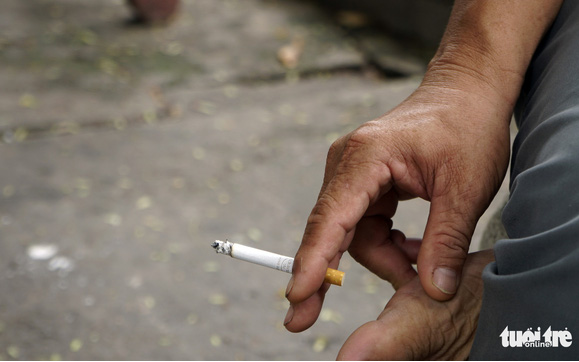
An AI-generated illustrative photo of a person holding a lit cigarette
According to a draft decree prepared by the Vietnamese Ministry of Health, the country is considering a complete ban on indoor smoking in hotels, bars, karaoke venues, and other public spaces.
The proposal outlines a phased roadmap, beginning with public transport and airport isolation areas, before extending to hospitality and entertainment venues.
The goal is to gradually eliminate designated smoking areas and transition toward fully smoke-free indoor environments.
Chatterji, with a background in human resource management as well as learning and development, said he supported the proposal, drawing on his experience of living in London.
“One thing I observed while living in London when England introduced its indoor smoking ban in 2007 was that people did not stop going to their chosen venues. They changed where they smoked,” he said.
“It is easy to overestimate how much a familiar habit is essential to an experience.”
He said the experience demonstrated that changing smoking regulations did not necessarily require people to give up their social activities, but could instead change how and where they smoked.
Chatterji believed that clear communication would be crucial to the policy's success.
“A good policy does not have to make people abandon what they enjoy. It can remove the part that harms others,” he said.
Secondhand smoke and workplace fairness
He highlighted concerns about secondhand smoke, particularly for employees who cannot avoid exposure while working indoors.
“A non-smoker cannot always avoid it, for example, an employee whose job requires them to remain there,” he said.
He framed the issue as one of fairness, saying that employees should not have to choose between earning a living and protecting their health.
He believed a complete indoor ban would make venues healthier and more comfortable for non-smokers, stressing the distinction between choosing to smoke and choosing to expose others to smoke.
Lessons from abroad
Reflecting on England’s experience, he noted how quickly the ban became normalized.
“What struck me was how quickly an arrangement that initially seemed unusual could become ordinary. People moved outside to smoke; the venues continued operating normally.”
He suggested Vietnam could learn from this by ensuring expectations are clear and transitions manageable.
He also pointed out that communication is key: announcing a rule is not the same as ensuring people understand it.
Impact on businesses and smokers
Chatterji acknowledged that the proposed policy would entail adjustment costs for both smokers and businesses.
Hotels, bars, and karaoke venues may need to reorganize their spaces, while smokers will have to adapt their routines.
However, he believed the initial disruption will be temporary.
“My experience in London suggests that people and businesses can adapt when the new expectations are clear.”
Designated outdoor smoking areas could be a reasonable alternative, provided they are designed to prevent smoke from drifting back indoors.
Challenges of enforcement
While he considered the ban practical and enforceable, he cautioned that compliance will be the real test.
“Passing the rule is probably the easier part. The harder part is making compliance predictable,” he said.
He emphasized that staff need clear procedures and managerial support to enforce the law effectively.
He also noted differences in venue capacity, elaborating that large hotels may have resources to adapt, while small bars may struggle without tailored guidance.
Gradual transition recommended
Chatterji supports Vietnam’s proposed gradual roadmap, arguing that it allows venues time to adjust.
“People need time to understand it, practice it, and make it routine,” he explained.
He advised policymakers to anticipate resistance, limited outdoor space, and uneven enforcement, while setting clear milestones and communicating them early.
Minh Duy / Tuoi Tre News
Link nội dung: https://news.tuoitre.vn/expat-backs-vietnams-proposed-indoor-smoking-ban-citing-englands-experience-103261017193637206.htm