
Fish get a unique ‘bath’ on Vietnam’s Tho Chu islands
Located more than 200 km from the mainland, life for residents of Vietnam’s Tho Chu special zone is closely tied to cage farming of grouper and cobia. Amid rough seas and strong winds, fish farmers have a unique practice passed down among them: 'bathing' their fish about once every 10 days to treat parasites and keep the fish healthy.
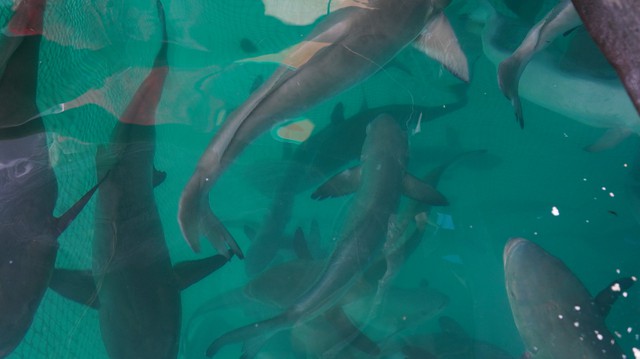
Fish need regular ‘baths’ to keep parasites at bay. Photo: Thanh Huyen / Tuoi Tre
Nguyen Duc Thang, a longtime cage fish farmer in Tho Chu special zone, An Giang Province, southern Vietnam, said residents on the island mainly earn a living by farming cobia and grouper and trading seafood on a small scale.
Each farming cycle lasts from nine months to one year. Thang typically stocks fish weighing 300-500 grams and raises them until they reach 7-10 kg before selling them.
“To make a profit, we have to buy bait fish directly from fishing boats to feed the farmed fish. If cobia sells for VND200,000 (US$7.70) per kilogram or more, farmers are assured of making a profit,” Thang said.
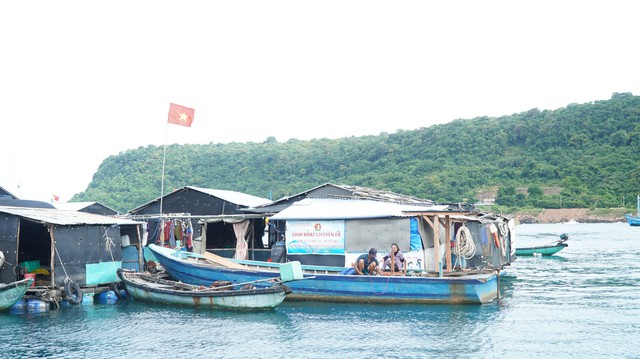
The fish cages are sheltered from waves and strong winds by the island’s natural protection. Photo: Thanh Huyen / Tuoi Tre
In addition to cobia, Thang also farms several grouper species, including tiger grouper, striped grouper and starry grouper, using fingerlings transported from Nha Trang.
Groupers consume less feed than cobia but command a much higher market value. Tiger grouper sells for about VND200,000 ($7.70) per kilogram, while starry grouper can fetch more than VND600,000 ($23.10) per kilogram at times, with most fish sold live.
However, marine fish farming has never been easy. To build a fish farm covering about 280 square meters, Thang has to spend at least VND500 million ($19,250) on constructing the cages and another VND300 million ($11,550) on fingerlings.
The cages are divided into multiple smaller compartments to separate fish by age, preventing larger fish from eating smaller ones and making it easier to control disease outbreaks.
A cage holding about 150 cobia requires roughly 40 kg of feed per day.
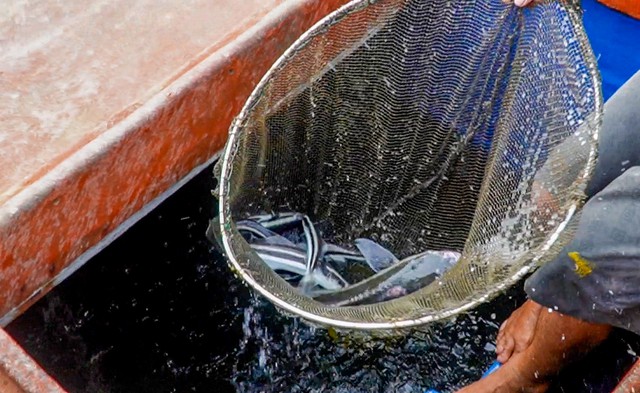
Fingerlings bought from local fishermen are better suited to the farming environment and grow well. Photo: Thanh Huyen / Tuoi Tre
According to Thang, the most challenging stage for cobia is when the fish reach around 3 kg.
At this stage, they are highly susceptible to disease and can die suddenly. The fish are also prone to skin diseases and parasite infections.
“In the past, the water was cleaner, so the fish were less prone to disease. As long as we fed them enough, they grew well. Now, we have to bathe the fish regularly to have any hope of achieving high yields and profits,” Thang said.
Having worked in the island area for more than 15 years, Nguyen Thi Hong, who operates fish cages in Tho Chu special zone, considers her cobia cages a form of savings for her family.
Hong said cobia can be harvested after about seven months, when the fish reach 6-10 kg. The longer they are raised and the heavier they become, the higher their value.
“Cobia raised for a full 12 months and weighing more than 10 kg can sell for as much as VND250,000 ($9.62) per kilogram. This is when the meat tastes best, fragrant and sweet, so major restaurants in Phu Quoc are very fond of them and place orders regularly. Each giant cobia sold to the market brings in at least VND2 million ($77),” Hong said enthusiastically.
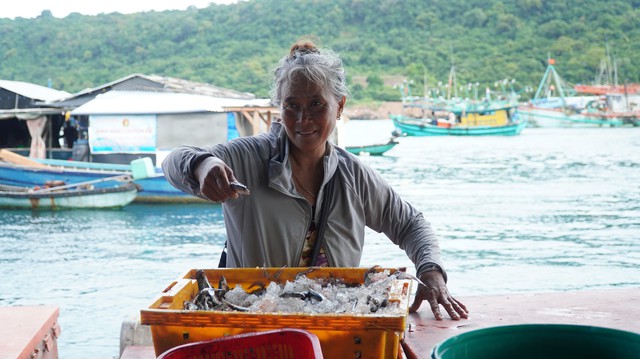
Hong prepares assorted small fish to feed the groupers. Photo: Thanh Huyen / Tuoi Tre
To reduce the risk of disease in recent years, Hong has shifted to farming grouper for 50 percent of her cages, as the fish fetch a stable price of more than $7.70 per kilogram. The remaining cobia are raised under a strict care schedule.
Explaining the fish 'bathing' technique, Hong said cobia living in seawater are highly susceptible to parasitic organisms attaching to their skin and eyes, causing them to stop eating, suffer eye damage and eventually become sick and die.
Therefore, every seven to 10 days, Hong and her husband pull up the nets to catch the fish and place them in large tubs of fresh water mixed with specialized treatment chemicals.
After soaking and rinsing for about 15 minutes to eliminate the parasites, the fish are returned to their sea cages.
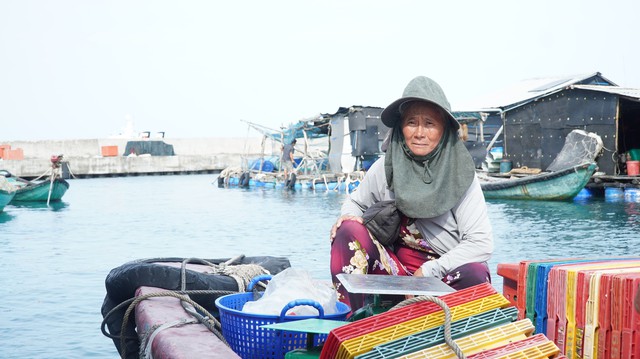
Hong buys bait fish daily from fishing boats to feed the fish in her cages. Photo: Thanh Huyen / Tuoi Tre
Thanks to meticulous care and a diet consisting entirely of naturally caught shrimp and small fish supplied by fishing boats, Tho Chu cobia is said to have a flavor and quality comparable to wild-caught fish.
The fish cages have not only helped Hong and her husband support their family but also enabled them to put their children through school and secure stable jobs.
Cage fish farming in Tho Chu began taking shape in the 2000s and quickly became a key economic activity on the island. In each 20-square-meter cage, farmers stock about 200 fingerlings.
After 12 months, the harvest can reach about 1.5 metric tons per cage.
Developing the marine economy, particularly cage fish farming in the remote Tho Chu island special zone, not only generates income and improves the livelihoods of local fishermen but also carries strategic significance for national security and defense.
The fish cages that remain anchored at sea around the clock serve as 'living markers,' contributing to the protection of Vietnam’s sovereignty over its southwestern seas and islands.
Van Giang - Thanh Huyen / Tuoi Tre News
Link nội dung: https://news.tuoitre.vn/fish-get-a-unique-bath-on-vietnams-tho-chu-islands-103260916121959554.htm