
Ho Chi Minh City eyes flood-resilient metro stations
Ho Chi Minh City’s Department of Construction has called on the city’s Management Authority for Urban Railways to take the lead in researching and developing metro stations capable of withstanding flooding, as part of the city’s long-term strategy to adapt to climate change.
The proposal aligns with a Politburo resolution on building and developing Ho Chi Minh City in a new era, with long-term, stable urban planning that proactively adapts to climate change and minimizes the impacts of flooding and rising sea levels.
The explanatory report on the city’s master plan for the 2025-30 period, with a 100-year vision, also identifies Ho Chi Minh City as an area facing significant risks from flooding, land subsidence, rising sea levels and climate change.
According to the municipal department, the city is reviewing its railway network plans in conjunction with efforts to manage and make effective use of underground space.
Multiple urban railway lines are being developed, with underground rail infrastructure expected to play a central role.
As such, flood prevention measures for underground infrastructure, particularly metro projects, have become an urgent priority.
Such facilities must be designed to minimize risks, ensure safety and maintain continuous, stable operations throughout their service life.
The department has asked the authority to coordinate with agencies responsible for project preparation, consultants and experts to undertake several key tasks.
First, the authority must review domestic and international technical regulations and standards, assess practices in Vietnam, and draw on global experience in designing flood prevention and protection systems for urban railways.
Countries and territories to be studied include Russia, China, Japan, Singapore, Hong Kong and Thailand.
Based on this review, the authority is expected to propose appropriate design parameters for metro projects in Ho Chi Minh City.
Second, it must prepare a report outlining the calculations and forecasts required for flood prevention system designs, taking into account the risks posed by flooding, land subsidence, rising sea levels and climate change.
Particular attention must be paid to extreme rainfall and high tides.
The assessment should calculate groundwater levels, historical flood frequencies and design water levels at ventilation shafts, tunnel portals and depots over the projected service life of the infrastructure.
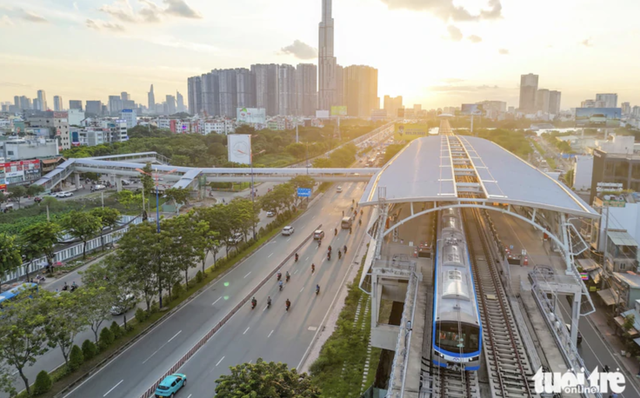
Ho Chi Minh City’s metro line No. 1. Photo: Chau Tuan / Tuoi Tre
The report must also clearly assess how land subsidence in surrounding areas, including subsidence rates and projected settlement, could affect the relative elevations of station entrances and exits, as well as drainage capacity.
Remedial measures should be proposed where necessary.
In addition, the authority must review the drainage capacity of surrounding systems and assess the installed capacity and number of pumps at pumping stations.
Third, the authority is required to evaluate flood prevention and protection designs for metro lines that have already been implemented or are currently under construction.
The review must identify which requirements have been met, which remain unmet, and what corrective measures are needed.
Fourth, consultants must be instructed to proactively engage with relevant technical agencies to collect data and agree on the input parameters needed for engineering calculations.
Finally, the authority must propose the necessary solutions and work plans for incorporation into the preparation, revision and appraisal of design documents.
These proposals should include preliminary estimates of their potential impacts on project costs and schedules.
The measures must be planned in a way that avoids disrupting the completion of priority urban railway projects targeted during the 2026-30 period.
The Ben Thanh - Suoi Tien metro line, the first of its kind in Ho Chi Minh City, began commercial operations in December 2024, featuring 14 stations, with three underground stations and 11 elevated ones.
The southern metropolis aims to complete eight metro lines running a combined length of 255 kilometers by 2030.
Tieu Bac - Duc Phu - Le Phan / Tuoi Tre News
Link nội dung: https://news.tuoitre.vn/ho-chi-minh-city-eyes-flood-resilient-metro-stations-10326102415414049.htm