
Ho Chi Minh City steps up water storage as El Niño raises fears of 2027 shortages
Ho Chi Minh City has ordered authorities to step up water storage and prepare contingency plans for rotational water supply as El Niño raises concerns over potential shortages in 2027.
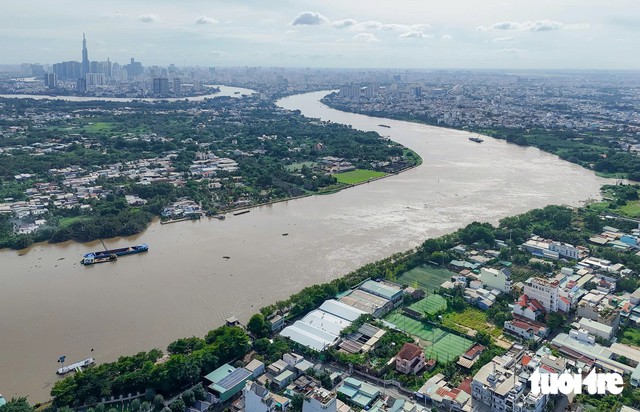
Ho Chi Minh City plans to store water ahead of the 2027 dry season. Photo: Chau Tuan / Tuoi Tre
According to the Ministry of Agriculture and Environment, flows in most rivers and streams across the Dong Nai River basin were 8.4-50 percent below their long-term averages between July and September.
Major hydropower reservoirs, including Dong Nai 2, Dak R'Tih, Ham Thuan, Tri An, and Thac Mo, remain at 83-97 percent of their designed storage capacity.
Of the 71 irrigation reservoirs with a capacity of at least three million cubic meters, 48 are holding more than 70 percent of their designed capacity.
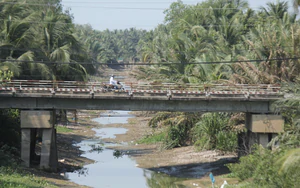
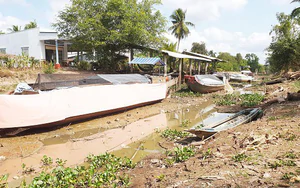
However, the rainy season is forecast to end earlier than usual, with rainfall expected to decrease in both volume and geographical coverage from late October.
Water levels could drop rapidly toward the end of the flood season, raising concerns over potential shortages.
In response, the Ho Chi Minh City People's Committee has instructed reservoir operators to closely monitor rainfall, inflows, and weather conditions to adjust operations while ensuring dam safety and sufficient water storage for the coming dry season.
Multipurpose reservoirs must prioritize domestic water supplies and other essential needs.
For the Song Ray Reservoir, authorities have ordered an assessment of storage capacity through the end of the flood season and the establishment of minimum water levels for different periods, particularly through December.
Water transfers from Song Ray to the Da Den, Da Bang, Xuyen Moc, and Suoi Giau Reservoirs, as well as downstream areas, must also be adjusted according to water availability.
The city has tasked the Department of Agriculture and Environment with coordinating releases from the Dau Tieng and Tri An Reservoirs to combat saltwater intrusion and replenish freshwater supplies in downstream rivers and canals during dry periods.
Authorities have also called for tighter control of discharges into the Saigon and Dong Nai Rivers, particularly near the intake points of the Tan Hiep, Thu Duc, and BOO Thu Duc water treatment plants.
Meanwhile, the Department of Construction has instructed water suppliers to prepare flexible operating plans, combining surface water and groundwater sources, reducing water losses, and maintaining backup supplies.
If surface water becomes scarce or saltwater intrusion occurs, suppliers must be ready to adjust distribution networks and introduce rotational water supply schedules.
The measures come as Vietnam faces an exceptionally strong El Niño, which is forecast to persist into early summer 2027, raising concerns over drought and water shortages during the 2026-27 dry season.
According to the Ministry of Agriculture and Environment, river flows across most of Vietnam's 12 major river basins were 10-75 percent below their long-term averages between June and August 2026, except for the Red River and the main course of the Ma River.
Le Dinh Quyet, head of the forecasting division at the Southern Regional Hydrometeorological Station, said the rainy season in southern Vietnam is expected to end 15-20 days earlier than usual.
El Niño is forecast to peak in November and December before gradually weakening in early 2027, although it is expected to remain very strong.
Southern Vietnam is likely to see little unseasonal rainfall between December 2026 and April 2027, while temperatures could climb 1.5-2 degrees Celsius above long-term averages.
Ngoc Nguyen - Chau Tuan / Tuoi Tre News
Link nội dung: https://news.tuoitre.vn/ho-chi-minh-city-steps-up-water-storage-as-el-nio-raises-fears-of-2027-shortages-10326102809472821.htm