
Horticulture gains ground in Vietnam’s Mekong Delta, fragmented production limits exports: Dutch embassy
While rice remains the backbone of agriculture in Vietnam’s Mekong Delta, the region is gradually diversifying toward horticultural crops, driven by their higher economic value and greater resilience to climate change.
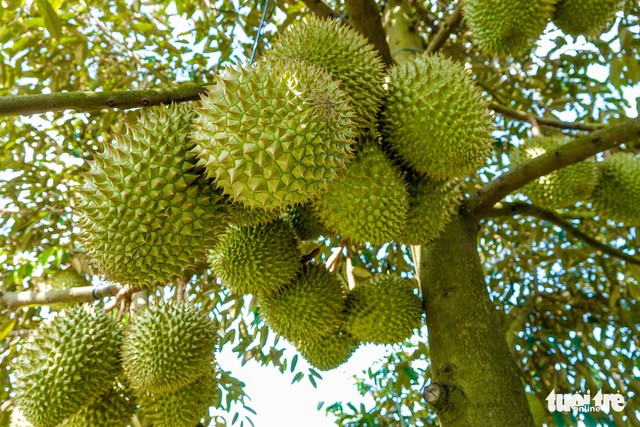
Durians at an orchard in Can Tho City, southern Vietnam. Photo: T.Luy / Tuoi Tre
The Mekong Delta has long been Vietnam’s agricultural powerhouse.
Recent figures from the Mekong Institute at Can Tho University in Can Tho City show that the region produces about 50 percent of the country’s rice, nearly 90 percent of its rice exports, almost 70 percent of the national fruit output, and around 65 percent of aquaculture production.
Yet rice still dominates land use.
Data updated in June last year by the Agricultural Department of the Netherlands Embassy in Vietnam show that roughly 70 percent of the delta’s land area, or about 2.5 million hectares, is used for agricultural crop production, with around 60 percent devoted to rice cultivation.
Horticulture gains ground
Despite its central role in national food production, the Mekong Delta is also among the regions most vulnerable to climate change.
In recent years, farmers have faced challenges from salinity intrusion, soil acidity, pests and plant diseases, flooding, drought, and land subsidence.
Climate change and upstream developments are “drastically changing the outlook for water resources availability in the Delta,” according to a 2023 overview on sustainable agricultural transformation released by the Netherlands Embassy in Vietnam.
The report warns that salinity intrusion is expanding further inland, while land subsidence is emerging as a growing threat for the use of groundwater in agriculture.
In response to climate change, the Vietnamese government has rolled out a clear, integrated development plan for the 2021–30 period, with a vision to 2050 to develop the Mekong Delta toward sustainable development and green growth.
One of its key agricultural directions is to promote three strategic product groups – aquaculture, fruits, and rice –by increasing the share of aquaculture and fruit production while gradually reducing reliance on rice.
With its tropical climate and fertile alluvial soil, the Mekong Delta is well suited to a wide range of horticultural crops.
These are often grown in mixed orchards or intercropped with rice or aquaculture to optimize land use and diversify income sources.
According to the Agricultural Department of the Netherlands Embassy, the delta’s provinces currently have more than 362,000 hectares of fruit trees, accounting for over 34 percent of Vietnam’s total fruit-growing area and around 70 percent of the national fruit output.
Each year, the region supplies more than four million tonnes of fruit to both domestic and export markets, with key products including dragon fruit, bananas, mangoes, jackfruit, pomelos, citrus fruits, pineapples, durian, longan, rambutan, and soursop.
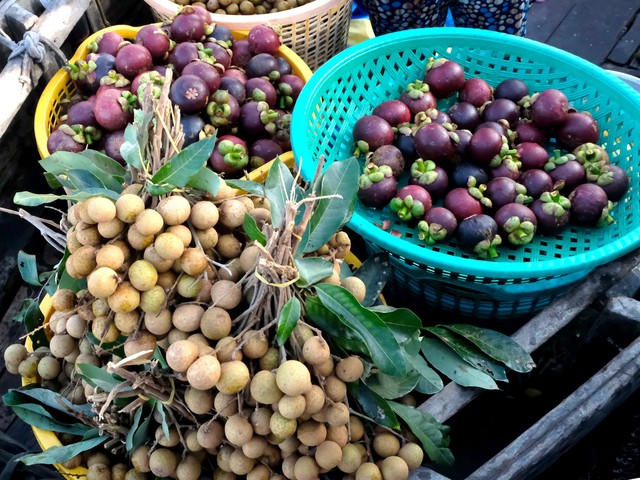
Longan and mangosteen on sale in Vietnam’s Mekong Delta. Photo: Quan Nam / Tuoi Tre
Vegetables are also gaining ground. In 2024, the Mekong Delta contributed 49 percent of Vietnam’s US$7.1 billion vegetable export value, with major crops ranging from tomatoes, cabbage, onions, and chili peppers to leafy greens such as mustard greens and water spinach, as well as cucumbers and gourds.
However, vegetable production in the region remains largely oriented toward the domestic market.
Fragmented production poses challenges
Despite its potential, horticulture exports in the Mekong Delta continue to face significant hurdles.
According to the Agricultural Department of the Netherlands Embassy, the biggest challenge lies in the small-scale and fragmented nature of production.
Growing areas remain small and fragmented, which makes it difficult to meet large export orders.
Fragmented cultivation not only creates obstacles for businesses in sourcing produce, but also hinders farmers from applying advanced techniques in production.
As a result, production costs remain high, product quality is inconsistent, and market access continues to be held back.
For many years, the Netherlands and Vietnam have worked closely together through the Strategic Partnership Arrangement on Sustainable Agriculture and Food Security and the Strategic Partnership Arrangement on Water Management and Climate Change.
The Dutch Embassy said horticulture and the Mekong Delta have long been priorities in bilateral cooperation between the Netherlands and Vietnam, and both countries remain committed to sharing knowledge, technology, and partnerships for mutual economic and environmental gains.
Dong Nguyen / Tuoi Tre News