
No storm, yet trees keep falling: Is it a warning sign for Da Nang?
Heavy rain from Monday to Wednesday left streets across Da Nang, central Vietnam, littered with fallen trees, with 157 toppled in areas managed by Da Nang Greenery Parks Company alone. The scale of the damage raises a question: why are so many trees falling without storm-force winds?
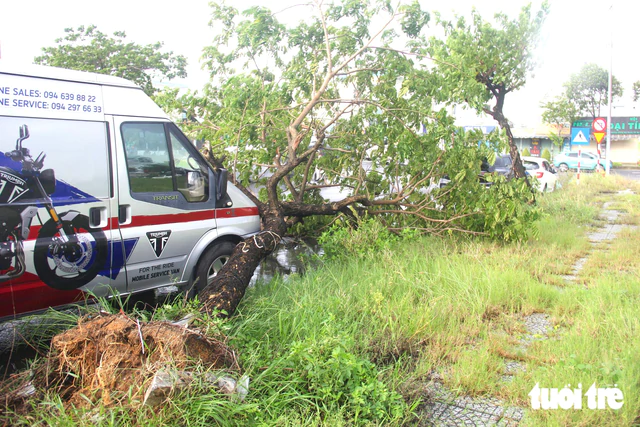
A tree uprooted in Hai Chau Ward, Da Nang. Photo: Truong Trung / Tuoi Tre
Notably, rain trees and yellow flamboyant trees were among the species most frequently uprooted, due in part to their brittle trunks and branches and root systems constrained by limited soil space.
Speaking to Tuoi Tre (Youth) online newspaper, Le Huy Hoang, head of the Technical Division at Da Nang Greenery Parks Company, said tree falls were caused not only by heavy rain and strong winds but also by species-specific growth characteristics, soil conditions and limited space for root development.
Fallen trees reveal shallow root systems
Hoang said the 157 fallen trees recorded in Da Nang between Monday and Wednesday were linked to the combined effects of heavy rain and strong easterly winds associated with the northeast monsoon.
Of these, 71 had to be removed, while 86 were pruned and supported to keep them upright.
Heavy rain saturated the soil, weakening the bond between roots and soil, while strong gusts exerted considerable pressure on tree canopies, trunks and root systems.
The damage was concentrated in riverside and coastal areas, at intersections and in open spaces exposed to strong winds.
Rain trees and yellow flamboyant trees were the species most commonly affected. Research shows that both species grow rapidly and have relatively soft wood, with brittle trunks and branches that make them more prone to breaking in strong winds.
Their large canopies also require extensive root systems, but underground space is often restricted by urban infrastructure, preventing balanced growth above and below ground.
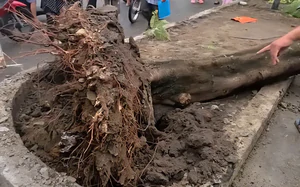
With limited soil available, roots tend to spread horizontally along pavements within designated planting areas.
This makes the two species more susceptible to uprooting during periods of heavy rain, storms and flooding.
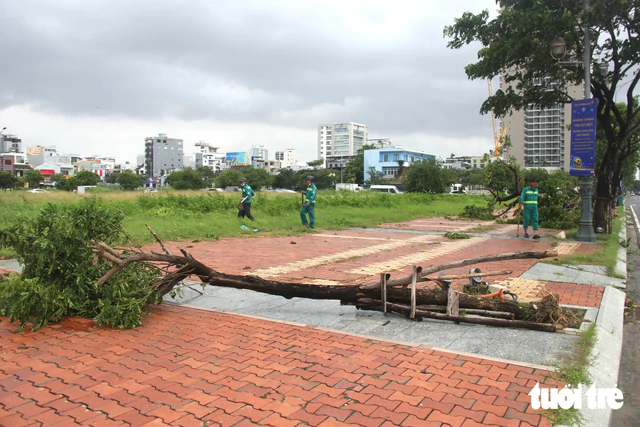
Uprooted trees expose sparse, shallow root systems. Photo: Truong Trung / Tuoi Tre
Why trees still fall despite pre-storm pruning
According to Hoang, Da Nang Greenery Parks Company carries out annual tree-pruning operations across all roads under its management ahead of any rainy and storm season, except for newly planted trees or those newly handed over to the company.
The work prioritizes high-risk areas, including exposed roads, coastal routes and locations where trees may be affected by unstable infrastructure.
Particular attention is given to species considered more vulnerable to falling, such as flamboyant trees, rain trees, yellow flamboyant trees, mahogany trees and tropical almond trees, as well as trees showing signs of instability.
Pruning and reducing canopy height help lower the weight of tree crowns and reduce wind resistance, thereby limiting the risk of broken branches, tilting and toppling.
However, the company said these measures could not eliminate the risk entirely, particularly during prolonged heavy rain accompanied by strong winds.
Trees with decayed or damaged roots, or those whose root systems have been affected by infrastructure construction, may have a weakened anchorage in the soil.
As a result, they can still tilt or become uprooted even after pruning.
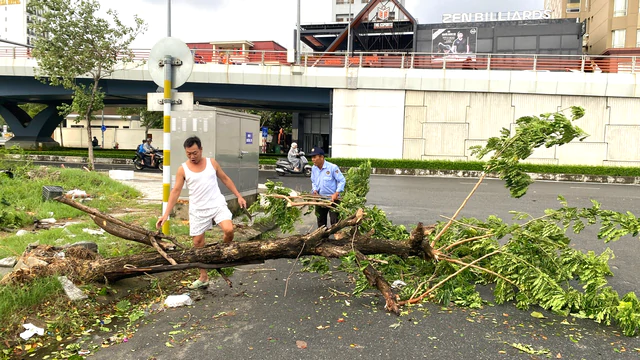
A fallen tree along a Da Nang street following recent heavy rain. Photo: Truong Trung / Tuoi Tre
Reviewing and replacing tree species to reduce future risks
Speaking about tree support systems, Da Nang Parks and Greenery Company said they help keep trees upright and reduce the risk of leaning or falling, particularly for newly planted trees or those with unstable trunks.
However, their effectiveness depends on proper design and installation, taking into account each tree's size, weight and growth characteristics.
Supports that are poorly designed, improperly installed or unable to withstand the required loads may offer little protection.
The company said support systems along roads and sidewalk renovation projects should be inspected to ensure they meet technical standards, with relevant units responsible for fixing any shortcomings.
Also, the company acknowledged the need to gradually replace tree species whose root systems are poorly suited to urban conditions, saying the issue had already been examined in a research project led by the University of Agriculture and Forestry at Hue University.
Based on the research, it has proposed reviewing the list of tree species planted across Da Nang, prioritizing those better suited to the city's climate, soil conditions and limited urban space while discouraging the planting of species prone to breaking or uprooting.
The company also plans to review technical standards for tree planting, including planting pit dimensions and the amount of soil available for root development, to improve tree stability.
Aging, weakened or potentially hazardous trees will also be gradually replaced with more suitable species, based on assessments of conditions along individual streets and in different areas.
Keeping a closer watch on high-risk trees
Hoang said the company updates its tree inventory monthly and regularly inspects streets to identify dead, diseased, weakened or potentially hazardous trees and recommend appropriate measures.
For old-growth and large trees showing unusual signs, inspections focus on their overall health, trunk and branch structure, base condition and root systems to assess their stability.
Warning signs include cracked, decaying or hollow trunks, abnormalities around the base, damaged roots, leaning trunks or declining health. The company assesses the level of risk before recommending appropriate action.
Van Giang - Truong Trung / Tuoi Tre News
Link nội dung: https://news.tuoitre.vn/no-storm-yet-trees-keep-falling-is-it-a-warning-sign-for-da-nang-10326111410582858.htm