
Unlocking low-altitude economy in Vietnam’s Mekong Delta: New opportunities from farmland to sea
Beyond its vast agricultural fields, waterways, and coastline, Vietnam’s Mekong Delta is exploring a new dimension of economic development: the low-altitude economy, where drones, sensors, artificial intelligence (AI), and digital data could transform production, resource management, and service delivery.
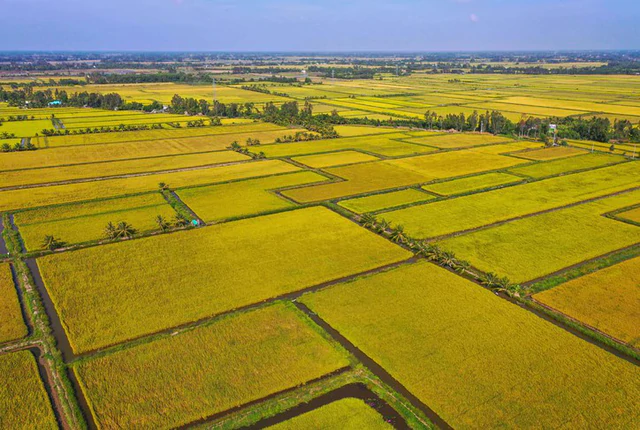
Rice fields in the Mekong Delta need greater application of science and technology to boost output and value. Photo: Quang Dinh / Tuoi Tre
Deploying aerial technology, however, is only the beginning.
The greater challenge lies in turning data into informed decisions, translating technological innovation into economic value, and connecting the region’s existing strengths.
New dimension of economic development
With extensive farmland, orchards, rivers, canals, aquaculture areas, and more than 750 kilometers of coastline, the Mekong Delta supports the livelihoods of tens of millions of people through agriculture, fisheries, transportation, trade, and tourism.
The region’s economic advantages have traditionally been defined by its agricultural output, natural resources, transportation networks, seaports, and tourism potential.
These foundations remain central to the region’s development.
However, as science, technology, and digital transformation increasingly reshape production methods, development potential is no longer defined solely by land area, water resources, or coastline length.
Above rice fields, shrimp ponds, mangrove forests, and river tourism routes lies another space for economic activity, where aerial technology and digital data can connect industries and resources.
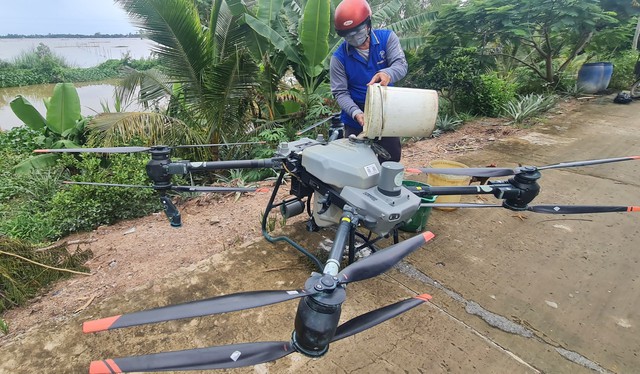
Many farmers have adopted drones to spray pesticides on rice fields. Photo: Quoc Minh
The low-altitude economy has emerged alongside advances in unmanned aerial vehicles (UAVs), positioning technologies, remote sensing, sensors, AI, and data processing platforms.
Its potential extends far beyond using drones to spray pesticides, take photographs, or record videos.
These technologies could reshape production methods, improve resource management, facilitate service delivery, and strengthen connections across value chains.
Drones are merely tools. Their economic value lies in how effectively they help users detect problems earlier, collect more accurate information, conserve resources, and make better decisions.
Each flight can involve an entire chain of activities, including mapping, data processing and analysis, consulting, maintenance, workforce training, and specialized services.
Only when these activities address practical needs can technology foster an economic ecosystem rather than remain limited to individual devices.
For the Mekong Delta, where economic activities and natural ecosystems are closely interconnected, such applications could be particularly valuable.
Environmental quality affects aquaculture production, transportation and logistics influence agricultural competitiveness, while ecosystem conservation is closely tied to community livelihoods and tourism.
Combining aerial imagery with ground-based, water-based, and sector-specific data could help authorities, businesses, and producers better understand changes that are difficult to detect through conventional monitoring alone.
However, data must be verified, analyzed, and translated into action to generate tangible benefits.
A sophisticated map does not automatically increase productivity, just as a monitoring system alone cannot protect the environment or improve incomes.
Developing the low-altitude economy should therefore begin with identifying practical problems and determining how the economic value of technological solutions can be measured, rather than simply investing in equipment.
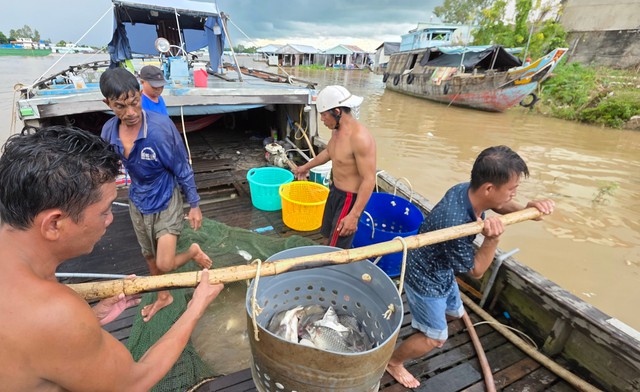
Technology could help the Mekong Delta’s aquaculture industry develop more sustainably. Photo: Quoc Minh / Tuoi Tre
From farmland, waterways to sea
Agriculture offers one of the clearest opportunities for applying aerial technology in the Mekong Delta.
In rice-growing areas, orchards, and large-scale agricultural production zones, drones can support field surveys, mapping, crop monitoring, early detection of abnormalities, and certain farming operations, subject to technical and safety requirements.
When combined with information on soil, water, weather, cropping schedules, and market requirements, aerial data can help farmers identify areas requiring attention, adjust farming practices, and use agricultural inputs more efficiently.
The effectiveness of these applications should be measured through lower production costs, reduced losses, and improved product quality rather than the number of drones deployed.
Similar opportunities exist in aquaculture and coastal areas.
Shrimp and fish farming areas, estuaries, and coastal zones span vast areas with changing environmental conditions, making regular monitoring labor-intensive. Aerial technology and sensor systems can help survey aquaculture sites, monitor infrastructure, detect certain surface changes, and integrate data for management purposes.
However, a clear distinction must be made between aerial observation and comprehensive water quality assessments or the diagnosis of health conditions in farmed aquatic species. The latter still require specialized equipment, on-site sensors, sampling, and appropriate analytical procedures.
The greater potential lies in integrating technology across the fisheries value chain.
Data on aquaculture areas can support production management, while information on infrastructure and transportation conditions can help improve harvesting, preservation, and logistics.
When integrated with management systems and market data, technology can help reduce fragmented decision-making across the value chain. However, achieving tangible results requires stakeholders to be able to share and use data effectively. Technology alone cannot bridge the gaps between production, processing, and distribution.
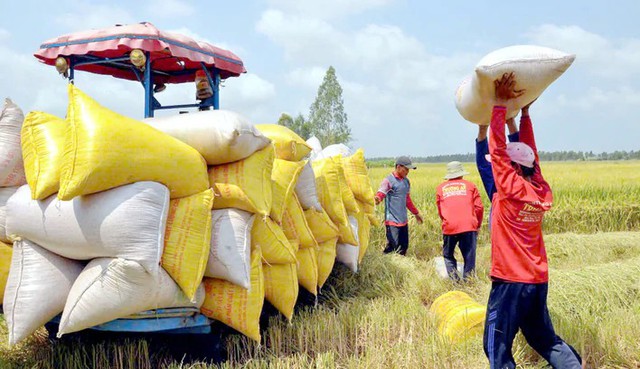
Mekong Delta farmers are skilled in rice cultivation, and technology could help them earn higher incomes. Photo: Buu Dau / Tuoi Tre
Along the coast, drone imagery, remote sensing data, and geographic maps could support the monitoring of mangrove forests, sea dikes, estuaries, and areas affected by erosion.
Technology could also assist with surveys of fishing ports, anchorage areas, coastal infrastructure, and connecting routes within permitted areas.
These applications highlight the potential for closer integration between the low-altitude economy and the marine economy, particularly in ecosystem conservation, aquaculture, coastal infrastructure management, and community livelihoods.
Technology, however, cannot replace effective planning, governance, or community participation.
Tourism could also benefit from low-altitude technologies.
Spatial data could support landscape surveys, tourism route planning, destination management, and product development across river-based tourism, orchards, traditional craft villages, mangrove forests, and coastal and island destinations.
Drones could also be used for filming, promotional activities, and technical surveys in compliance with relevant regulations.
Nevertheless, the long-term attractiveness of tourist destinations depends more on visitor experiences, service quality, cultural heritage, environmental conditions, and the benefits generated for local communities than on aerial imagery alone.
Instead of having each locality purchase its own equipment or each industry develop a separate system, the region could identify common needs, standardize data, and develop technology services that cater to multiple sectors.
A single service provider, for instance, could offer survey services to agricultural cooperatives, seafood businesses, and government agencies.
Such a model could reduce investment costs, improve access to technology, and create opportunities for local technology service businesses.
Turning opportunities into economic value
The Mekong Delta’s opportunities to develop a low-altitude economy stem primarily from the region’s practical needs.
Agriculture and aquaculture span extensive production areas, creating substantial demand for monitoring and resource optimization. Coastal areas need additional tools to monitor ecosystems and infrastructure, while the tourism sector requires better data for route planning, destination management, and the integration of tourism products.
These needs could create a market for technology services, provided that solutions meet requirements for affordability, reliability, safety, and accessibility.
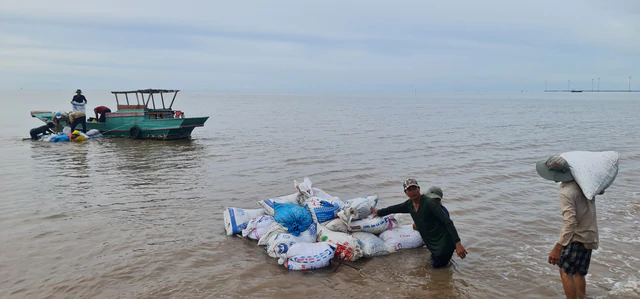
Residents of Dong Thap Province raise clams along the coast in what was formerly Tien Giang Province. Photo: Quoc Minh / Tuoi Tre
One approach worth considering is developing shared technology services instead of requiring individual farmers, cooperatives, and small businesses to invest in their own equipment, software, and specialized personnel.
Under this model, users pay for the services or outcomes they need, while providers are responsible for equipment, operations, maintenance, and data quality in accordance with contractual agreements.
The model could lower initial investment barriers, but its long-term viability would depend on sufficiently stable demand, appropriate pricing, and transparent quality assessment mechanisms.
The capacity to adopt technology is another challenge.
Farmers must not only know how to use applications but also understand what the data represents, recognize its limitations, and know when to seek expert advice.
Cooperatives need the capacity to consolidate demand, monitor service quality, and evaluate effectiveness.
Technology companies must understand local production processes, seasonal cycles, biological characteristics, and business conditions. Without such connections, technology may feature in demonstrations but struggle to become integrated into everyday economic activities.
Regulatory frameworks and safety are equally important.
UAV operations must comply with existing regulations governing aircraft management, operating areas and conditions, as well as requirements concerning security, safety, privacy, and data.
Low-altitude airspace is not an unregulated domain that anyone can exploit at will. As technology-enabled activities expand, coordination among regulatory authorities, service providers, and users becomes increasingly important.
Success should not be measured by the number of devices purchased, flights conducted, or maps generated.
Instead, the focus should be on whether production costs and losses have been reduced, product quality and value have improved, resource monitoring capabilities have been strengthened, and residents and businesses have benefited.
Each model should establish a baseline for comparison, fully account for investment and operating costs, assess outcomes over a production cycle or a sufficiently long period, and identify potential risks and opportunities for scaling up.
An appropriate approach would be to start in localities and commodity sectors with clearly defined needs, conduct pilot projects with verifiable results, publicly disclose the findings, and expand only afterward.
Universities, research institutes, technology companies, cooperatives, and local authorities should work together throughout the process, from identifying problems to assessing impacts.
In the marine economy, data must support the management of ecosystems, infrastructure, and livelihoods. In agriculture, it must be linked to farming practices and market outlets. In tourism, it must help improve visitor experiences and generate additional value for local communities.
Technology is worth investing in only when it addresses a real-world problem.
This article was originally written in Vietnamese by Dr. Tran Huu Hiep and rewritten in English by Tuoi Tre News.
Tuoi Tre News