


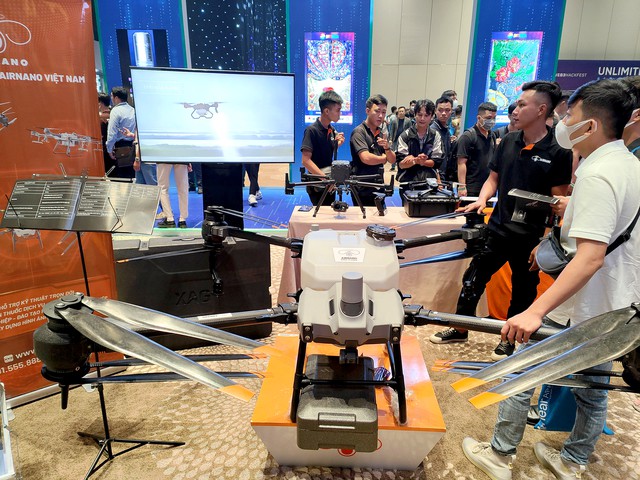
Unmanned aerial vehicles (UAVs), or drones, combined with 5G infrastructure and satellite Internet, are opening up billions of dollars in economic opportunities. Photo: Duc Thien / Tuoi Tre
The target is set out in Politburo Conclusion No. 99 on the exploitation, governance, and protection of low-altitude airspace, signed by Tran Cam Tu, permanent member of the Party Central Committee’s Secretariat.
Under the conclusion, low-altitude airspace is defined as a national resource, a new development space, and a special domain of national sovereignty.
Its management is therefore closely linked to safeguarding airspace and data sovereignty, cybersecurity, critical infrastructure, border areas, seas, islands, and major cities.
By 2030, Vietnam aims to have three national-level flight-testing zones and at least one national research and testing center for unmanned aerial vehicles, or UAVs.
The country also targets a localization rate of more than 30-40 percent for key UAV models by 2030, rising to over 85 percent by 2045.
By 2045, the low-altitude economy is expected to become a major economic and technological sector and one of Vietnam’s new growth drivers, contributing around 1.5 percent of national GDP and strengthening the country’s regional competitiveness.
National framework for low-altitude airspace
The Politburo called for low-altitude airspace to be incorporated into national and urban planning, with clearly designated test-flight areas, restricted zones, and no-fly zones.
Vietnam will also build a unified national governance model based on data, digital platforms, and risk management.
In 2027, authorities are expected to complete national technical standards and regulations for infrastructure, equipment, and management technologies in line with international standards, while improving capacity for testing, certification, and conformity assessment.
The state will prioritize investment in essential infrastructure for the governance, development, and protection of low-altitude airspace.
Such infrastructure is expected to be modern, coordinated, and shared, with the ability to connect with airspace management systems, military and civil flight operations, and other specialized platforms.
Priority funding will also go to scientific research and the development and application of low-altitude technologies, with investment focused on key areas to improve efficiency and avoid fragmentation and waste.
At the same time, Vietnam plans to develop the low-altitude industry with a dual-use orientation and gradually build the capacity to master core technologies.
Businesses involved in UAV research, production, testing, and commercialization may receive support through tax, credit, and land incentives, while technology complexes, manufacturing clusters, and national UAV testing zones are also planned.
The country intends to prioritize applications in logistics, agriculture, natural-resource management, environmental protection, infrastructure monitoring, disaster response, search and rescue, emergency medical services, and smart cities.
The Politburo also called for stronger training and policies to attract leading domestic and international experts and scientists as Vietnam builds a high-quality workforce for the sector.
What is the low-altitude economy?
The low-altitude economy (LAE) is an emerging sector covering commercial activities and services conducted in relatively low-altitude airspace, often defined in some policy frameworks as below 1,000 meters (3,280 feet) above ground level.
The industry generally consists of three components: aircraft such as eVTOLs, autonomous drones, helicopters, and airships; supporting infrastructure including vertiports, charging stations, and air traffic management systems; and services such as passenger transport, cargo delivery, emergency response, tourism, and surveillance.
UAVs, commonly known as drones, are a key part of this ecosystem. Operating without a pilot on board, they can be remotely controlled or programmed to fly autonomously.
Their applications range from logistics and agriculture to infrastructure inspection, environmental monitoring, emergency response, and urban services, making UAVs one of the key technologies underpinning the development of the low-altitude economy.









Max: 1500 characters
There are no comments yet. Be the first to comment.